CCSS.
The Standard
Interpret the parameters in a linear or exponential function in terms of a context.
Common Core State Standards for Mathematics
Teacher's field guide
What This Standard Means
What Students Need to Do
- Students explain what each number in a linear or exponential equation means in the given situation. They connect starting values and rates of change to quantities, time intervals, and units.
What Mastery Looks Like
- A student identifies the starting amount and describes the change per unit of input. For exponential models, the student converts factors such as 1.08 and 0.92 into 8% growth and 8% decay.
Common Misconceptions
- Students often call every coefficient a slope or treat an exponential factor as a constant amount added. They may read 1.08 as 108% growth instead of 8% growth, or leave units out of their explanation.
How to Assess It
- Exit ticket: A phone worth $800 is modeled by V(t) = 800(0.75)^t, where t is years. Explain 800 and 0.75, including the yearly percent change.
Lesson moves
Ways to Teach It
Give pairs jars and counters for repeated additions or removals, then have them write and interpret a linear model.
Ask: In P(t) = 1200(1.04)^t, what story does each number tell, and which units belong in the explanation?
Play a card sort matching equations, context cards, and parameter interpretations for taxi fares, savings, and depreciation.
Use a local hourly wage and a savings account rate to compare constant dollar change with constant percent change.
Free download
Printable HSF-LE.B.5 Worksheet
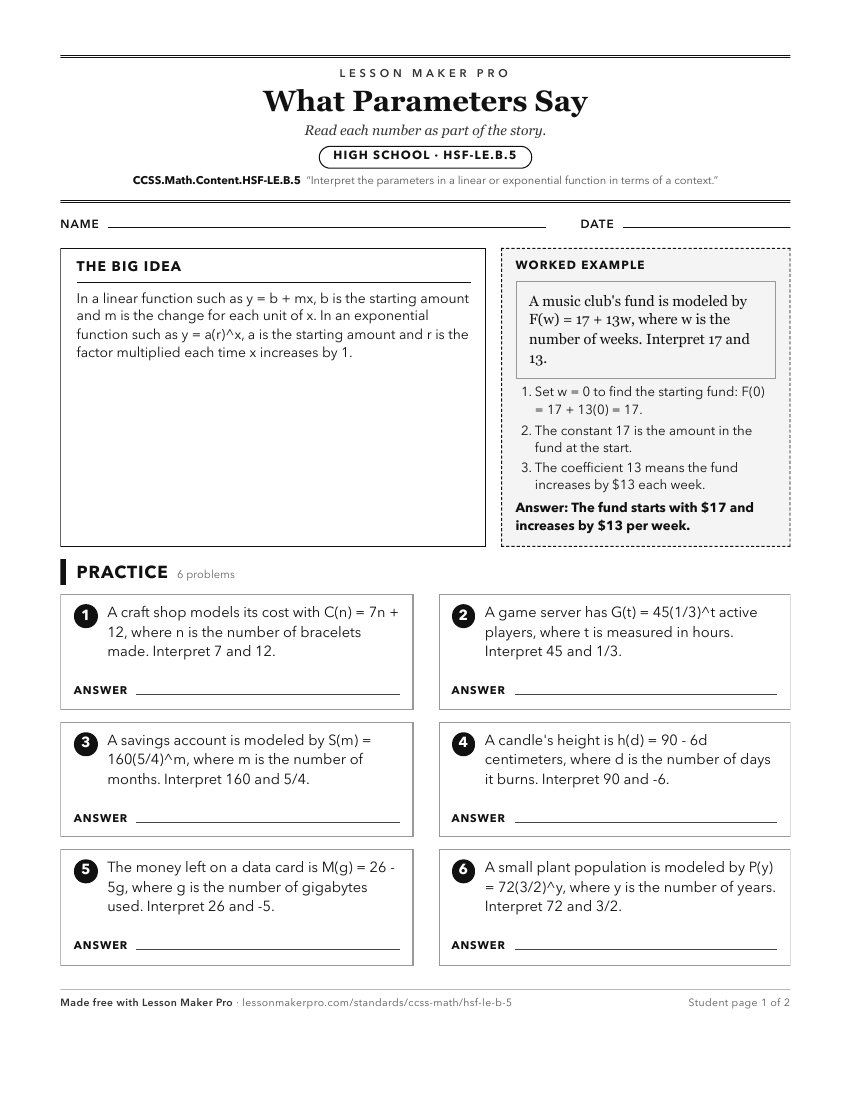
A ready-to-print activity worksheet aligned to CCSS.Math.Content.HSF-LE.B.5, with an answer key for the teacher on its own page. No account needed.
PDF, US Letter, prints cleanly in black and white.
Download the worksheetLearning progression
Where This Standard Sits
Before This Standard
If students are struggling here, check these first.
- CCSS.Math.Content.HSF-IF.B.4
Interpreting graph and table features in context supports explaining slope, intercept, growth factor, or initial value as function parameters.
- CCSS.Math.Content.HSA-SSE.A.1
Interpreting terms, factors, and coefficients in context supports explaining slope, intercept, initial value, and growth rate in function models.
- CCSS.Math.Content.HSF-LE.A.2
Writing linear and exponential rules from contexts supports seeing slope, intercept, initial value, and growth factor as meaningful quantities.
Keep exploring
Related Standards
Turn this exact standard into a lesson
Grade, subject, topic, and the complete standard are prefilled. Create one free, no account needed.
Also for this standard:Make a WorksheetMake a QuizMake a Sub Lesson