CCSS.
Standard Cluster
Interpret expressions for functions in terms of the situation they model
Common Core State Standards for Mathematics · High School — Functions
Cluster contents
Standards in This Cluster
CCSS.Math.Content.HSF-LE.B is a cluster heading. These are the individual standards under it.
Teacher's field guide
What This Cluster Means
What Students Need to Do
- Students explain what numbers in linear and exponential models represent in a given situation. They connect initial values, constant rates, growth factors, and decay factors to quantities and units.
What Mastery Looks Like
- Given a linear or exponential model, students identify the initial value and rate or growth factor. They explain each value in a complete sentence with correct units and context.
Common Misconceptions
- Students often read an exponential factor of 1.08 as an 8 percent multiplier rather than an 8 percent increase. They may confuse slope with initial value or leave units out of an interpretation. They may also describe a number without connecting it to the situation.
How to Assess It
- Exit ticket: A bacteria culture follows B(t) = 250(1.12)^t, where t is hours. Explain what 250, 1.12, and 0.12 mean in context.
Lesson moves
Ways to Teach It
Build tile figures, record figure number and tile count, write a linear rule, and explain the coefficient and constant with units.
Ask students to write how the meanings of 0.06 and 1.06 differ in an exponential growth model.
Play a card match using equations, short situations, parameter labels, and interpretation statements.
Use A(t) = 500(1.03)^t for a savings account, then explain the deposit, growth factor, and annual percent increase.
Free download
Printable HSF-LE.B Worksheet
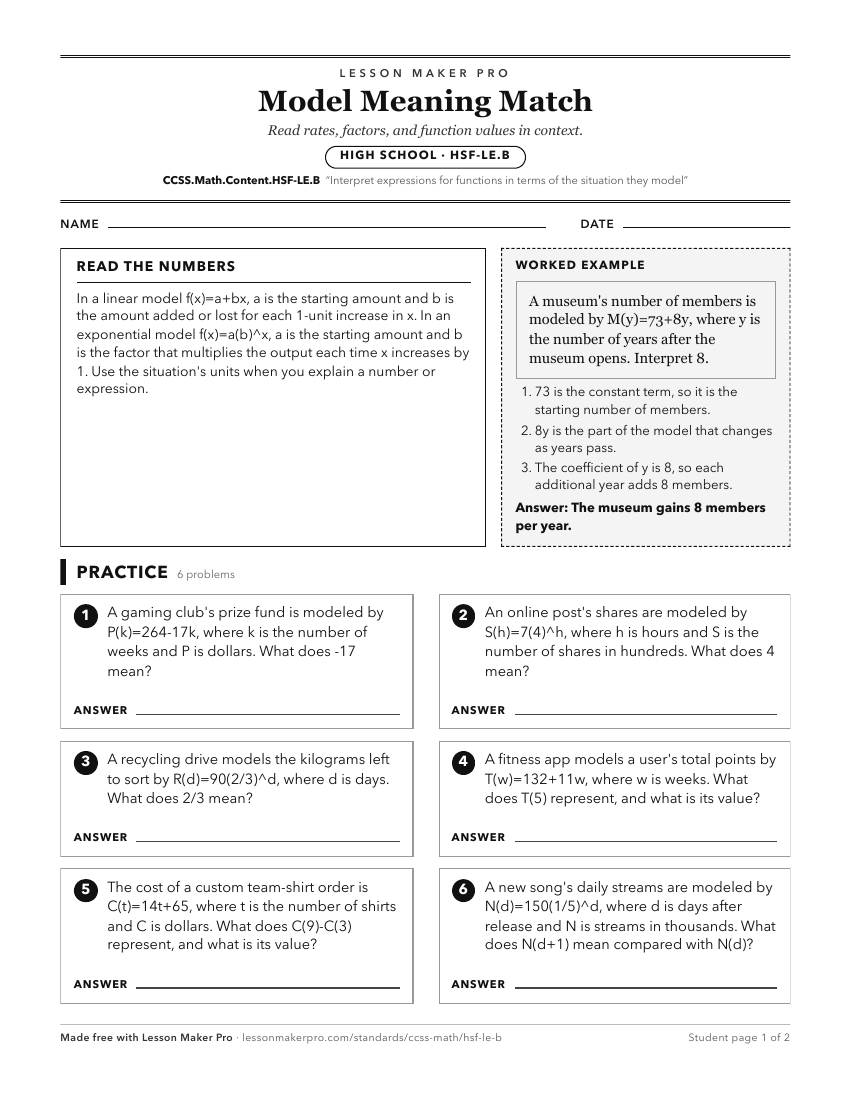
A ready-to-print activity worksheet aligned to CCSS.Math.Content.HSF-LE.B, with an answer key for the teacher on its own page. No account needed.
PDF, US Letter, prints cleanly in black and white.
Download the worksheetKeep exploring
Related Standards
Turn this cluster into a lesson
Grade, subject, topic, and the complete cluster are prefilled. Create one free, no account needed.
Also for this cluster:Make a WorksheetMake a QuizMake a Sub Lesson