CCSS.
The Standard
Interpret expressions that represent a quantity in terms of its context
Common Core State Standards for Mathematics
Teacher's field guide
What This Standard Means
What Students Need to Do
- Students explain what each part of an algebraic expression represents in a real situation. They interpret terms, factors, coefficients, operations, and grouped subexpressions without simply calculating a value.
What Mastery Looks Like
- Students correctly explain the meaning of terms, factors, coefficients, and grouped parts using the given context. They connect each operation to the situation and include units when appropriate.
Common Misconceptions
- Students may treat every number as a coefficient or assume each term has the same unit. They may calculate an expression without explaining what its parts mean in the situation.
How to Assess It
- Use the prompt: “A bike rental costs 25 + 8h dollars. Explain what 25, 8, h, and the full expression represent.”
Lesson moves
Ways to Teach It
Give groups cards showing expressions, quantities, and meanings, then have them match the cards and justify each match.
Ask students to compare 40 + 12m and 40m + 12 by describing a real situation each expression could represent.
Play Expression Detective, where students earn points by identifying the meaning of a highlighted term, factor, coefficient, or grouped part.
Have students examine a phone plan, taxi fare, or streaming bill and write an expression that represents its total cost.
Free download
Printable HSA-SSE.A.1 Worksheet
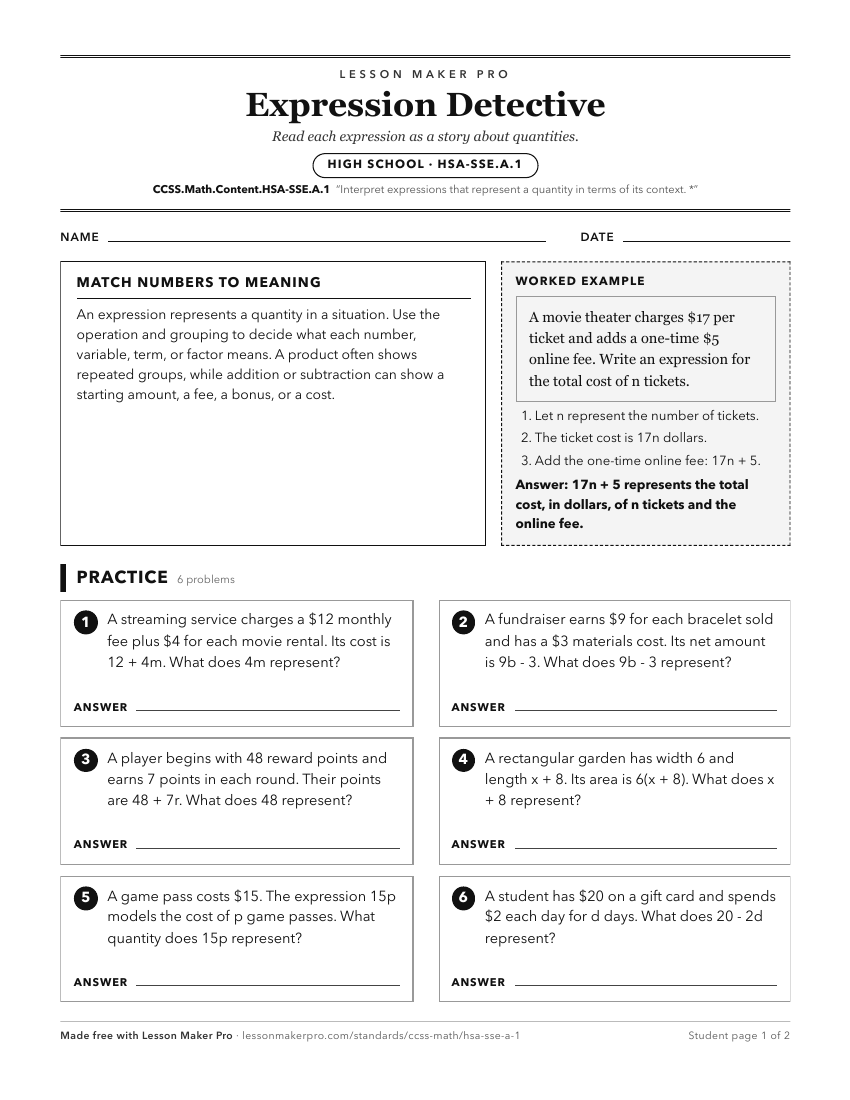
A ready-to-print activity worksheet aligned to CCSS.Math.Content.HSA-SSE.A.1, with an answer key for the teacher on its own page. No account needed.
PDF, US Letter, prints cleanly in black and white.
Download the worksheetLearning progression
Where This Standard Sits
Before This Standard
If students are struggling here, check these first.
- CCSS.Math.Content.7.EE.A.2
Seeing how equivalent forms reveal relationships supports interpreting terms, factors, and coefficients of contextual expressions.
- CCSS.Math.Content.HSN-Q.A.1
Tracking units and quantities helps students explain what terms, factors, and coefficients in an expression mean in context.
- CCSS.Math.Content.7.EE.A.1
Factoring and expanding linear expressions helps students recognize equivalent forms and explain terms, factors, and coefficients in context.
What This Unlocks
Mastery here sets students up for these next.
- CCSS.Math.Content.HSA-SSE.A.1a
Interpreting whole expressions in context helps students give meaning to terms, factors, and coefficients within those expressions.
- CCSS.Math.Content.HSA-SSE.A.1b
Interpreting expressions in context supports treating grouped parts of a complex expression as meaningful quantities.
- CCSS.Math.Content.HSF-LE.B.5
Interpreting terms, factors, and coefficients in context supports explaining slope, intercept, initial value, and growth rate in function models.
- CCSS.Math.Content.HSA-CED.A.1
Interpreting contextual expressions supports choosing variables, operations, and constraints when writing equations or inequalities from word problems.
- CCSS.Math.Content.HSF-IF.C.8b
Interpreting parts of contextual expressions supports explaining exponential forms, factors, and rates after exponent properties rewrite them.
Keep exploring
Related Standards
Turn this exact standard into a lesson
Grade, subject, topic, and the complete standard are prefilled. Create one free, no account needed.
Also for this standard:Make a WorksheetMake a QuizMake a Sub Lesson