CCSS.
The Standard
Interpret parts of an expression, such as terms, factors, and coefficients.
Common Core State Standards for Mathematics · Interpret the structure of expressions
Teacher's field guide
What This Standard Means
What Students Need to Do
- Students break an algebraic expression into additive pieces and explain the role of each number and variable. They distinguish multiplication within a piece from addition or subtraction between pieces.
What Mastery Looks Like
- Given 4x² - 7x + 3, a student identifies -7x as one term and -7 as its coefficient. The student can explain that -7 and x are factors multiplied within that term.
Common Misconceptions
- Students often treat subtraction signs as separators instead of part of the following term. They may call an exponent a coefficient or miss the implied coefficient of 1. They also confuse terms joined by addition with factors joined by multiplication.
How to Assess It
- Exit ticket: For 6x² - 5xy + y, list the terms, identify each coefficient, and name the factors of -5xy.
Lesson moves
Ways to Teach It
Give students number, variable, operation, and exponent cards to build expressions, then label each term, coefficient, and factor.
Ask students to explain how the role of 3 changes in 3x + 4, 3(x + 4), and x³.
Run an expression sort where teams place cards under term, coefficient, factor, exponent, or constant and justify each choice.
Use C = 12n + 8 for a delivery cost, then have students explain what 12, n, 12n, and 8 represent.
Free download
Printable HSA-SSE.A.1a Worksheet
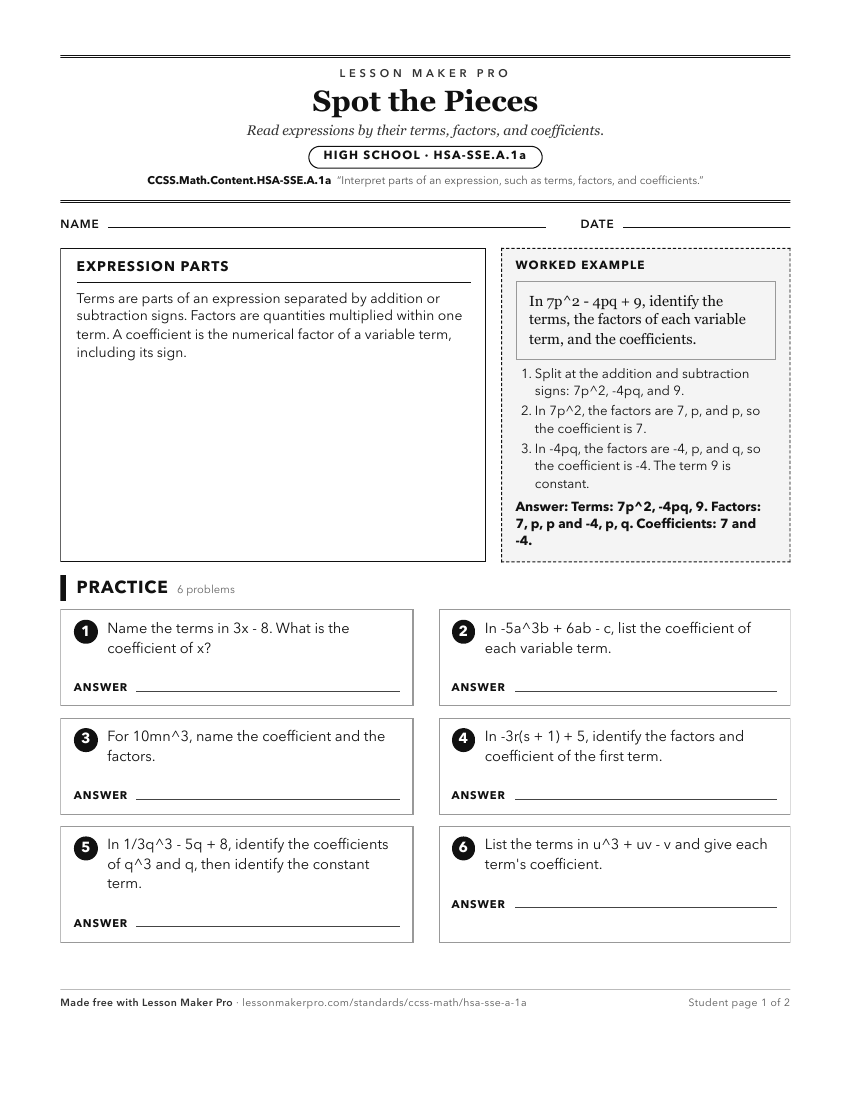
A ready-to-print activity worksheet aligned to CCSS.Math.Content.HSA-SSE.A.1a, with an answer key for the teacher on its own page. No account needed.
PDF, US Letter, prints cleanly in black and white.
Download the worksheetLearning progression
Where This Standard Sits
Before This Standard
If students are struggling here, check these first.
- CCSS.Math.Content.7.EE.A.1
Working with linear expressions gives practice identifying terms, factors, and coefficients before interpreting those parts in broader expressions.
- CCSS.Math.Content.HSA-SSE.A.1
Interpreting whole expressions in context helps students give meaning to terms, factors, and coefficients within those expressions.
- CCSS.Math.Content.7.EE.A.2
Rewriting contextual expressions helps students see how terms, factors, and coefficients represent quantities and relationships in later expressions.
What This Unlocks
Mastery here sets students up for these next.
- CCSS.Math.Content.HSA-APR.C.5
Recognizing terms and coefficients helps students read binomial expansions and connect Pascal’s Triangle numbers to each term.
- CCSS.Math.Content.HSA-SSE.A.2
Recognizing terms, factors, and coefficients is needed to see expression structure and choose useful rewrites like factoring or grouping.
- CCSS.Math.Content.HSA-SSE.A.1b
Recognizing terms, factors, and coefficients supports treating larger expression parts as chunks with their own meaning.
- CCSS.Math.Content.HSA-APR.A.1
Recognizing terms, factors, and coefficients supports combining like terms and multiplying polynomial parts accurately.
- CCSS.Math.Content.HSA-SSE.B.3a
Recognizing terms and factors helps students restructure quadratics and understand why factored form shows zeros.
- CCSS.Math.Content.HSN-CN.A.1
Interpreting terms and coefficients helps students parse a + bi as real part plus coefficient times the new unit i.
Keep exploring
Related Standards
- CCSS.Math.Content.HSF-LE.B.5
Interpret the parameters in a linear or exponential function in terms of a context.
- CCSS.Math.Content.5.OA.A
Write and interpret numerical expressions.
- CCSS.Math.Content.6.EE.A.2b
Identify parts of an expression using mathematical terms (sum, term, product, factor, quotient, coefficient); view one or more parts of an expression as a singl...
Turn this exact standard into a lesson
Grade, subject, topic, and the complete standard are prefilled. Create one free, no account needed.
Also for this standard:Make a WorksheetMake a QuizMake a Sub Lesson