CCSS.
The Standard
Understand that polynomials form a system analogous to the integers, namely, they are closed under the operations of addition, subtraction, and multiplication; add, subtract, and multiply polynomials.
Common Core State Standards for Mathematics
Teacher's field guide
What This Standard Means
What Students Need to Do
- Students add, subtract, and multiply polynomial expressions. They simplify each result and determine whether it is still a polynomial.
What Mastery Looks Like
- A student combines like terms and keeps exponents attached to the correct coefficients. They distribute signs and factors accurately, then state that sums, differences, and products of polynomials remain polynomials.
Common Misconceptions
- Students may combine terms with different variable parts, such as 3x and 3x². They may forget to distribute a subtraction sign or multiply every term across two factors. Some think division should also always produce a polynomial.
How to Assess It
- Give an exit ticket: simplify (3x² + 2x - 5) - (x² - 4x + 1) and (x + 3)(2x - 1). Ask whether each result is a polynomial.
Lesson moves
Ways to Teach It
Use algebra tiles to model the sum, difference, and product of two binomials, then connect each model to symbolic steps.
Ask students to explain why multiplying two polynomials cannot create a variable in a denominator or a negative exponent.
Run a card-sort race matching polynomial operation problems with simplified results and error explanations.
Model the area of a garden with side lengths x + 3 and 2x + 1, then expand and interpret the product.
Free download
Printable HSA-APR.A.1 Worksheet
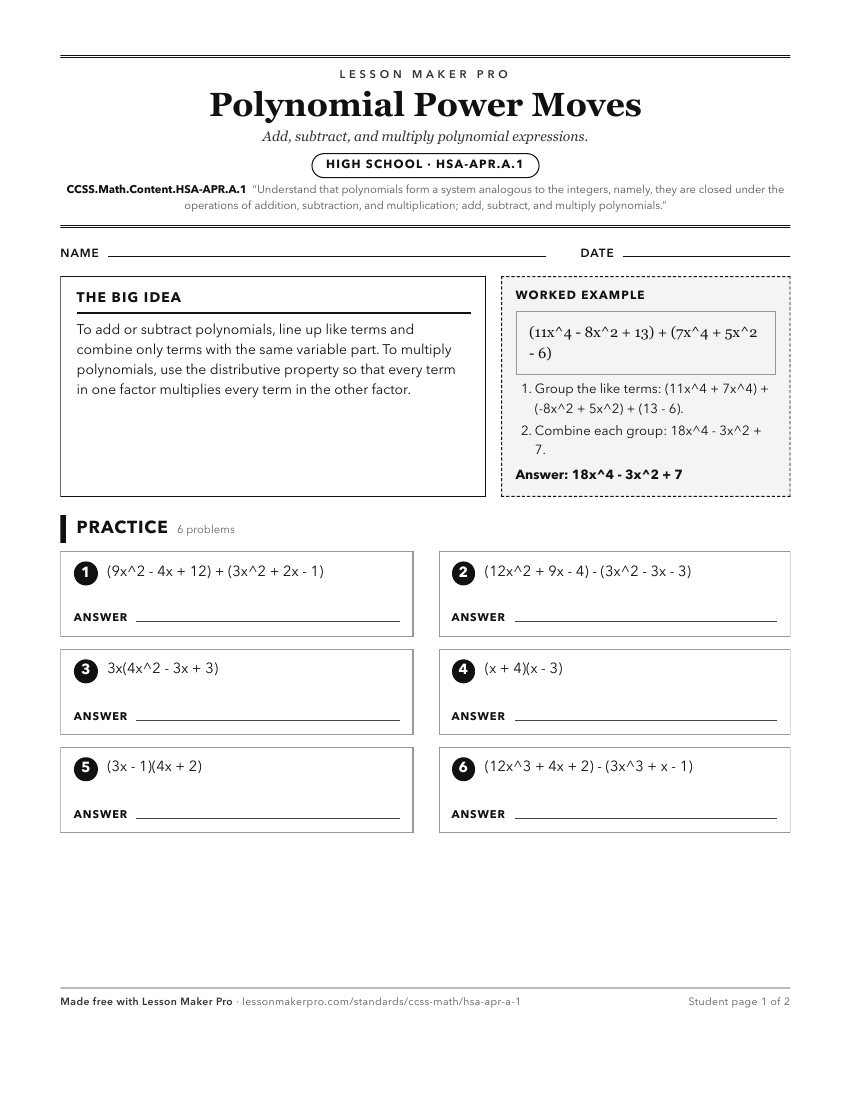
A ready-to-print activity worksheet aligned to CCSS.Math.Content.HSA-APR.A.1, with an answer key for the teacher on its own page. No account needed.
PDF, US Letter, prints cleanly in black and white.
Download the worksheetLearning progression
Where This Standard Sits
Before This Standard
If students are struggling here, check these first.
- CCSS.Math.Content.7.EE.A.1
Combining and expanding linear expressions gives the distributive and like-term reasoning needed for polynomial operations.
- CCSS.Math.Content.8.EE.A.1
Exponent rules carry over when multiplying monomials and polynomial terms, where powers of the same variable combine.
- CCSS.Math.Content.HSA-SSE.A.1a
Recognizing terms, factors, and coefficients supports combining like terms and multiplying polynomial parts accurately.
What This Unlocks
Mastery here sets students up for these next.
- CCSS.Math.Content.HSA-APR.C.5
Multiplying binomials and combining like terms underlie why powers expand into polynomial terms with Pascal's Triangle coefficients.
- CCSS.Math.Content.HSA-APR.D.6
Polynomial division rewrites rational expressions by multiplying and subtracting polynomials while tracking degrees and remainders.
- CCSS.Math.Content.HSA-APR.B.2
Polynomial multiplication and subtraction support checking factors and carrying out the division steps used in the Remainder Theorem.
- CCSS.Math.Content.HSA-APR.C.4
Proving identities requires expanding, multiplying, and combining polynomial expressions to show both sides are equivalent.
- CCSS.Math.Content.HSA-APR.D.7
Rational expression operations require treating numerators and denominators as polynomials and adding, subtracting, and multiplying them accurately.
- CCSS.Math.Content.HSN-CN.A.2
Polynomial operations practice carries over to distributing products and combining like terms when simplifying expressions with i² = -1.
Keep exploring
Related Standards
- CCSS.Math.Content.HSA-APR.A
Perform arithmetic operations on polynomials
- CCSS.Math.Content.1.OA.B
Understand and apply properties of operations and the relationship between addition and subtraction.
- CCSS.Math.Content.HSN-CN.C.9
(+) Know the Fundamental Theorem of Algebra; show that it is true for quadratic polynomials.
Turn this exact standard into a lesson
Grade, subject, topic, and the complete standard are prefilled. Create one free, no account needed.
Also for this standard:Make a WorksheetMake a QuizMake a Sub Lesson