CCSS.
The Standard
(+) Know the Fundamental Theorem of Algebra; show that it is true for quadratic polynomials.
Common Core State Standards for Mathematics · The Complex Number System
Teacher's field guide
What This Standard Means
What Students Need to Do
- Students connect a polynomial’s degree to its number of complex zeros, counting repeated zeros. They use the quadratic formula to show that every quadratic has two complex zeros, including nonreal or repeated ones.
What Mastery Looks Like
- Students find both zeros of any quadratic, including nonreal or repeated zeros. They write the related linear factors and explain why every quadratic has two complex zeros when multiplicity is counted.
Common Misconceptions
- Students may think a negative discriminant means a quadratic has no zeros. They may count a repeated zero only once or expect the degree to equal the number of distinct zeros. Some forget that complex conjugates appear in pairs for quadratics with real coefficients.
How to Assess It
- Exit ticket: Find all zeros of x² − 6x + 13, factor it over the complex numbers, and explain how the result matches its degree.
Lesson moves
Ways to Teach It
Give groups quadratic cards; students sort them by discriminant, solve each, and place two root cards under every polynomial.
Ask students to write why a negative discriminant means nonreal roots rather than no roots.
Run a matching race with cards showing quadratics, complex roots, factored forms, and root multiplicities.
Solve a projectile height equation, then discuss why both algebraic roots count when only one time fits the situation.
Free download
Printable HSN-CN.C.9 Worksheet
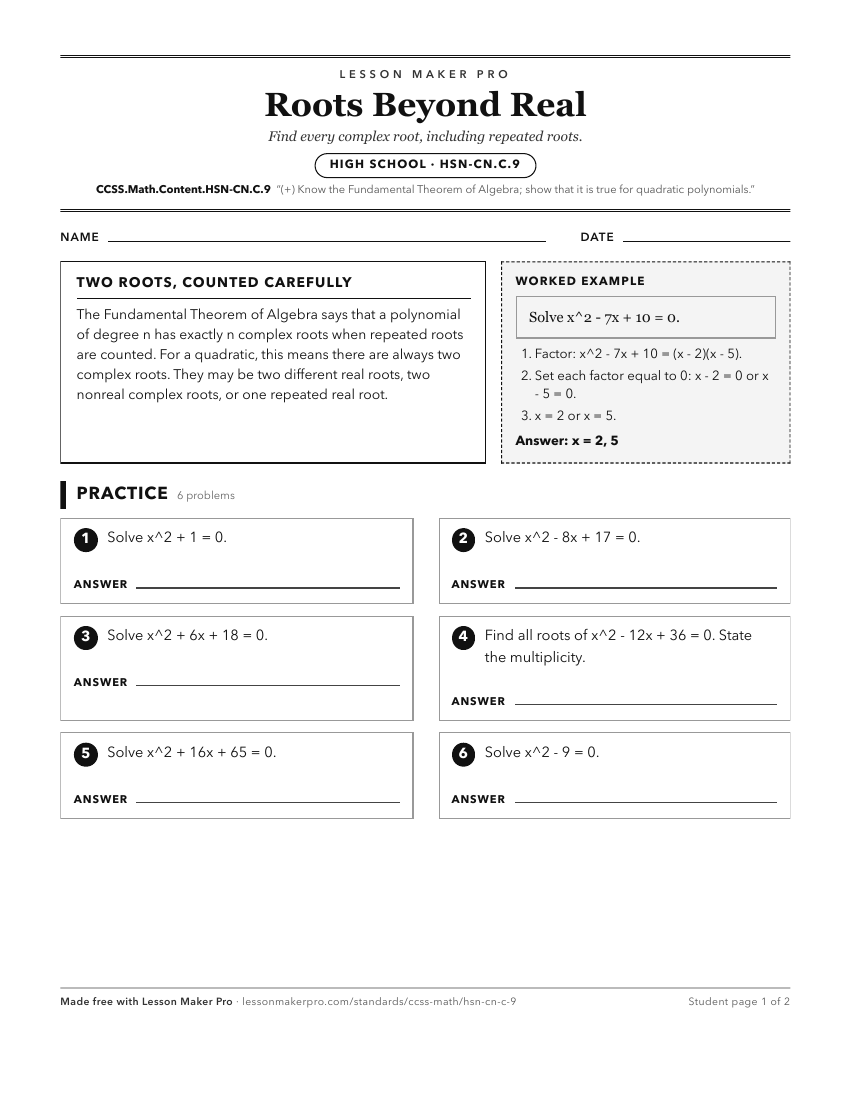
A ready-to-print activity worksheet aligned to CCSS.Math.Content.HSN-CN.C.9, with an answer key for the teacher on its own page. No account needed.
PDF, US Letter, prints cleanly in black and white.
Download the worksheetLearning progression
Where This Standard Sits
Before This Standard
If students are struggling here, check these first.
- CCSS.Math.Content.HSN-CN.C.7
Showing the theorem for quadratics requires using the quadratic formula and understanding nonreal complex roots when the discriminant is negative.
- CCSS.Math.Content.HSN-CN.C.8
Factoring identities over complex numbers support showing every quadratic splits into linear complex factors.
- CCSS.Math.Content.HSA-REI.B.4b
Showing the theorem for quadratics requires using the quadratic formula and interpreting real or complex roots from the discriminant.
Keep exploring
Related Standards
- CCSS.Math.Content.HSA-APR.A.1
Understand that polynomials form a system analogous to the integers, namely, they are closed under the operations of addition, subtraction, and multiplication; ...
- CCSS.Math.Content.HSG-SRT.D.10
(+) Prove the Laws of Sines and Cosines and use them to solve problems.
- CCSS.Math.Content.HSF-IF.C.8a
Use the process of factoring and completing the square in a quadratic function to show zeros, extreme values, and symmetry of the graph, and interpret these in ...
Turn this exact standard into a lesson
Grade, subject, topic, and the complete standard are prefilled. Create one free, no account needed.
Also for this standard:Make a WorksheetMake a QuizMake a Sub Lesson