CCSS.
The Standard
(+) Extend polynomial identities to the complex numbers.
Common Core State Standards for Mathematics · The Complex Number System
Teacher's field guide
What This Standard Means
What Students Need to Do
- Students factor polynomial expressions that do not factor over the real numbers by using i² = -1. They apply familiar identities and check their factors by multiplying.
What Mastery Looks Like
- A student can rewrite x² + a² as a product of complex conjugates. They multiply the factors and simplify i² to -1 to recover the original polynomial.
Common Misconceptions
- Students may say a sum of squares cannot be factored because they are thinking only about real numbers. They may write repeated factors, miss middle-term cancellation, or treat i² as 1.
How to Assess It
- Ask students to factor x² + 25 completely over the complex numbers, then verify the result by multiplying the factors.
Lesson moves
Ways to Teach It
Give students factor cards and polynomial cards, then have them match each pair and verify matches by expanding on mini whiteboards.
Ask, “Why can a sum of squares factor over complex numbers but not over real numbers?” and require an example.
Run a two-minute relay where teams factor sums of squares, expand their answers, and earn points only when both forms match.
Use the oscillator polynomial r² + 9, factor it, and connect the roots ±3i to repeating motion in an engineering model.
Free download
Printable HSN-CN.C.8 Worksheet
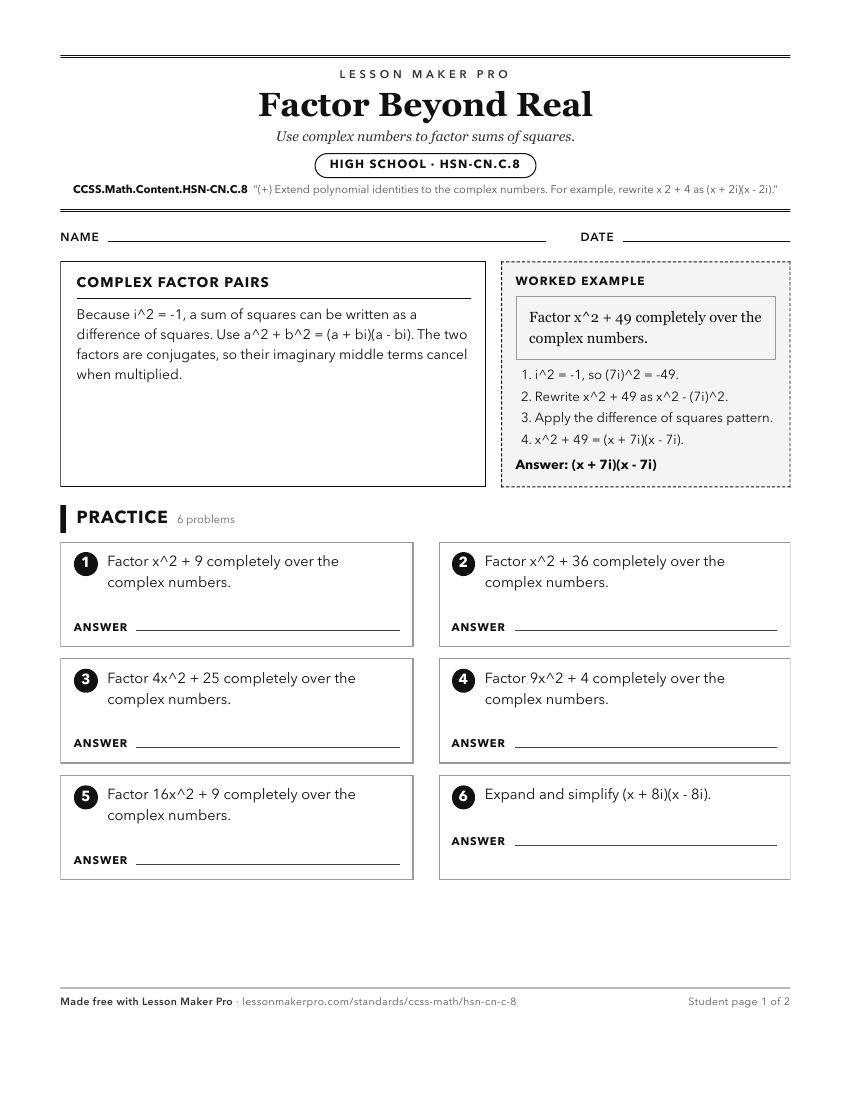
A ready-to-print activity worksheet aligned to CCSS.Math.Content.HSN-CN.C.8, with an answer key for the teacher on its own page. No account needed.
PDF, US Letter, prints cleanly in black and white.
Download the worksheetLearning progression
Where This Standard Sits
Before This Standard
If students are struggling here, check these first.
- CCSS.Math.Content.HSN-CN.A.2
Students need complex multiplication and i² = -1 to expand and verify identities with complex factors like x² + 1.
- CCSS.Math.Content.HSA-APR.C.4
Students must already manipulate and justify polynomial identities before rewriting those identities with complex factors or roots.
- CCSS.Math.Content.HSN-CN.A.1
Using identities with complex factors requires knowing i² = -1 and writing numbers in a + bi form.
What This Unlocks
Mastery here sets students up for these next.
Keep exploring
Related Standards
- CCSS.Math.Content.HSN-CN.C
Use complex numbers in polynomial identities and equations.
- CCSS.Math.Content.HSN-CN.A.3
(+) Find the conjugate of a complex number; use conjugates to find moduli and quotients of complex numbers.
- CCSS.Math.Content.HSN-CN.B.5
(+) Represent addition, subtraction, multiplication, and conjugation of complex numbers geometrically on the complex plane; use properties of this representatio...
Turn this exact standard into a lesson
Grade, subject, topic, and the complete standard are prefilled. Create one free, no account needed.
Also for this standard:Make a WorksheetMake a QuizMake a Sub Lesson