CCSS.
The Standard
(+) Represent addition, subtraction, multiplication, and conjugation of complex numbers geometrically on the complex plane; use properties of this representation for computation.
Common Core State Standards for Mathematics · The Complex Number System
Teacher's field guide
What This Standard Means
What Students Need to Do
- Students plot complex numbers as points or vectors and connect each operation to a visible transformation. They use vector geometry, reflection, scaling, and rotation to calculate and check results.
What Mastery Looks Like
- A student can plot inputs and results, then explain addition with vector sums, subtraction with difference vectors, and conjugation as reflection across the real axis. They can compute products or powers by multiplying moduli and adding arguments, then verify the result algebraically.
Common Misconceptions
- Students often multiply real and imaginary parts separately, or add arguments when adding complex numbers. They may reflect across the imaginary axis for a conjugate. They also choose the wrong argument quadrant or forget that multiplication multiplies moduli.
How to Assess It
- Exit ticket: Let z = 1 + i and w = -1 + i. Plot z, w, z + w, z - w, and the conjugate of z, then find zw using modulus and argument.
Lesson moves
Ways to Teach It
Use transparent complex-plane grids and arrow cutouts to build vector sums, differences, conjugate reflections, and multiplication as rotation plus scaling.
Ask students to explain why multiplying by i rotates every point 90 degrees counterclockwise, using two examples and one labeled sketch.
Run a card sort matching algebraic expressions, plotted results, moduli, arguments, and operation descriptions, then have pairs justify each match.
Model a signal as a phasor, then multiply by a complex factor to show how gain changes size and phase changes angle.
Free download
Printable HSN-CN.B.5 Worksheet
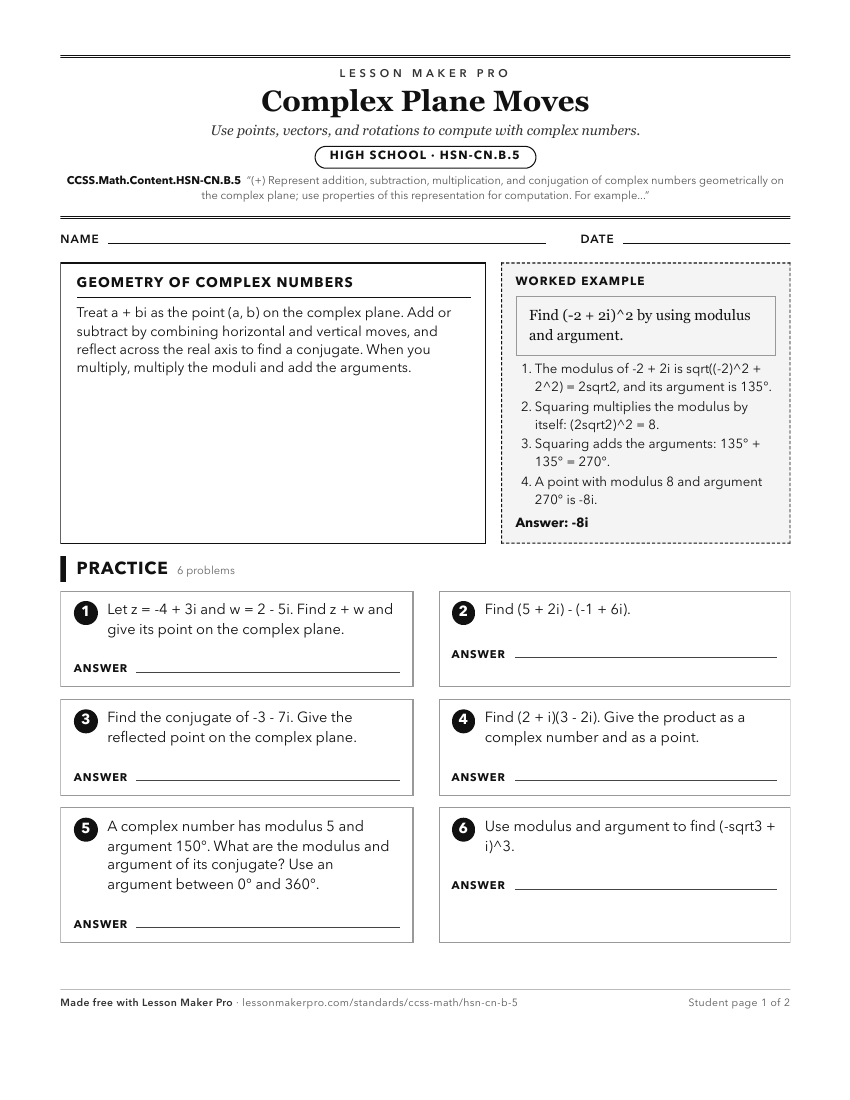
A ready-to-print activity worksheet aligned to CCSS.Math.Content.HSN-CN.B.5, with an answer key for the teacher on its own page. No account needed.
PDF, US Letter, prints cleanly in black and white.
Download the worksheetLearning progression
Where This Standard Sits
Before This Standard
If students are struggling here, check these first.
- CCSS.Math.Content.HSN-CN.A.3
Knowing conjugates and moduli algebraically supports seeing conjugation as reflection and using complex-plane properties in computations.
- CCSS.Math.Content.HSN-CN.B.4
Geometric operations require placing complex numbers on the plane, with polar form supporting multiplication as rotation and scaling.
- CCSS.Math.Content.HSN-CN.A.2
Algebraic complex addition, subtraction, and multiplication carry into plotting those operations and checking computations on the complex plane.
Keep exploring
Related Standards
Turn this exact standard into a lesson
Grade, subject, topic, and the complete standard are prefilled. Create one free, no account needed.
Also for this standard:Make a WorksheetMake a QuizMake a Sub Lesson