CCSS.
Standard Cluster
Represent complex numbers and their operations on the complex plane.
Common Core State Standards for Mathematics
Cluster contents
Standards in This Cluster
CCSS.Math.Content.HSN-CN.B is a cluster heading. These are the individual standards under it.
- CCSS.Math.Content.HSN-CN.B.4
(+) Represent complex numbers on the complex plane in rectangular and polar form (including real and imaginary numbers), and explain why the rectangular and pol...
- CCSS.Math.Content.HSN-CN.B.5
(+) Represent addition, subtraction, multiplication, and conjugation of complex numbers geometrically on the complex plane; use properties of this representatio...
- CCSS.Math.Content.HSN-CN.B.6
(+) Calculate the distance between numbers in the complex plane as the modulus of the difference, and the midpoint of a segment as the average of the numbers at...
Teacher's field guide
What This Cluster Means
What Students Need to Do
- Students plot complex numbers as points and vectors using real and imaginary coordinates, and express them in rectangular and polar forms. They show addition, subtraction, and multiplication geometrically. They use modulus to find distance and averages to find midpoint.
What Mastery Looks Like
- Students accurately plot complex numbers and switch between rectangular and polar forms. They graph sums and products, then explain multiplication as a rotation and scale change. They also find distances with modulus and midpoints by averaging.
Common Misconceptions
- Students may reverse the real and imaginary axes or treat i as a variable rather than a unit. They often forget that i² = -1, or confuse modulus with the real part. Some add angles when adding complex numbers, though that rule applies to multiplication in polar form.
How to Assess It
- Exit ticket: Plot z = 2 + i and w = -1 + 3i, then plot z + w and find the distance between z and w.
Lesson moves
Ways to Teach It
Give pairs graph paper and arrow cutouts to model complex numbers, then combine arrows to show addition and subtraction.
Ask students to explain in writing why multiplying by i rotates a point 90 degrees around the origin.
Run a card sort matching complex numbers, plotted points, polar forms, sums, products, distances, and midpoints.
Model AC voltage with complex phasors, then have students convert amplitude and phase values into rectangular form.
Free download
Printable HSN-CN.B Worksheet
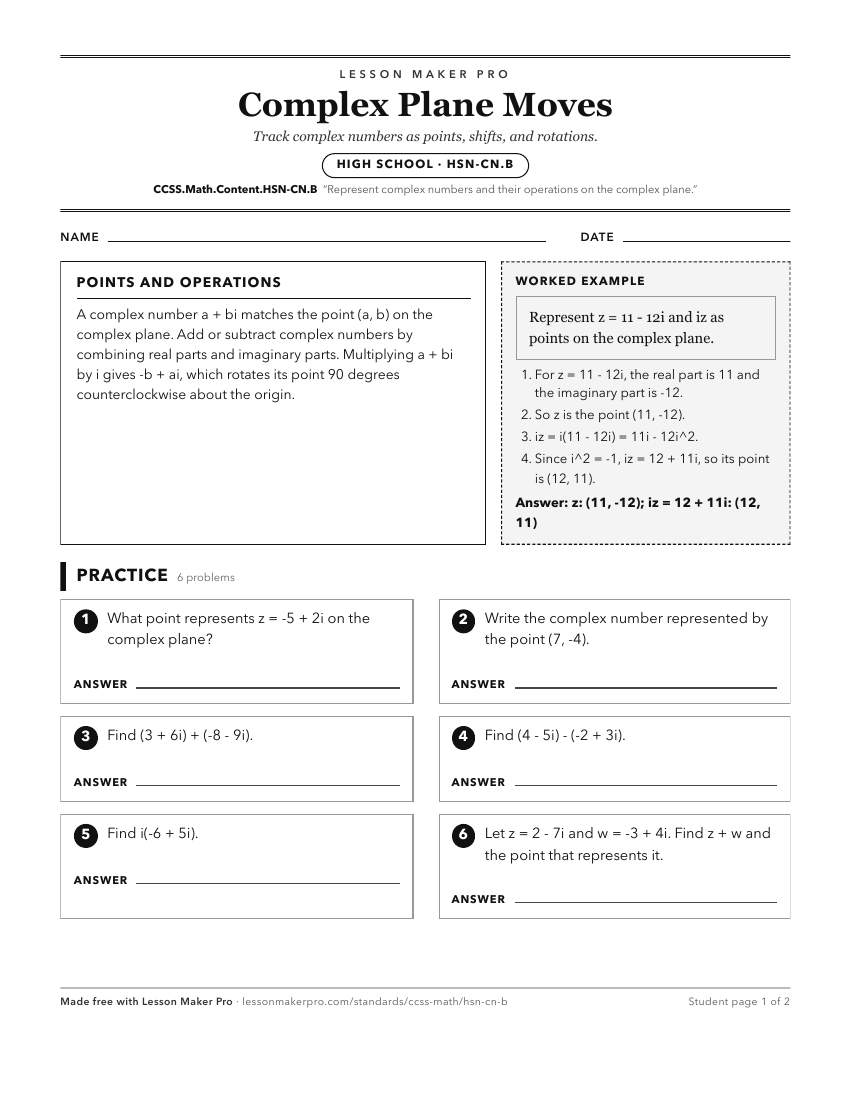
A ready-to-print activity worksheet aligned to CCSS.Math.Content.HSN-CN.B, with an answer key for the teacher on its own page. No account needed.
PDF, US Letter, prints cleanly in black and white.
Download the worksheetKeep exploring
Related Standards
Turn this cluster into a lesson
Grade, subject, topic, and the complete cluster are prefilled. Create one free, no account needed.
Also for this cluster:Make a WorksheetMake a QuizMake a Sub Lesson