CCSS.
Standard Cluster
Use complex numbers in polynomial identities and equations.
Common Core State Standards for Mathematics
Cluster contents
Standards in This Cluster
CCSS.Math.Content.HSN-CN.C is a cluster heading. These are the individual standards under it.
- CCSS.Math.Content.HSN-CN.C.7
Solve quadratic equations with real coefficients that have complex solutions.
- CCSS.Math.Content.HSN-CN.C.8
(+) Extend polynomial identities to the complex numbers.
- CCSS.Math.Content.HSN-CN.C.9
(+) Know the Fundamental Theorem of Algebra; show that it is true for quadratic polynomials.
Teacher's field guide
What This Cluster Means
What Students Need to Do
- Students solve polynomial equations when some roots are complex. They use complex arithmetic to rewrite and verify polynomial identities. They also connect roots to linear factors.
What Mastery Looks Like
- Students solve polynomial equations with real or complex roots and simplify powers of i correctly. They connect each root to a linear factor and verify identities by expansion. They recognize conjugate root pairs when coefficients are real.
Common Misconceptions
- Students may treat i² as 1 instead of -1, or write √-9 as -3. They may forget that nonreal roots of polynomials with real coefficients come in conjugate pairs. They may find roots correctly but write the wrong signs in the matching factors.
How to Assess It
- Give this exit ticket: Solve x² + 4x + 13 = 0, write the polynomial as linear factors, and verify by multiplying.
Lesson moves
Ways to Teach It
Match cards showing a polynomial, its complex roots, and its linear factorization, then confirm each set by multiplication.
Discuss and write a response to: “Why must nonreal roots of a real-coefficient polynomial occur in conjugate pairs?”
Run a root-factor relay where teams solve one polynomial, write its factors, and check another team’s multiplication.
Solve -5t² + 20t = 25 for an unreachable projectile height, then explain why its complex times have no physical meaning.
Free download
Printable HSN-CN.C Worksheet
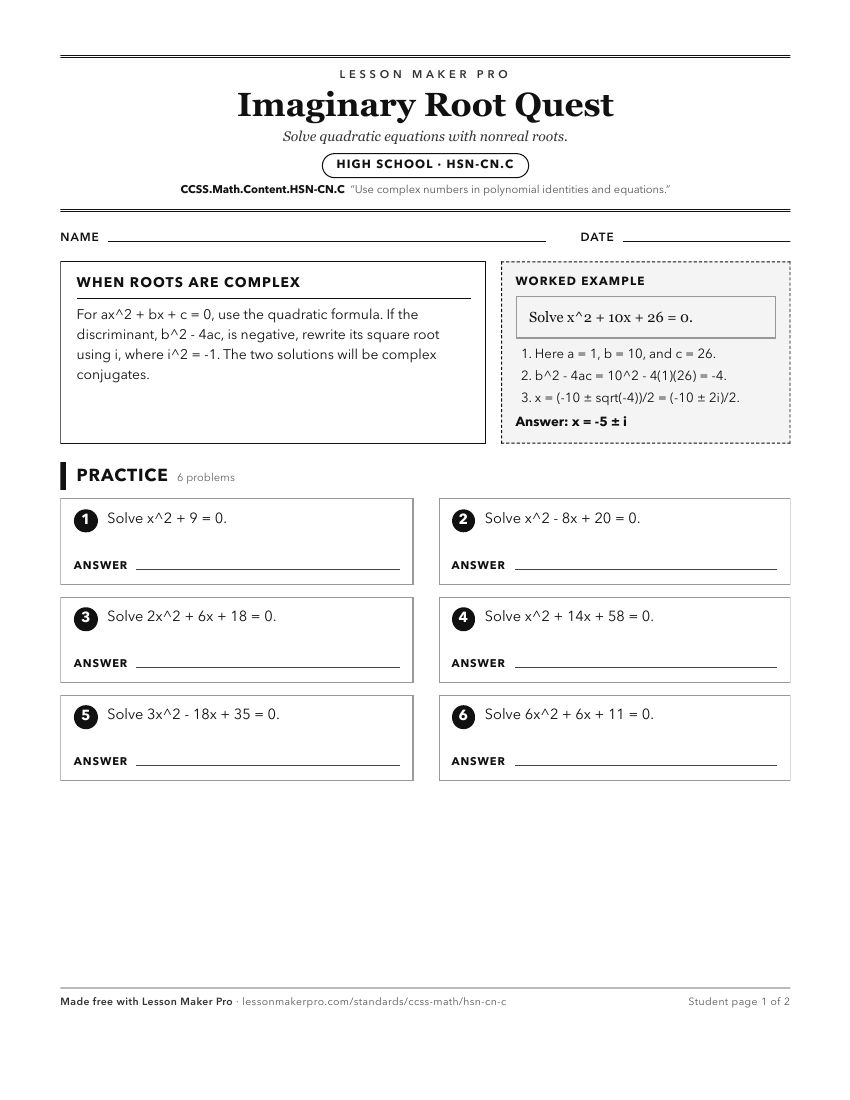
A ready-to-print activity worksheet aligned to CCSS.Math.Content.HSN-CN.C, with an answer key for the teacher on its own page. No account needed.
PDF, US Letter, prints cleanly in black and white.
Download the worksheetKeep exploring
Related Standards
Turn this cluster into a lesson
Grade, subject, topic, and the complete cluster are prefilled. Create one free, no account needed.
Also for this cluster:Make a WorksheetMake a QuizMake a Sub Lesson