CCSS.
The Standard
Prove polynomial identities and use them to describe numerical relationships.
Common Core State Standards for Mathematics
Teacher's field guide
What This Standard Means
What Students Need to Do
- Students rewrite polynomial expressions by expanding, factoring, or regrouping terms to prove two forms are always equal. They use proven identities to explain number patterns and generate relationships such as Pythagorean triples.
What Mastery Looks Like
- A student expands or factors each side, gets matching expressions, and justifies each step. The student can generate a Pythagorean triple and explain why it satisfies a² + b² = c².
Common Misconceptions
- Students often think checking several number choices proves an identity. They may make sign errors when squaring binomials or cancel terms across addition. Some treat an identity like an equation with only a few solutions.
How to Assess It
- Exit ticket: Prove (a + b)² − (a − b)² = 4ab, then use a = 7 and b = 3 to state the resulting numerical equality.
Lesson moves
Ways to Teach It
Arrange algebra tiles for (x + y)², then regroup them to show x² + 2xy + y² without changing the total area.
Write a response to: Why do three successful substitutions support an identity but fail to prove it?
Match cards showing factored expressions, expanded expressions, and numerical examples, then defend each match with one algebraic step.
Use m² − n², 2mn, and m² + n² with m = 4 and n = 1 to plan a right triangular brace.
Free download
Printable HSA-APR.C.4 Worksheet
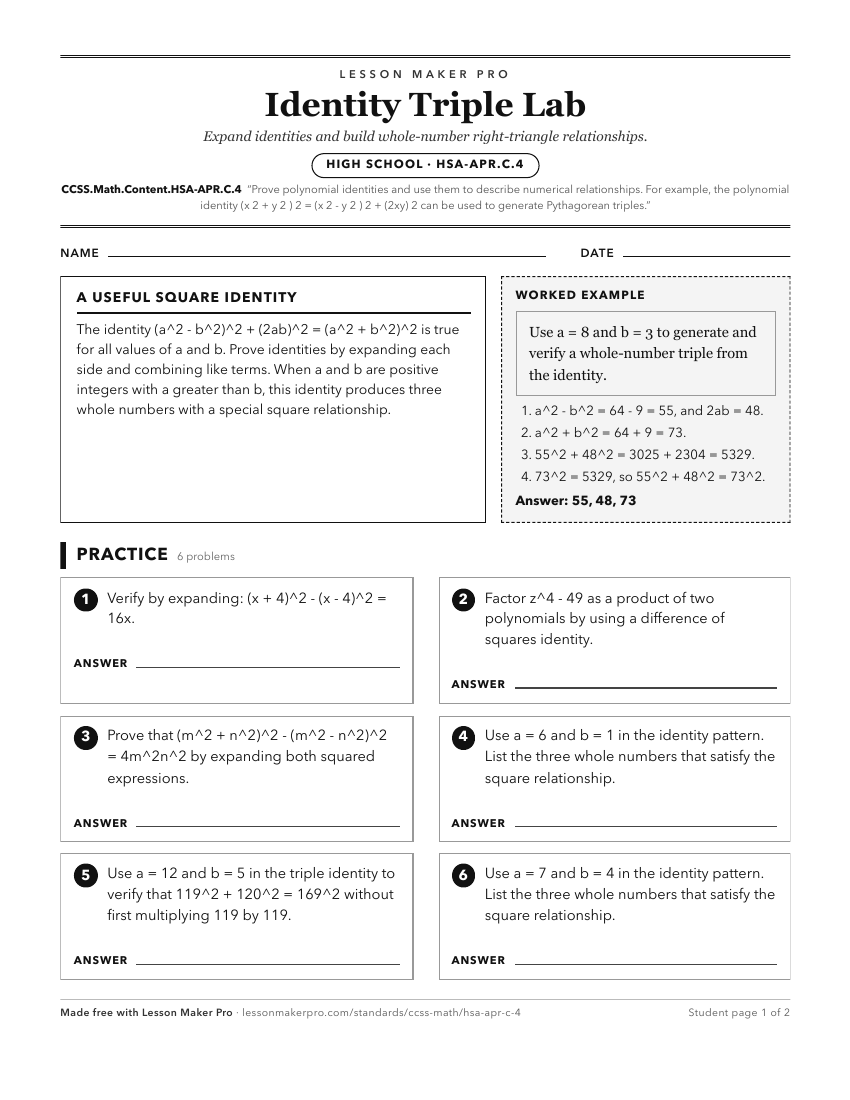
A ready-to-print activity worksheet aligned to CCSS.Math.Content.HSA-APR.C.4, with an answer key for the teacher on its own page. No account needed.
PDF, US Letter, prints cleanly in black and white.
Download the worksheetLearning progression
Where This Standard Sits
Before This Standard
If students are struggling here, check these first.
- CCSS.Math.Content.HSA-SSE.A.2
Recognizing expression structure helps students rewrite and transform polynomials when proving that two forms are identically equal.
- CCSS.Math.Content.HSA-APR.A.1
Proving identities requires expanding, multiplying, and combining polynomial expressions to show both sides are equivalent.
- CCSS.Math.Content.7.EE.A.1
Proving polynomial identities depends on reliably expanding, factoring, and combining expressions using operation properties.
What This Unlocks
Mastery here sets students up for these next.
Keep exploring
Related Standards
- CCSS.Math.Content.HSN-CN.C
Use complex numbers in polynomial identities and equations.
- CCSS.Math.Content.8.EE.A.1
Know and apply the properties of integer exponents to generate equivalent numerical expressions.
- CCSS.Math.Content.HSF-TF.C
Prove and apply trigonometric identities
- CCSS.Math.Content.HSA-APR.C
Use polynomial identities to solve problems
Turn this exact standard into a lesson
Grade, subject, topic, and the complete standard are prefilled. Create one free, no account needed.
Also for this standard:Make a WorksheetMake a QuizMake a Sub Lesson