CCSS.
Standard Cluster
Prove and apply trigonometric identities
Common Core State Standards for Mathematics · High School — Functions
Cluster contents
Standards in This Cluster
CCSS.Math.Content.HSF-TF.C is a cluster heading. These are the individual standards under it.
- CCSS.Math.Content.HSF-TF.C.8
Prove the Pythagorean identity sin²(θ) + cos²(θ) = 1 and use it to find sin(θ), cos(θ), or tan(θ) given sin(θ), cos(θ), or tan(θ) and the quadrant of the angle.
- CCSS.Math.Content.HSF-TF.C.9
(+) Prove the addition and subtraction formulas for sine, cosine, and tangent and use them to solve problems.
Teacher's field guide
What This Cluster Means
What Students Need to Do
- Students show that two trigonometric expressions are equal by transforming one side with known identities and algebra. They use those relationships to simplify expressions and find exact values while tracking quadrants and restrictions.
What Mastery Looks Like
- Students can transform one side of an equation into the other using known identities and valid algebra. They can find exact values, choose signs by quadrant, and state restrictions.
Common Misconceptions
- Students often treat an identity as an equation to solve for an angle. They may cancel terms across sums or choose the wrong sign for a square root. Some ignore undefined values or think checking one angle proves equality.
How to Assess It
- Exit ticket: Simplify (1 − cos²x)/sin x and state where the original expression is defined. Then find cos θ if sin θ = 3/5 and θ is in quadrant II.
Lesson moves
Ways to Teach It
Use a paper unit circle and right triangles to label x, y, and radius, then derive x² + y² = 1.
Ask students why dividing by sin²x creates restrictions, then compare the valid domains in two sample derivations.
Run an identity card sort matching 1 − sin²x, cos²x, and other equivalent forms, with students justifying every match.
Have students find the vertical component of a 100 newton force at 75° by expanding sin(45° + 30°).
Free download
Printable HSF-TF.C Worksheet
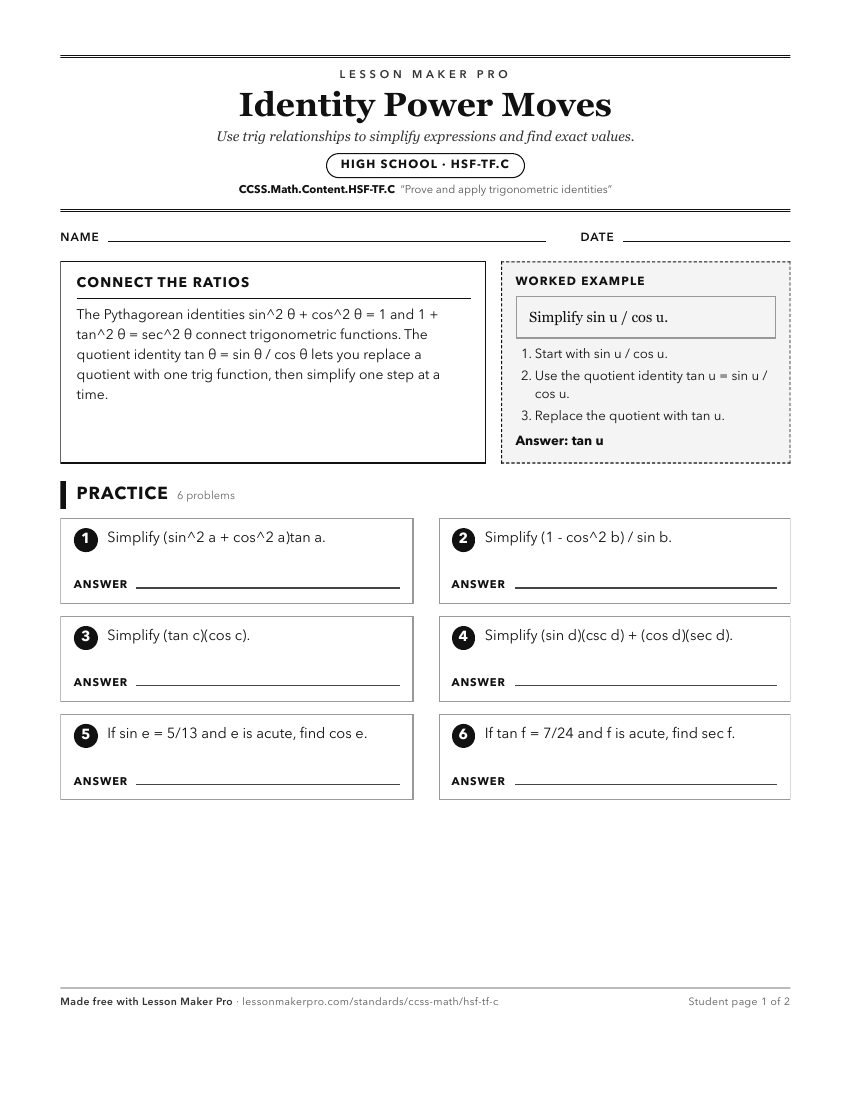
A ready-to-print activity worksheet aligned to CCSS.Math.Content.HSF-TF.C, with an answer key for the teacher on its own page. No account needed.
PDF, US Letter, prints cleanly in black and white.
Download the worksheetKeep exploring
Related Standards
Turn this cluster into a lesson
Grade, subject, topic, and the complete cluster are prefilled. Create one free, no account needed.
Also for this cluster:Make a WorksheetMake a QuizMake a Sub Lesson