CCSS.
The Standard
Prove the Pythagorean identity sin²(θ) + cos²(θ) = 1 and use it to find sin(θ), cos(θ), or tan(θ) given sin(θ), cos(θ), or tan(θ) and the quadrant of the angle.
Common Core State Standards for Mathematics
Teacher's field guide
What This Standard Means
What Students Need to Do
- Students connect sine and cosine to coordinates on the unit circle and use that relationship to justify the squared identity. They then calculate missing sine, cosine, or tangent values and use the quadrant to select the correct sign.
What Mastery Looks Like
- Students can derive the identity from the unit circle equation or a right triangle. They can find exact missing values and choose each sign from the stated quadrant.
Common Misconceptions
- Students often forget that sine and cosine are squared, or they square only one term. They may choose the positive square root automatically, ignore the quadrant, or use sine divided by cosine for tangent in the wrong order.
How to Assess It
- Exit ticket: Given cos(θ) = -12/13 and θ is in quadrant II, find sin(θ) and tan(θ), then show the equation used.
Lesson moves
Ways to Teach It
Give pairs a paper unit circle, ruler, and coordinate cards; they measure x and y, then test x² + y².
Ask students to explain in writing why knowing the quadrant is necessary when taking a square root.
Run a card match with given trig values, quadrant cards, and exact missing-value cards; students justify each completed set.
Track a Ferris wheel seat using its normalized horizontal coordinate and quadrant, then calculate its normalized vertical coordinate.
Free download
Printable HSF-TF.C.8 Worksheet
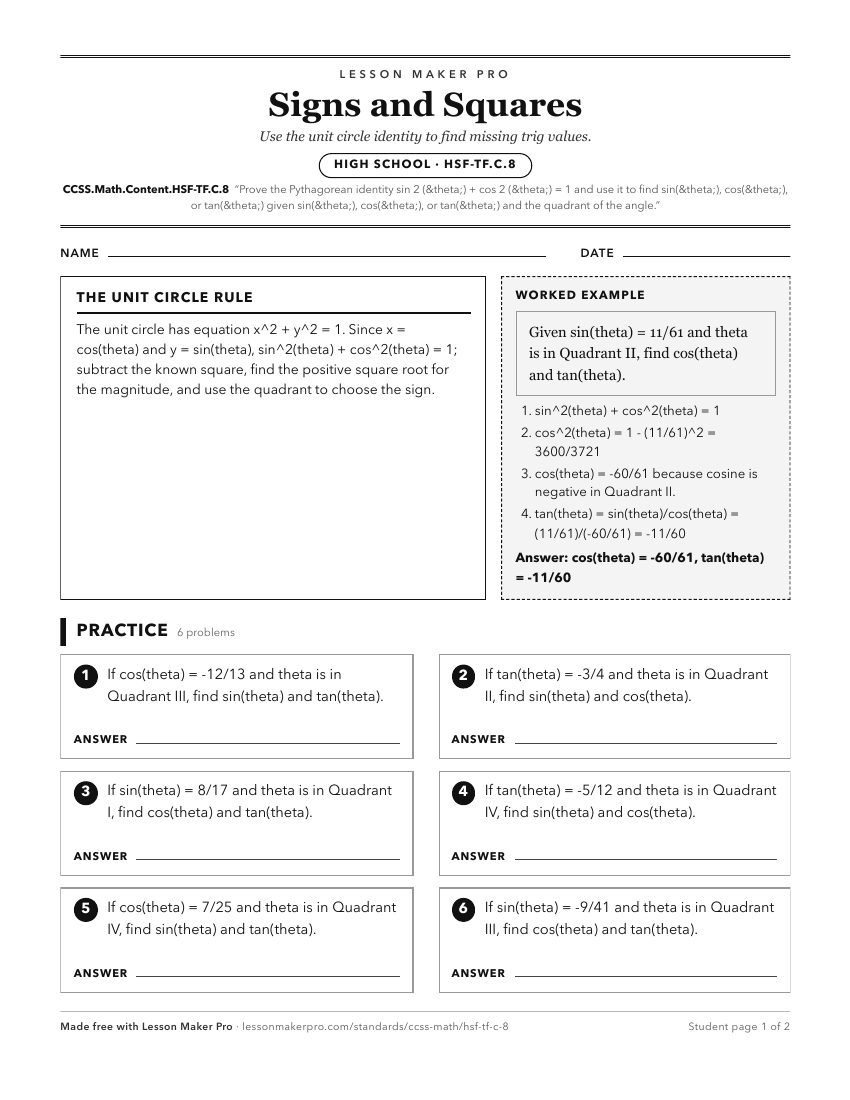
A ready-to-print activity worksheet aligned to CCSS.Math.Content.HSF-TF.C.8, with an answer key for the teacher on its own page. No account needed.
PDF, US Letter, prints cleanly in black and white.
Download the worksheetLearning progression
Where This Standard Sits
Before This Standard
If students are struggling here, check these first.
- CCSS.Math.Content.HSF-TF.A.2
Unit circle coordinates define sine and cosine for any angle, making the identity and quadrant sign choices meaningful.
- CCSS.Math.Content.8.G.B.6
The identity comes directly from applying the Pythagorean Theorem to the unit-circle right triangle with legs cos θ and sin θ.
- CCSS.Math.Content.8.EE.A.2
Solving sin² or cos² from the identity requires square-root notation and choosing a sign using the quadrant.
What This Unlocks
Mastery here sets students up for these next.
Keep exploring
Related Standards
Turn this exact standard into a lesson
Grade, subject, topic, and the complete standard are prefilled. Create one free, no account needed.
Also for this standard:Make a WorksheetMake a QuizMake a Sub Lesson