CCSS.
The Standard
Know and apply the properties of integer exponents to generate equivalent numerical expressions.
Common Core State Standards for Mathematics · Expressions and Equations
Teacher's field guide
What This Standard Means
What Students Need to Do
- Students use product, quotient, power, zero-exponent, and negative-exponent rules to rewrite numerical expressions. They show that the original and rewritten expressions have the same value.
What Mastery Looks Like
- A student correctly simplifies expressions such as 2^3 × 2^-5 and (3^2)^-2. They explain each exponent change and write answers without negative exponents when asked.
Common Misconceptions
- Students often add bases instead of exponents, multiply exponents in a product, or apply a power to only one factor. They may think a negative exponent makes the value negative, or that any nonzero number raised to zero equals zero.
How to Assess It
- Exit ticket: Simplify 4^3 × 4^-5 and (2^3)^2 ÷ 2^4, then name the exponent rule used in each step.
Lesson moves
Ways to Teach It
Give pairs exponent-rule cards and expression cards, then have students match each expression to an equivalent form and verify with calculators.
Ask students to explain why 5^-2 equals 1/25, using repeated division instead of naming the rule alone.
Run an exponent relay where teams simplify one step at a time, and each student must justify the previous step before continuing.
Compare powers of ten in file sizes or scientific measurements, then calculate ratios using quotient and negative-exponent rules.
Free download
Printable 8.EE.A.1 Worksheet
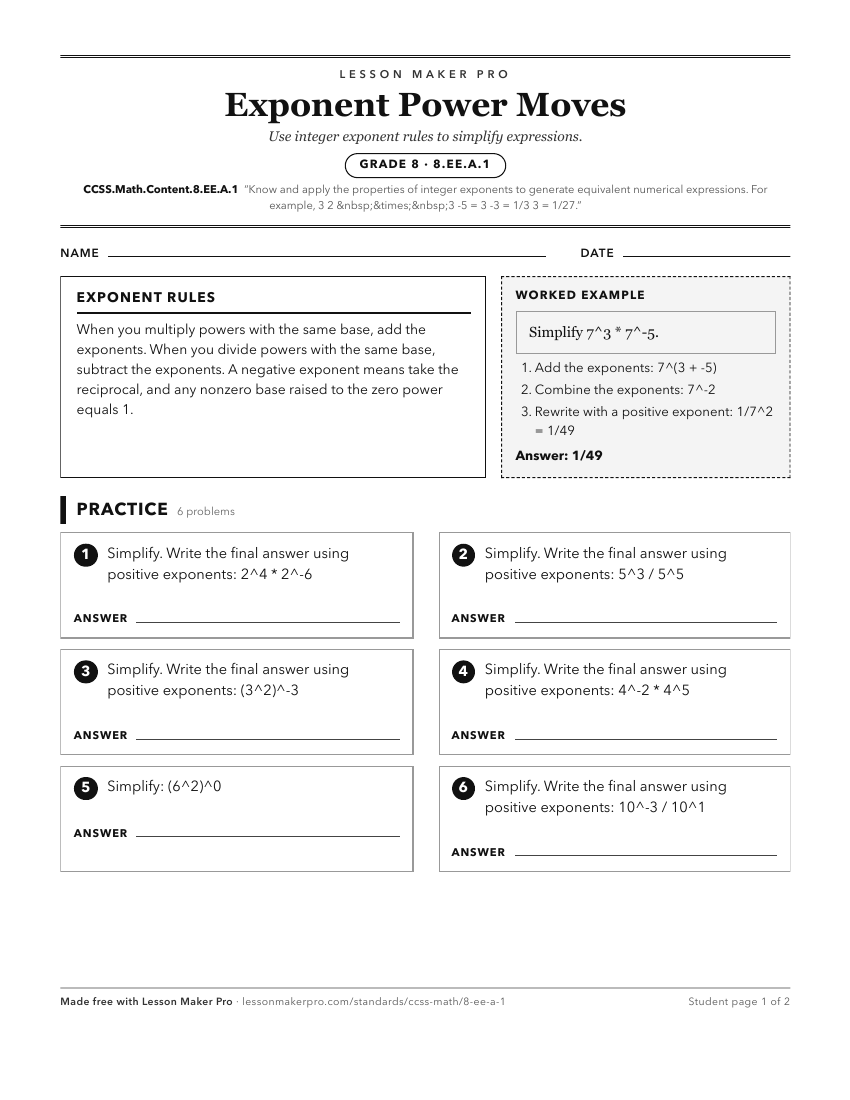
A ready-to-print activity worksheet aligned to CCSS.Math.Content.8.EE.A.1, with an answer key for the teacher on its own page. No account needed.
PDF, US Letter, prints cleanly in black and white.
Download the worksheetLearning progression
Where This Standard Sits
See the whole path on the Expressions & Equations progression map.
Before This Standard
If students are struggling here, check these first.
- CCSS.Math.Content.6.EE.A.1
Understanding and evaluating whole-number powers supports applying exponent rules and extending them to zero and negative exponents.
- CCSS.Math.Content.6.EE.A.3
Using operation properties to rewrite expressions supports seeing exponent rules as valid ways to create equivalent numerical expressions.
- CCSS.Math.Content.6.EE.A.4
Recognizing that different forms can name the same value supports using exponent rules to rewrite numerical expressions equivalently.
What This Unlocks
Mastery here sets students up for these next.
- CCSS.Math.Content.8.EE.A.4
Scientific notation operations require exponent rules for powers of ten to combine, compare, and rewrite quantities correctly.
- CCSS.Math.Content.8.EE.A.3
Properties of powers of 10 support writing scientific notation and comparing sizes by multiplying or dividing powers of ten.
- CCSS.Math.Content.HSA-SSE.B.3c
Transforming exponential function forms requires fluently using exponent rules first practiced with numerical expressions and integer exponents.
- CCSS.Math.Content.HSF-IF.C.8b
Interpreting exponential function forms relies on exponent laws like powers of powers and products of powers to see growth rates.
- CCSS.Math.Content.HSN-RN.A.2
Rational exponent and radical rewrites require the same exponent laws first practiced with integer exponents in simpler numerical cases.
- CCSS.Math.Content.HSN-RN.A.1
Rational exponents are defined by preserving integer exponent rules, especially powers of powers and products, when exponents become fractions.
Keep exploring
Related Standards
Turn this exact standard into a lesson
Grade, subject, topic, and the complete standard are prefilled. Create one free, no account needed.
Also for this standard:Make a WorksheetMake a QuizMake a Sub Lesson