CCSS.
Standard Cluster
Use properties of operations to generate equivalent expressions.
Common Core State Standards for Mathematics
Cluster contents
Standards in This Cluster
CCSS.Math.Content.7.EE.A is a cluster heading. These are the individual standards under it.
- CCSS.Math.Content.7.EE.A.1
Apply properties of operations as strategies to add, subtract, factor, and expand linear expressions with rational coefficients.
- CCSS.Math.Content.7.EE.A.2
Understand that rewriting an expression in different forms in a problem context can shed light on the problem and how the quantities in it are related.
Teacher's field guide
What This Cluster Means
What Students Need to Do
- Students rewrite expressions by distributing, combining like terms, and factoring. They use operation properties to show that different forms have the same value.
What Mastery Looks Like
- A student can expand 3(x + 5), simplify 7x + 2 - 4x, and factor 6x + 18. They can explain why two expressions are equivalent.
Common Misconceptions
- Students may rewrite 3(x + 4) as 3x + 4. They may combine unlike terms or lose negative signs when removing parentheses.
How to Assess It
- Exit ticket: Rewrite 4(2x + 3) - 5x in simplest form, then name the property used to remove the parentheses.
Lesson moves
Ways to Teach It
Use algebra tiles to model 2(x + 3), then rearrange the tiles to show 2x + 6.
Ask students to explain in writing why 5(x + 2) and 5x + 10 give the same value.
Run a card match game pairing expanded, factored, and simplified forms of the same expression.
Model five identical ticket orders with 5(x + 3), then connect the situation to 5x + 15.
Free download
Printable 7.EE.A Worksheet
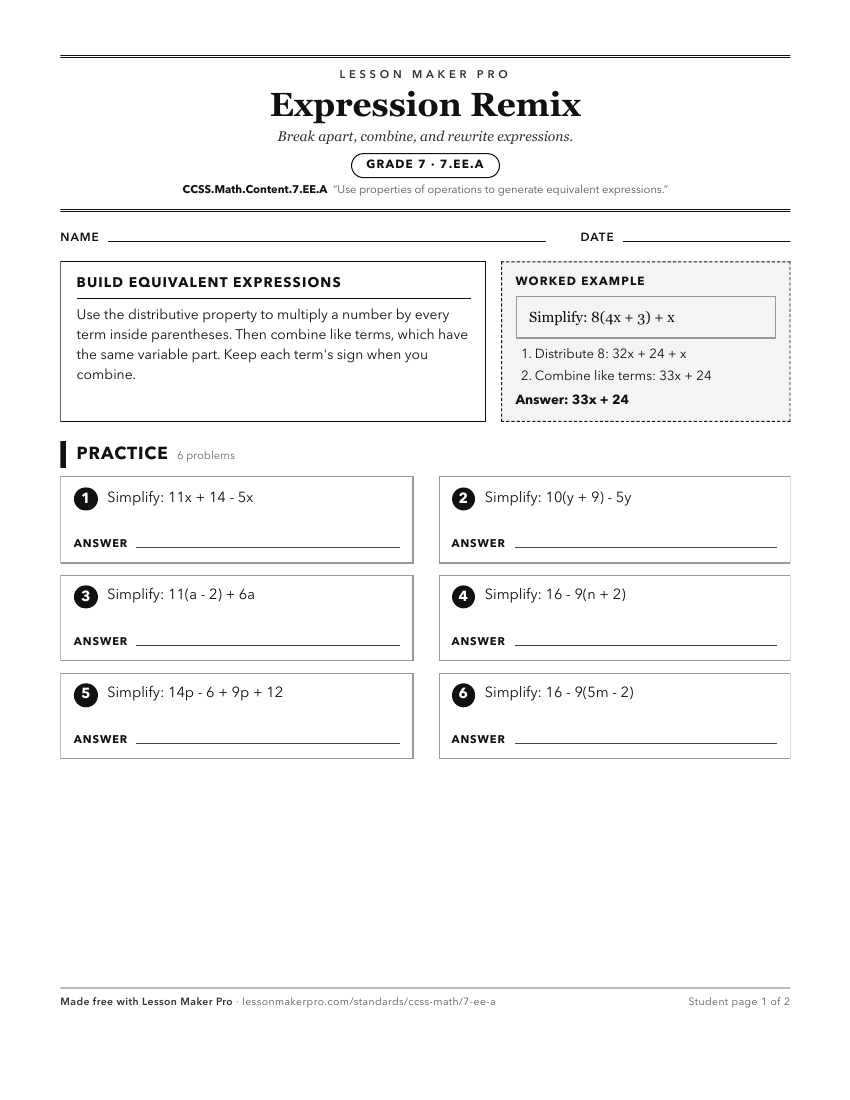
A ready-to-print activity worksheet aligned to CCSS.Math.Content.7.EE.A, with an answer key for the teacher on its own page. No account needed.
PDF, US Letter, prints cleanly in black and white.
Download the worksheetKeep exploring
Related Standards
- CCSS.Math.Content.HSA-SSE.B.3
Choose and produce an equivalent form of an expression to reveal and explain properties of the quantity represented by the expression.
- CCSS.Math.Content.8.EE.A.1
Know and apply the properties of integer exponents to generate equivalent numerical expressions.
- CCSS.Math.Content.HSA-SSE.B
Write expressions in equivalent forms to solve problems
- CCSS.Math.Content.6.EE.A.3
Apply the properties of operations to generate equivalent expressions.
Turn this cluster into a lesson
Grade, subject, topic, and the complete cluster are prefilled. Create one free, no account needed.
Also for this cluster:Make a WorksheetMake a QuizMake a Sub Lesson