CCSS.
The Standard
Choose and produce an equivalent form of an expression to reveal and explain properties of the quantity represented by the expression.
Common Core State Standards for Mathematics
Teacher's field guide
What This Standard Means
What Students Need to Do
- Students rewrite expressions into equivalent forms that make a useful feature easy to see. They choose a form, such as factored, vertex, or regrouped exponential form, and explain what it reveals.
What Mastery Looks Like
- A student selects a useful form and rewrites the expression without changing its value. They accurately identify zeros, a maximum or minimum, or a growth factor and connect it to the given quantity.
Common Misconceptions
- Students may change an expression's value by dropping a negative sign or misusing distribution. They may factor correctly but confuse a factor with a zero. They may multiply exponents incorrectly when regrouping exponential expressions.
How to Assess It
- Exit ticket: Rewrite h(t) = -16t² + 64t + 80 in a form that reveals its maximum. State the maximum height and when it occurs.
Lesson moves
Ways to Teach It
Use algebra tiles to build x² + 6x + 5, rearrange them into a rectangle, and record the side lengths as factors.
Compare expanded, factored, and vertex forms of one quadratic, then write which form best shows zeros or a maximum and why.
Run a matching game with cards showing equivalent expressions, graphs, zeros, vertices, and growth factors. Students justify every match.
Model monthly savings with 500(1.01)^m, rewrite it to show yearly growth, and explain the meaning of the new growth factor.
Free download
Printable HSA-SSE.B.3 Worksheet
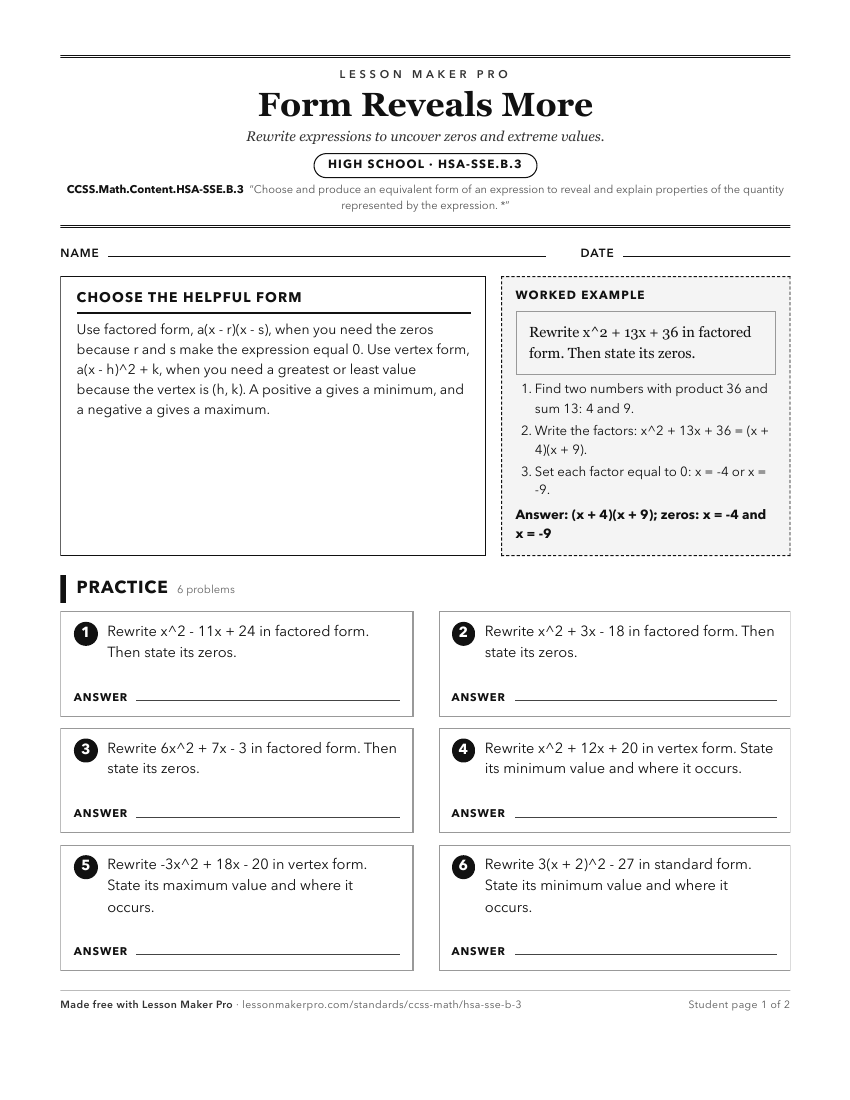
A ready-to-print activity worksheet aligned to CCSS.Math.Content.HSA-SSE.B.3, with an answer key for the teacher on its own page. No account needed.
PDF, US Letter, prints cleanly in black and white.
Download the worksheetLearning progression
Where This Standard Sits
Before This Standard
If students are struggling here, check these first.
- CCSS.Math.Content.HSA-SSE.A.2
Students must recognize expression structure to select and create forms that reveal zeros, growth, or other properties.
- CCSS.Math.Content.7.EE.A.1
Rewriting quadratics and other algebraic expressions depends on using operation properties to factor, expand, and maintain equivalence.
- CCSS.Math.Content.7.EE.A.2
Students extend seeing equivalent forms reveal relationships to selecting factored, expanded, or transformed forms that show features of algebraic quantities.
What This Unlocks
Mastery here sets students up for these next.
- CCSS.Math.Content.HSA-SSE.B.3b
Choosing equivalent forms supports completing the square, where rewriting a quadratic reveals its vertex and maximum or minimum.
- CCSS.Math.Content.HSF-IF.C.8
Rewriting expressions to reveal features is the algebra skill needed to rewrite function formulas and interpret their properties.
Keep exploring
Related Standards
Turn this exact standard into a lesson
Grade, subject, topic, and the complete standard are prefilled. Create one free, no account needed.
Also for this standard:Make a WorksheetMake a QuizMake a Sub Lesson