CCSS.
The Standard
Apply the properties of operations to generate equivalent expressions.
Common Core State Standards for Mathematics · Expressions and Equations
Teacher's field guide
What This Standard Means
What Students Need to Do
- Students use the distributive, commutative, and associative properties to rewrite expressions without changing their value. They expand grouped expressions, factor common factors, and combine repeated variable terms.
What Mastery Looks Like
- Students correctly expand, factor, and combine like terms without changing an expression's value. They can name the property used and verify equivalence with a substituted value.
Common Misconceptions
- Students may add unlike terms, such as changing 3x + 4 into 7x. They may distribute to only one term or confuse 3(x + 2) with 3x + 2. Some think expressions must look the same to be equivalent.
How to Assess It
- Give students the exit ticket: “Rewrite 4(x + 3) + 2x in two equivalent forms. Show which properties you used.”
Lesson moves
Ways to Teach It
Use algebra tiles to model 3(x + 2), then rearrange the tiles to show 3x + 6.
Ask students to explain why 5(x + 2) and 5x + 10 give the same value for every x.
Play an expression match game using cards with equivalent forms, including expanded, factored, and combined expressions.
Model the cost of four movie tickets and four snacks as 4(t + s), then rewrite it using distribution.
Free download
Printable 6.EE.A.3 Worksheet
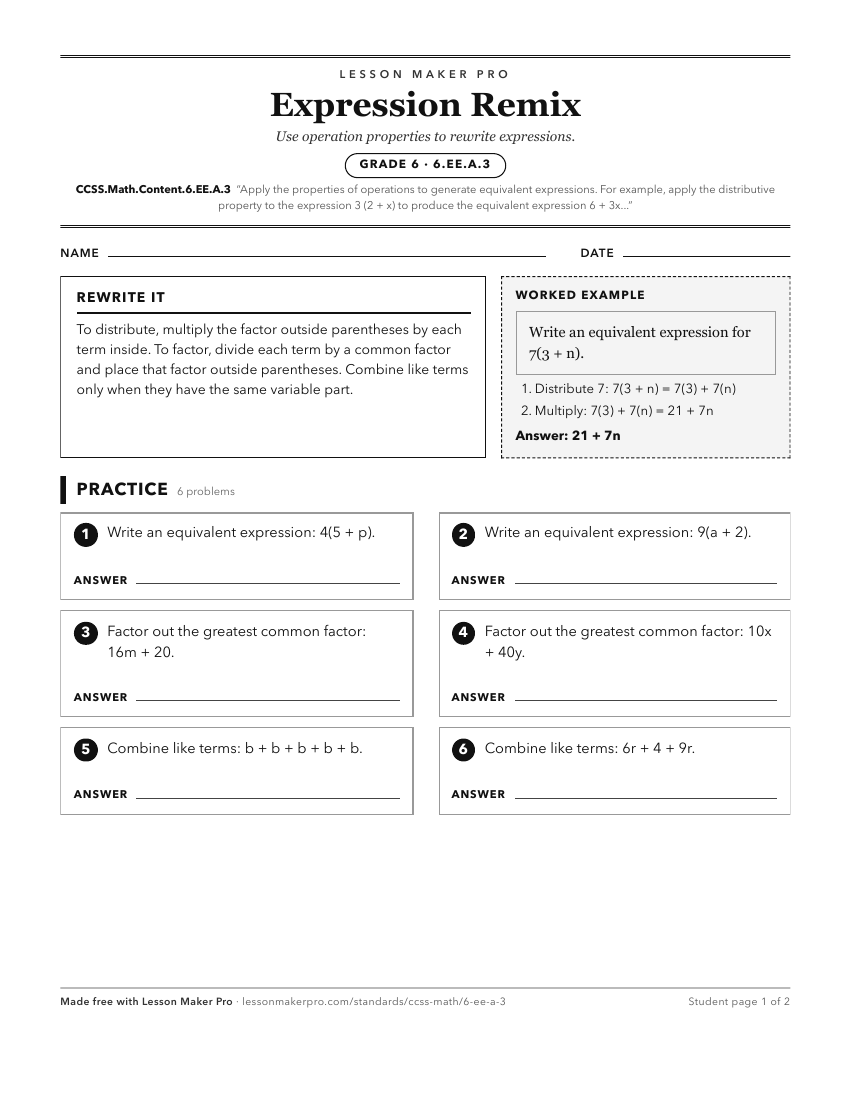
A ready-to-print activity worksheet aligned to CCSS.Math.Content.6.EE.A.3, with an answer key for the teacher on its own page. No account needed.
PDF, US Letter, prints cleanly in black and white.
Download the worksheetLearning progression
Where This Standard Sits
See the whole path on the Expressions & Equations progression map.
Before This Standard
If students are struggling here, check these first.
- CCSS.Math.Content.5.OA.A.2
Reading and writing calculation expressions prepares students to see expression structure before rewriting expressions with operation properties.
- CCSS.Math.Content.6.EE.A.2
Students must read and write variable expressions before using operation properties to rewrite them as equivalent forms.
- CCSS.Math.Content.5.OA.A.1
Reading and evaluating grouped numerical expressions supports seeing how parentheses affect equivalent forms, especially when using the distributive property.
What This Unlocks
Mastery here sets students up for these next.
- CCSS.Math.Content.7.EE.A.1
Students must use distributive, associative, and commutative properties to rewrite expressions before extending them to rational linear expressions.
- CCSS.Math.Content.7.EE.A.2
Students must use operation properties to create equivalent expressions before choosing forms that reveal relationships in a context.
- CCSS.Math.Content.6.EE.A.4
Using operation properties to rewrite expressions is needed to justify that two forms match for every possible value.
- CCSS.Math.Content.8.EE.A.1
Using operation properties to rewrite expressions supports seeing exponent rules as valid ways to create equivalent numerical expressions.
- CCSS.Math.Content.7.NS.A.1d
Using commutative, associative, and distributive properties with expressions supports choosing efficient strategies for rational number addition and subtraction.
- CCSS.Math.Content.7.NS.A.2a
Using distributive and other operation properties to rewrite expressions supports explaining why signed-number multiplication rules must work.
Keep exploring
Related Standards
Turn this exact standard into a lesson
Grade, subject, topic, and the complete standard are prefilled. Create one free, no account needed.
Also for this standard:Make a WorksheetMake a QuizMake a Sub Lesson