CCSS.
The Standard
Identify when two expressions are equivalent (i.e., when the two expressions name the same number regardless of which value is substituted into them).
Common Core State Standards for Mathematics · Expressions and Equations
Teacher's field guide
What This Standard Means
What Students Need to Do
- Students decide whether two algebraic expressions have the same value for every possible value of the variable. They use operation properties, repeated addition, or substitution to support their decisions.
What Mastery Looks Like
- Students can rewrite expressions using properties of operations and explain why the new expression has the same value. They can also use substitutions to disprove a false equivalence.
Common Misconceptions
- Students may think expressions are equivalent if they match for one tested value. They may also combine unlike terms, such as rewriting 3x + 2 as 5x, or confuse 3x with x + 3.
How to Assess It
- Give the pairs 4x + 2x and 6x, then 4x + 2 and 6x. Ask students to identify the equivalent pair and justify both decisions.
Lesson moves
Ways to Teach It
Give pairs of expression cards and algebra tiles, then have students build each expression and sort the pairs into equivalent or not equivalent.
Ask students to explain why 5a and a + a + a + a + a always match, without choosing a specific value.
Play Expression Match by having students pair cards such as 2(x + 3), 2x + 6, and x + x + 6.
Compare two phone plans written as expressions, then decide whether they always charge the same amount for any number of minutes.
Free download
Printable 6.EE.A.4 Worksheet
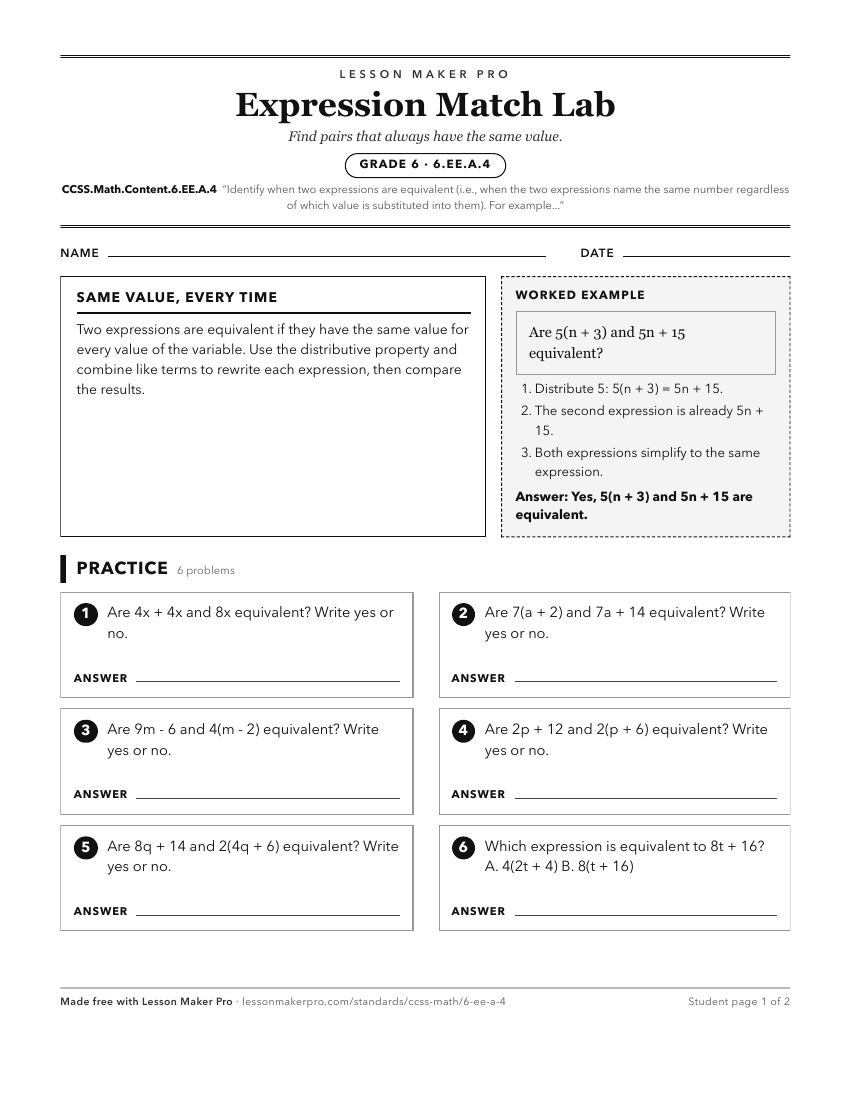
A ready-to-print activity worksheet aligned to CCSS.Math.Content.6.EE.A.4, with an answer key for the teacher on its own page. No account needed.
PDF, US Letter, prints cleanly in black and white.
Download the worksheetLearning progression
Where This Standard Sits
See the whole path on the Expressions & Equations progression map.
Before This Standard
If students are struggling here, check these first.
- CCSS.Math.Content.6.EE.A.2
Students must read variables and substitute values in expressions to test whether two expressions always produce the same number.
- CCSS.Math.Content.6.EE.A.3
Using operation properties to rewrite expressions is needed to justify that two forms match for every possible value.
- CCSS.Math.Content.6.EE.A.2c
Students must substitute values and compute each expression correctly before judging whether two expressions always give the same result.
What This Unlocks
Mastery here sets students up for these next.
- CCSS.Math.Content.7.EE.A.2
Students must know rewritten expressions keep the same value before interpreting how each equivalent form shows different relationships.
- CCSS.Math.Content.8.EE.A.1
Recognizing that different forms can name the same value supports using exponent rules to rewrite numerical expressions equivalently.
- CCSS.Math.Content.8.G.B.6
Recognizing equivalent expressions helps students follow area equations and algebraic rearrangements used in many Pythagorean Theorem proofs.
Keep exploring
Related Standards
- CCSS.Math.Content.3.NF.A.3a
Understand two fractions as equivalent (equal) if they are the same size, or the same point on a number line.
- CCSS.Math.Content.HSA-SSE.B.3
Choose and produce an equivalent form of an expression to reveal and explain properties of the quantity represented by the expression.
- CCSS.Math.Content.7.EE.A
Use properties of operations to generate equivalent expressions.
Turn this exact standard into a lesson
Grade, subject, topic, and the complete standard are prefilled. Create one free, no account needed.
Also for this standard:Make a WorksheetMake a QuizMake a Sub Lesson