CCSS.
The Standard
Understand that rewriting an expression in different forms in a problem context can shed light on the problem and how the quantities in it are related.
Common Core State Standards for Mathematics · Expressions and Equations
Teacher's field guide
What This Standard Means
What Students Need to Do
- Students rewrite an expression into an equivalent form. They use the new form to explain relationships such as percent increase, discount, repeated groups, or total cost.
What Mastery Looks Like
- Students correctly rewrite expressions using distribution, factoring, and combining like terms. They explain how a new form reveals a percent change, total cost, group size, or other relationship in the problem.
Common Misconceptions
- Students may rewrite a 5% increase as multiplying by 0.05 instead of 1.05. They may combine unlike terms or distribute incorrectly. Some think different-looking expressions cannot represent the same quantity.
How to Assess It
- Give this exit ticket: A gym fee of g dollars increases by 8%, so the new fee is g + 0.08g. Rewrite the expression and explain what the new form shows.
Lesson moves
Ways to Teach It
Build 3(x + 2) with algebra tiles, rearrange the tiles to show 3x + 6, and label both models.
Ask students to explain why p − 0.15p and 0.85p both represent a 15% discount.
Play a card match game pairing original expressions, equivalent forms, and short contexts that fit both forms.
Use a restaurant receipt to compare meal cost plus 20% tip with multiplying the meal cost by 1.20.
Free download
Printable 7.EE.A.2 Worksheet
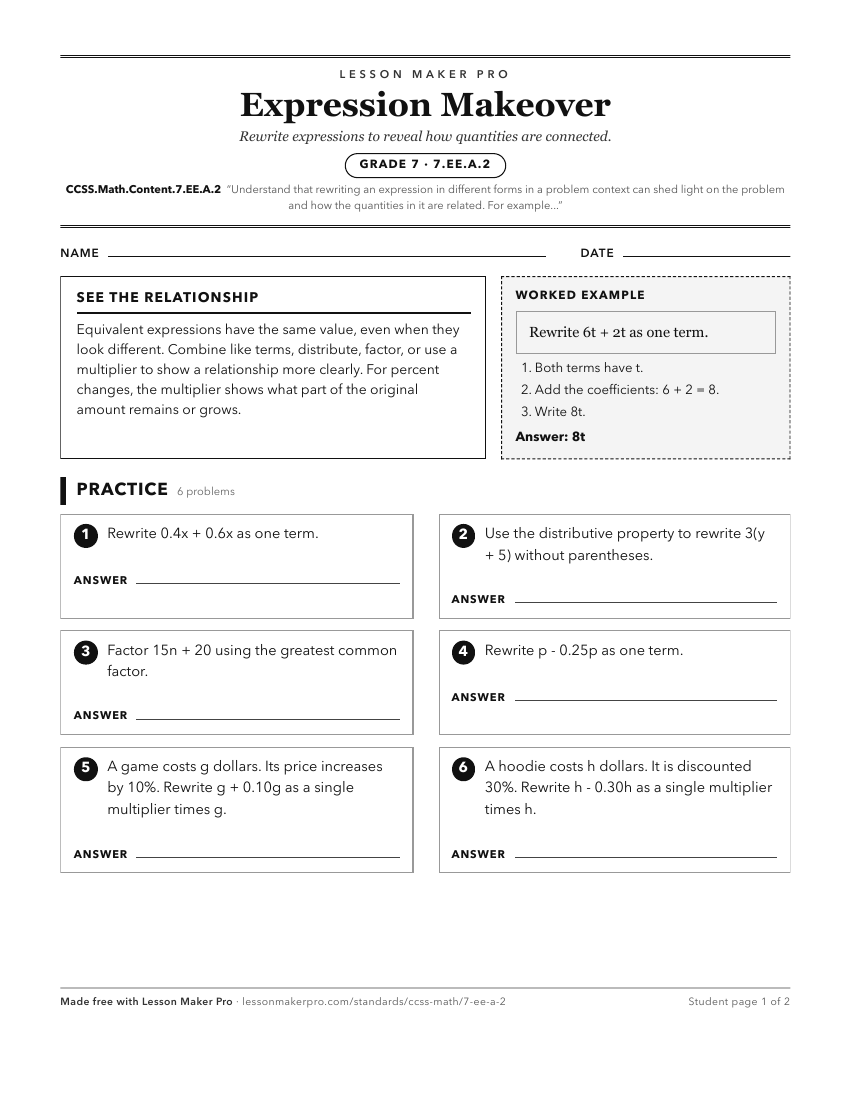
A ready-to-print activity worksheet aligned to CCSS.Math.Content.7.EE.A.2, with an answer key for the teacher on its own page. No account needed.
PDF, US Letter, prints cleanly in black and white.
Download the worksheetLearning progression
Where This Standard Sits
See the whole path on the Expressions & Equations progression map.
Before This Standard
If students are struggling here, check these first.
- CCSS.Math.Content.6.EE.A.4
Students must know rewritten expressions keep the same value before interpreting how each equivalent form shows different relationships.
- CCSS.Math.Content.7.EE.A.1
Using properties to expand, factor, and combine expressions supports interpreting how equivalent forms show different relationships in context.
- CCSS.Math.Content.6.EE.A.3
Students must use operation properties to create equivalent expressions before choosing forms that reveal relationships in a context.
What This Unlocks
Mastery here sets students up for these next.
- CCSS.Math.Content.HSA-SSE.A.1
Seeing how equivalent forms reveal relationships supports interpreting terms, factors, and coefficients of contextual expressions.
- CCSS.Math.Content.HSA-SSE.B.3
Students extend seeing equivalent forms reveal relationships to selecting factored, expanded, or transformed forms that show features of algebraic quantities.
- CCSS.Math.Content.HSA-SSE.A.1a
Rewriting contextual expressions helps students see how terms, factors, and coefficients represent quantities and relationships in later expressions.
- CCSS.Math.Content.HSA-SSE.A.1b
Rewriting expressions to reveal relationships supports seeing subexpressions as meaningful chunks within more complicated algebraic expressions.
Keep exploring
Related Standards
- CCSS.Math.Content.HSA-SSE.A.2
Use the structure of an expression to identify ways to rewrite it.
- CCSS.Math.Content.HSA-SSE.B
Write expressions in equivalent forms to solve problems
- CCSS.Math.Content.HSF-IF.C.8
Write a function defined by an expression in different but equivalent forms to reveal and explain different properties of the function.
Turn this exact standard into a lesson
Grade, subject, topic, and the complete standard are prefilled. Create one free, no account needed.
Also for this standard:Make a WorksheetMake a QuizMake a Sub Lesson