CCSS.
Standard Cluster
- CCSS.Math.Content.HSF-IF.C
- Analyze functions using different representations
Write a function defined by an expression in different but equivalent forms to reveal and explain different properties of the function.
Common Core State Standards for Mathematics
Cluster contents
Standards in This Cluster
CCSS.Math.Content.HSF-IF.C.8 is a cluster heading. These are the individual standards under it.
- CCSS.Math.Content.HSF-IF.C.8a
Use the process of factoring and completing the square in a quadratic function to show zeros, extreme values, and symmetry of the graph, and interpret these in ...
- CCSS.Math.Content.HSF-IF.C.8b
Use the properties of exponents to interpret expressions for exponential functions.
Teacher's field guide
What This Cluster Means
What Students Need to Do
- Students rewrite quadratic expressions by factoring or completing the square. They also rewrite exponential expressions using exponent rules, then choose forms that clearly show zeros, vertices, symmetry, or growth rates.
What Mastery Looks Like
- Students move correctly among standard, factored, and vertex forms of a quadratic. They use each form to identify properties and verify equivalence by expanding or applying exponent rules.
Common Misconceptions
- Students may change the function while factoring, completing the square, or applying exponent rules. They often confuse zeros with the vertex or misread 1.06 as 6 rather than 6 percent growth. Some assume expressions that look different cannot represent the same function.
How to Assess It
- Exit ticket: Let f(x) = x² - 6x + 5. Rewrite it in factored and vertex form, then state the zeros, axis of symmetry, and minimum value.
Adopted as
This framework is adopted as written in Connecticut, Delaware, District of Columbia, Illinois, Michigan, Nevada, New Hampshire, New Mexico, Vermont.
- California: F_IF_8
- Connecticut: CCSS.Math.Content.HSF-IF.C.8
- Delaware: CCSS.Math.Content.HSF-IF.C.8
- District of Columbia: CCSS.Math.Content.HSF-IF.C.8
- Maryland: F_IF_C_8
- Michigan: CCSS.Math.Content.HSF-IF.C.8
- Mississippi: F-IF_8
- Nevada: CCSS.Math.Content.HSF-IF.C.8
- New Hampshire: CCSS.Math.Content.HSF-IF.C.8
- New Mexico: CCSS.Math.Content.HSF-IF.C.8
- Vermont: CCSS.Math.Content.HSF-IF.C.8
- Washington: CCSS.Math.Content.HSF-IF.C.8
Lesson moves
Ways to Teach It
Use algebra tiles to rearrange x² + 6x + 5 into a rectangle, then connect its side lengths to (x + 1)(x + 5).
Ask which form of x² - 6x + 5 shows the zeros or minimum fastest, and have students defend each choice.
Play a matching game with cards showing equivalent expressions, graphs, zeros, vertices, and growth rates, with students explaining every match.
Give A(t) = 500(1.06)^t; students rewrite it with a monthly factor and explain what each factor means.
Free download
Printable HSF-IF.C.8 Worksheet
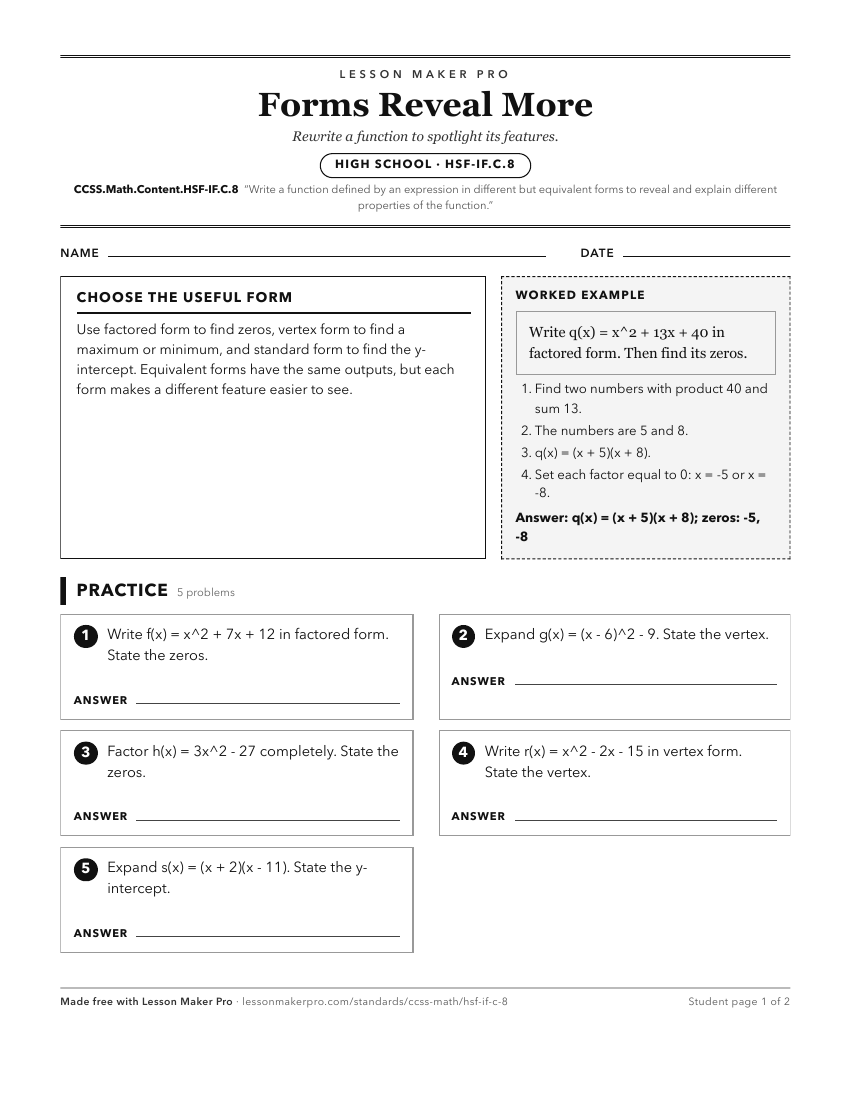
A ready-to-print activity worksheet aligned to CCSS.Math.Content.HSF-IF.C.8, with an answer key for the teacher on its own page. No account needed.
PDF, US Letter, prints cleanly in black and white.
Download the worksheetLearning progression
Where This Standard Sits
Before This Standard
If students are struggling here, check these first.
- CCSS.Math.Content.HSA-SSE.A.2
Recognizing expression structure supports rewriting function formulas into equivalent forms that reveal zeros, growth, or other features.
- CCSS.Math.Content.HSA-SSE.B.3
Rewriting expressions to reveal features is the algebra skill needed to rewrite function formulas and interpret their properties.
- CCSS.Math.Content.HSF-IF.A.2
Function notation and input-output meaning help students connect equivalent formulas to the same function and interpret the properties each form reveals.
Keep exploring
Related Standards
- CCSS.Math.Content.HSA-SSE.B
Write expressions in equivalent forms to solve problems
- CCSS.Math.Content.8.F.A.2
Compare properties of two functions each represented in a different way (algebraically, graphically, numerically in tables, or by verbal descriptions).
- CCSS.Math.Content.HSF-IF.C.9
Compare properties of two functions each represented in a different way (algebraically, graphically, numerically in tables, or by verbal descriptions).
Turn this cluster into a lesson
Grade, subject, topic, and the complete cluster are prefilled. Create one free, no account needed.
Also for this cluster:Make a WorksheetMake a QuizMake a Sub Lesson