CCSS.
The Standard
Use the structure of an expression to identify ways to rewrite it.
Common Core State Standards for Mathematics
Teacher's field guide
What This Standard Means
What Students Need to Do
- Students look for familiar patterns within longer expressions. They treat parts of an expression as single quantities, then rewrite or factor while keeping the value unchanged.
What Mastery Looks Like
- Students spot familiar patterns inside complex expressions, including repeated factors and differences of squares. They choose a useful rewrite and confirm it by expanding or substituting values.
Common Misconceptions
- Students often treat each term separately and miss that a whole expression can act as one quantity. They may lose negative signs, stop factoring too soon, or create a rewrite that is not equivalent.
How to Assess It
- Give this exit ticket: “Factor x^4 - 16 completely, then name the pattern you used at each step.”
Lesson moves
Ways to Teach It
Give groups expression and rewrite cards to match, then have them circle the repeated chunks that make each match work.
Ask students to explain why treating x² as one quantity helps factor x⁴ - 81.
Play a factoring relay where teams earn a point only after expanding their answer to verify the original expression.
Compare the areas of square garden plots with side lengths x² and y², then rewrite the difference in their areas.
Free download
Printable HSA-SSE.A.2 Worksheet
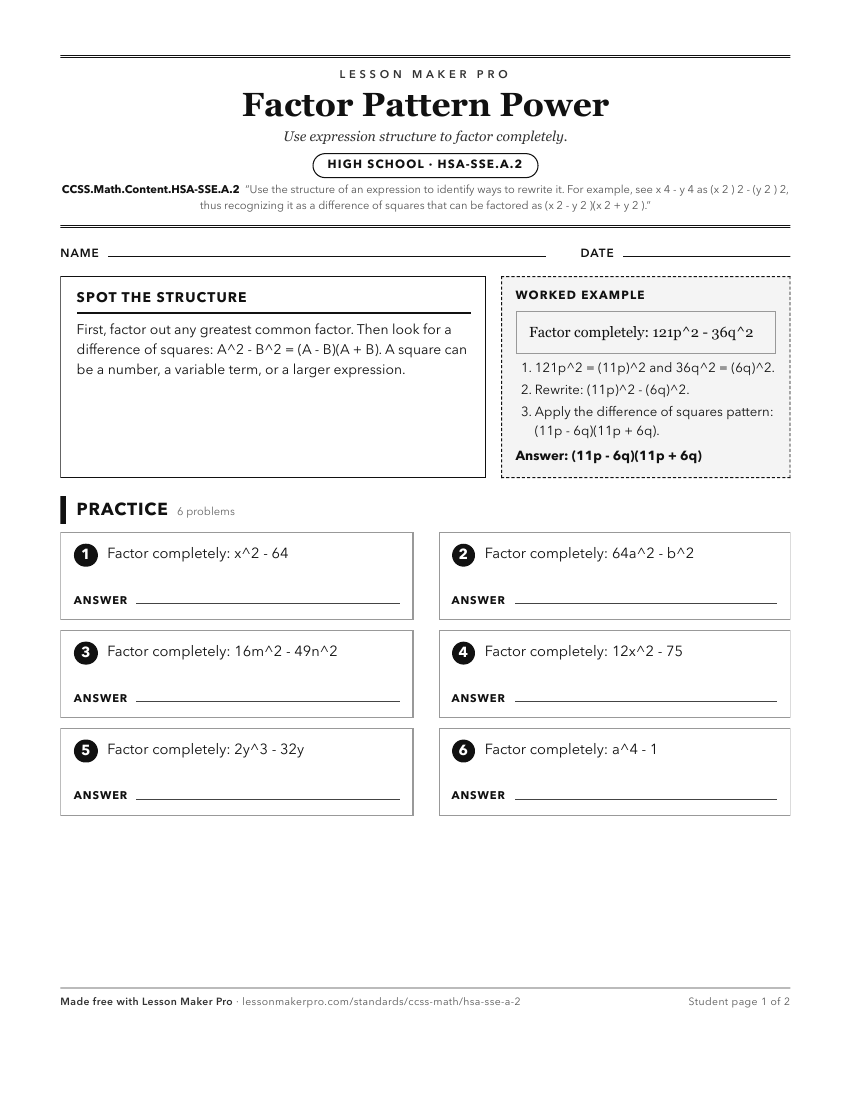
A ready-to-print activity worksheet aligned to CCSS.Math.Content.HSA-SSE.A.2, with an answer key for the teacher on its own page. No account needed.
PDF, US Letter, prints cleanly in black and white.
Download the worksheetLearning progression
Where This Standard Sits
Before This Standard
If students are struggling here, check these first.
- CCSS.Math.Content.7.EE.A.1
Factoring and expanding linear expressions prepare students to see terms, factors, and equivalent rewrites in more complex expressions.
- CCSS.Math.Content.HSA-SSE.A.1a
Recognizing terms, factors, and coefficients is needed to see expression structure and choose useful rewrites like factoring or grouping.
- CCSS.Math.Content.HSA-SSE.A.1b
Seeing parts of expressions as single units helps students spot patterns like squares or common factors for rewriting.
What This Unlocks
Mastery here sets students up for these next.
- CCSS.Math.Content.HSA-APR.B.3
Seeing polynomial structure supports factoring and reading factors as zeros, which then informs the rough graph.
- CCSS.Math.Content.HSA-APR.C.4
Recognizing expression structure helps students rewrite and transform polynomials when proving that two forms are identically equal.
- CCSS.Math.Content.HSA-SSE.B.3c
Recognizing expression structure supports choosing exponent rules and equivalent forms when transforming exponential expressions.
- CCSS.Math.Content.HSA-REI.B.4
Recognizing expression structure supports factoring, completing the square, and choosing efficient forms when solving quadratic equations.
- CCSS.Math.Content.HSA-REI.B.4a
Recognizing quadratic structure supports rewriting ax²+bx+c as a perfect-square expression when completing the square.
- CCSS.Math.Content.HSA-SSE.B.3
Students must recognize expression structure to select and create forms that reveal zeros, growth, or other properties.
Keep exploring
Related Standards
- CCSS.Math.Content.HSA-SSE.A
Interpret the structure of expressions
- CCSS.Math.Content.7.EE.A.2
Understand that rewriting an expression in different forms in a problem context can shed light on the problem and how the quantities in it are related.
- CCSS.Math.Content.HSA-SSE.B
Write expressions in equivalent forms to solve problems
- CCSS.Math.Content.HSF-IF.C.8
Write a function defined by an expression in different but equivalent forms to reveal and explain different properties of the function.
Turn this exact standard into a lesson
Grade, subject, topic, and the complete standard are prefilled. Create one free, no account needed.
Also for this standard:Make a WorksheetMake a QuizMake a Sub Lesson