CCSS.
The Standard
Use function notation, evaluate functions for inputs in their domains, and interpret statements that use function notation in terms of a context.
Common Core State Standards for Mathematics
Teacher's field guide
What This Standard Means
What Students Need to Do
- Students read expressions such as f(3) as the output when the input is 3. They substitute valid inputs, calculate outputs, and explain each value in the given situation.
What Mastery Looks Like
- A student correctly evaluates functions from formulas, tables, and graphs. The student identifies inputs outside the stated domain and describes f(a) using quantities and units from the context.
Common Misconceptions
- Students may treat f(x) as multiplication, confuse an input with its output, or substitute into only part of an expression. They may ignore domain restrictions or give an answer without explaining its meaning or units.
How to Assess It
- Exit ticket: A taxi ride costs C(m) = 3 + 2m dollars for 0 ≤ m ≤ 20. Find C(4), explain its meaning, and decide whether C(25) is defined.
Lesson moves
Ways to Teach It
Give pairs input cards and function-rule cards, then have students calculate and match each input to its output.
Ask students to write what P(6) means when P(t) represents a plant's height in centimeters after t weeks.
Play function notation bingo, calling formulas and inputs while students cover the matching outputs on their boards.
Display a phone battery graph labeled B(t), then have students interpret B(2), B(5), and the allowed time values.
Free download
Printable HSF-IF.A.2 Worksheet
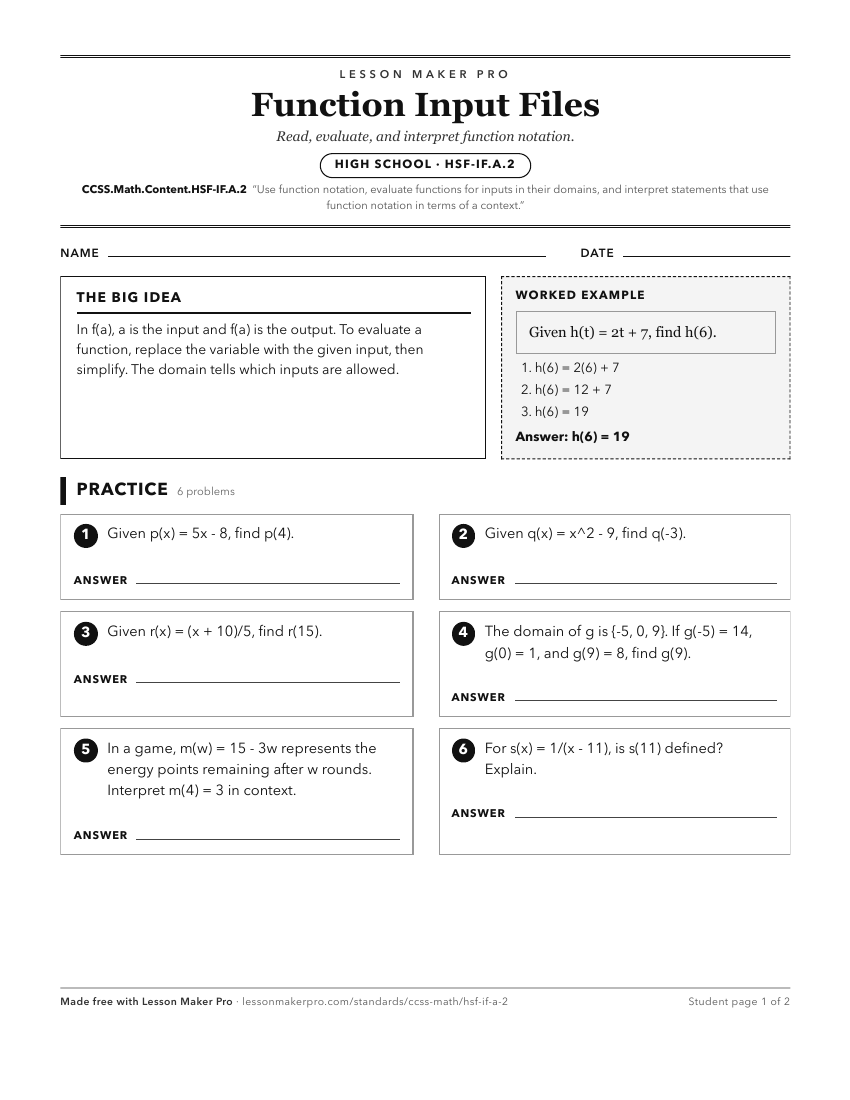
A ready-to-print activity worksheet aligned to CCSS.Math.Content.HSF-IF.A.2, with an answer key for the teacher on its own page. No account needed.
PDF, US Letter, prints cleanly in black and white.
Download the worksheetLearning progression
Where This Standard Sits
Before This Standard
If students are struggling here, check these first.
- CCSS.Math.Content.HSF-IF.A.1
Students need the meaning of f(x), input, output, and domain before evaluating functions and interpreting notation in context.
- CCSS.Math.Content.8.F.A.1
Function notation depends on seeing each input as having one output, then naming and evaluating that output in context.
- CCSS.Math.Content.8.F.A.3
Recognizing equations like y=mx+b as functions supports seeing f(x) as an input-output rule to evaluate and interpret.
What This Unlocks
Mastery here sets students up for these next.
- CCSS.Math.Content.HSF-BF.B.4a
Inverse work depends on understanding f(x) as an output for an input and interpreting equations like f(x)=c.
- CCSS.Math.Content.HSF-BF.B.4c
Understanding function inputs and outputs in notation supports reading inverse values by reversing which quantity is treated as input.
- CCSS.Math.Content.HSF-BF.A.1c
Composing functions requires using notation like f(g(x)) and treating one function’s output as another function’s input.
- CCSS.Math.Content.HSF-BF.B.3
Students must understand f(x) as output for an input before interpreting f(x)+k, f(kx), and f(x+k) transformations.
- CCSS.Math.Content.HSF-BF.A.1b
Students use function notation and evaluation to define and interpret sums, differences, products, or quotients of functions.
- CCSS.Math.Content.HSF-BF.B.4b
Verifying inverses by composition requires reading function notation and evaluating one function at another function’s output.
Keep exploring
Related Standards
- CCSS.Math.Content.HSF-LE.B
Interpret expressions for functions in terms of the situation they model
- CCSS.Math.Content.HSF-IF.B
Interpret functions that arise in applications in terms of the context
- CCSS.Math.Content.8.F.A
Define, evaluate, and compare functions.
- CCSS.Math.Content.HSF-IF.A
Understand the concept of a function and use function notation
Turn this exact standard into a lesson
Grade, subject, topic, and the complete standard are prefilled. Create one free, no account needed.
Also for this standard:Make a WorksheetMake a QuizMake a Sub Lesson