CCSS.
Standard Cluster
Interpret functions that arise in applications in terms of the context
Common Core State Standards for Mathematics · High School — Functions
Cluster contents
Standards in This Cluster
CCSS.Math.Content.HSF-IF.B is a cluster heading. These are the individual standards under it.
- CCSS.Math.Content.HSF-IF.B.4
For a function that models a relationship between two quantities, interpret key features of graphs and tables in terms of the quantities, and sketch graphs show...
- CCSS.Math.Content.HSF-IF.B.5
Relate the domain of a function to its graph and, where applicable, to the quantitative relationship it describes.
- CCSS.Math.Content.HSF-IF.B.6
Calculate and interpret the average rate of change of a function (presented symbolically or as a table) over a specified interval. Estimate the rate of change f...
Teacher's field guide
What This Cluster Means
What Students Need to Do
- Students connect features of a function to what is happening in a real situation. They explain inputs, outputs, intercepts, rates, intervals, and extreme values with suitable units and limits.
What Mastery Looks Like
- Students identify intercepts, maxima, minima, rates of change, and increasing or decreasing intervals from graphs, tables, or formulas. They explain each feature with correct units and choose a sensible domain for the situation.
Common Misconceptions
- Students may treat an intercept, maximum, or interval as a point with no real meaning. They often confuse input and output units or include input values that do not make sense. They may also call any upward graph segment a positive value rather than an increasing interval.
How to Assess It
- Give students a graph of water depth over time. Ask them to identify and explain one intercept, one increasing interval, and the maximum using units and context.
Lesson moves
Ways to Teach It
Have groups fill and drain a clear container, record water depth each minute, graph the data, and label key features.
Show a graph of ticket sales over time and ask, “What does each turning point tell the event manager?”
Play a matching game where students pair graph cards with context cards describing intercepts, intervals, extrema, and rates of change.
Compare two phone plans using tables and graphs, then have students explain when each plan costs less and why.
Free download
Printable HSF-IF.B Worksheet
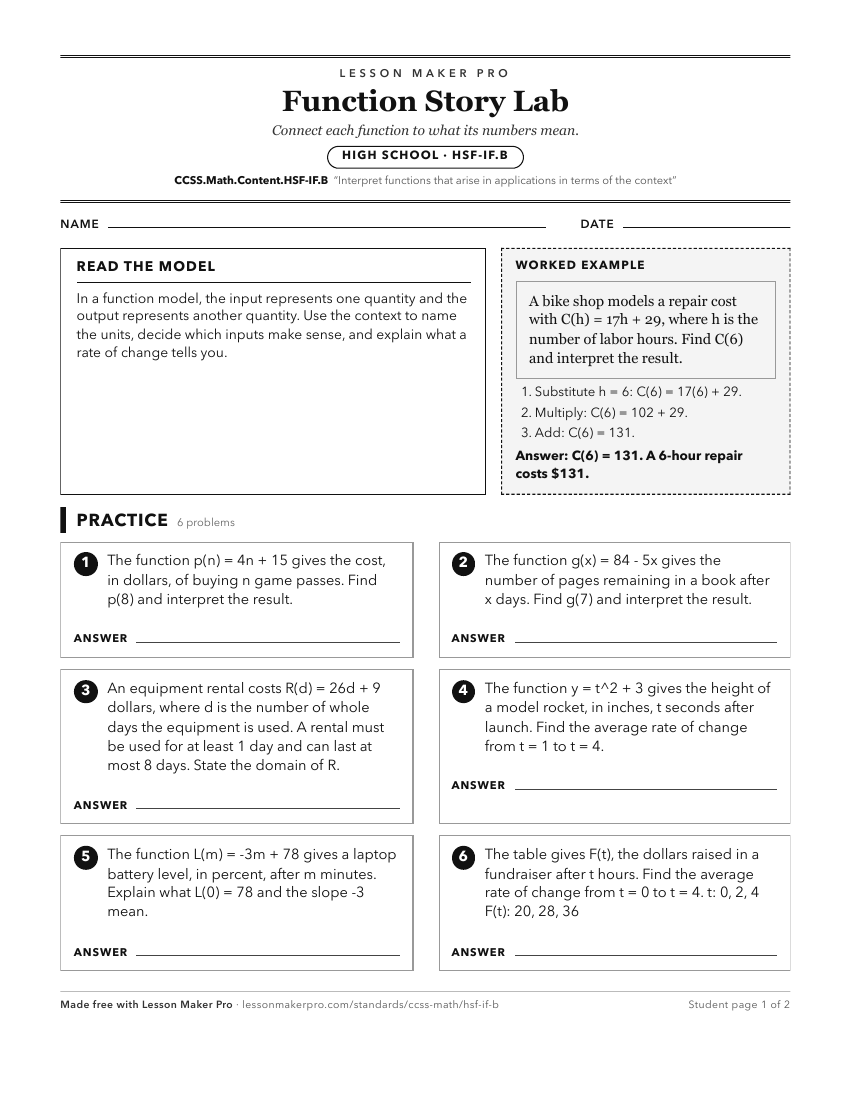
A ready-to-print activity worksheet aligned to CCSS.Math.Content.HSF-IF.B, with an answer key for the teacher on its own page. No account needed.
PDF, US Letter, prints cleanly in black and white.
Download the worksheetKeep exploring
Related Standards
- CCSS.Math.Content.HSF-LE.B
Interpret expressions for functions in terms of the situation they model
- CCSS.Math.Content.HSA-SSE.A.1
Interpret expressions that represent a quantity in terms of its context
- CCSS.Math.Content.HSF-IF.A.2
Use function notation, evaluate functions for inputs in their domains, and interpret statements that use function notation in terms of a context.
- CCSS.Math.Content.HSF-LE.B.5
Interpret the parameters in a linear or exponential function in terms of a context.
Turn this cluster into a lesson
Grade, subject, topic, and the complete cluster are prefilled. Create one free, no account needed.
Also for this cluster:Make a WorksheetMake a QuizMake a Sub Lesson