CCSS.
The Standard
Write and evaluate numerical expressions involving whole-number exponents.
Common Core State Standards for Mathematics · Expressions and Equations
Teacher's field guide
What This Standard Means
What Students Need to Do
- Students interpret a power as repeated multiplication and write powers from repeated factors. They evaluate numerical expressions with exponents using the correct order of operations.
What Mastery Looks Like
- A student can explain that 4³ means 4 × 4 × 4, not 4 × 3. The student accurately evaluates expressions such as 2⁴ + 3 × 5 and shows each step.
Common Misconceptions
- Students often read 5³ as 5 × 3 instead of 5 × 5 × 5. They may multiply the base by itself the wrong number of times or evaluate addition before exponents.
How to Assess It
- Exit ticket: Write 5 × 5 × 5 as a power, then evaluate 3 + 2⁴ × 2 and show your steps.
Lesson moves
Ways to Teach It
Use tiles and cubes to model 3² and 2³, then label each model with its repeated multiplication and value.
Ask, “Why is 5³ not equal to 5 × 3?” Students write an explanation and compare examples with a partner.
Play exponent match: students pair cards showing a power, its repeated multiplication, and its value, then check each completed set.
Have students compare bacteria counts that double hourly by calculating 2¹ through 2⁶ and describing what each exponent represents.
Free download
Printable 6.EE.A.1 Worksheet
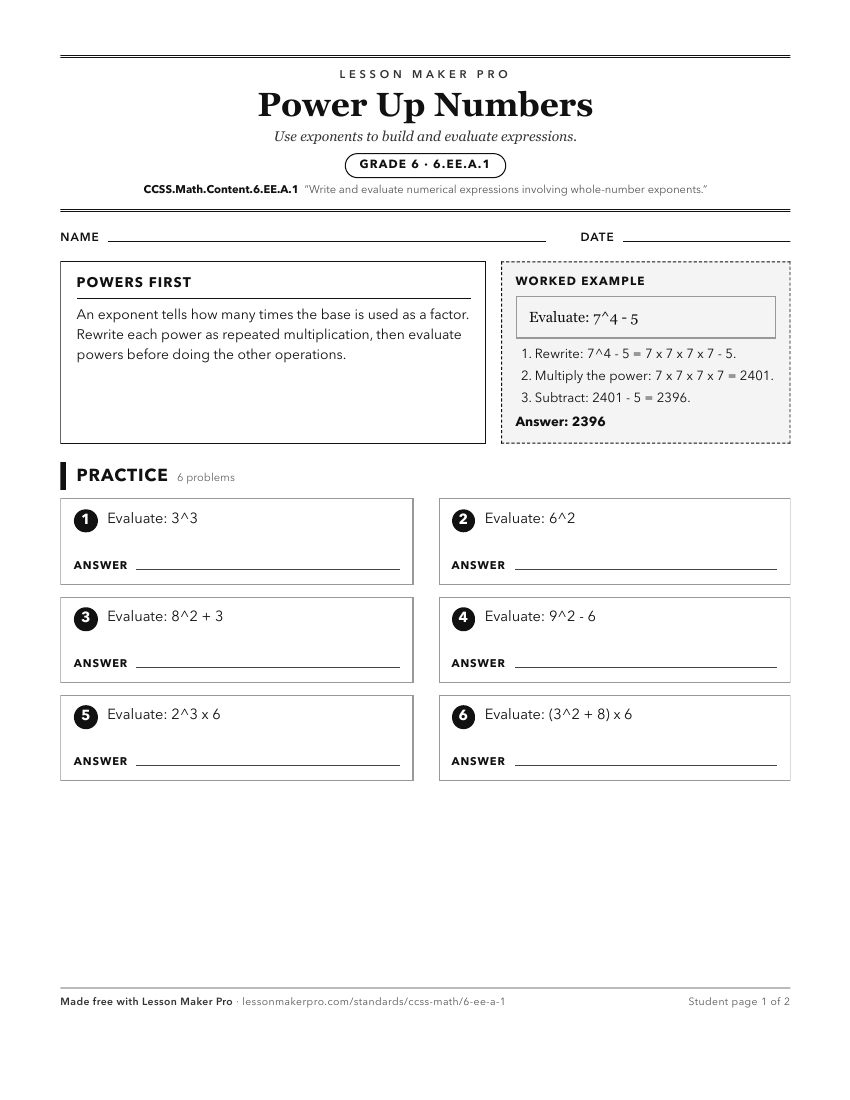
A ready-to-print activity worksheet aligned to CCSS.Math.Content.6.EE.A.1, with an answer key for the teacher on its own page. No account needed.
PDF, US Letter, prints cleanly in black and white.
Download the worksheetLearning progression
Where This Standard Sits
See the whole path on the Expressions & Equations progression map.
Before This Standard
If students are struggling here, check these first.
- CCSS.Math.Content.5.OA.A.2
Interpreting and writing numerical expressions supports adding exponent notation and evaluating it within the correct order of operations.
- CCSS.Math.Content.5.OA.A.1
Understanding grouping symbols supports evaluating exponent expressions within larger numerical expressions and following the intended order of operations.
- CCSS.Math.Content.5.NBT.B.5
Evaluating powers uses repeated multiplication, so fluency with whole-number products helps students compute exponent expressions accurately.
What This Unlocks
Mastery here sets students up for these next.
- CCSS.Math.Content.8.EE.A.3
Understanding exponent notation and evaluating powers carries over to interpreting powers of 10 in scientific notation.
- CCSS.Math.Content.8.EE.A.2
Students must understand squares and cubes as exponents before interpreting square and cube roots as their inverse operations.
- CCSS.Math.Content.8.EE.A.1
Understanding and evaluating whole-number powers supports applying exponent rules and extending them to zero and negative exponents.
- CCSS.Math.Content.8.G.B.6
Understanding square notation and evaluating squared lengths helps students follow algebraic statements in Pythagorean Theorem proofs.
- CCSS.Math.Content.6.EE.A.2c
Understanding whole-number exponents supports evaluating variable expressions that include powers and applying order of operations correctly.
Keep exploring
Related Standards
Turn this exact standard into a lesson
Grade, subject, topic, and the complete standard are prefilled. Create one free, no account needed.
Also for this standard:Make a WorksheetMake a QuizMake a Sub Lesson