CCSS.
The Standard
Use the properties of exponents to transform expressions for exponential functions.
Common Core State Standards for Mathematics · Write expressions in equivalent forms to solve problems
Teacher's field guide
What This Standard Means
What Students Need to Do
- Students rewrite exponential expressions by splitting or combining exponents. They change a growth factor tied to one time unit into an equivalent factor for another unit. They interpret the new factor as a rate per month, day, or other interval.
What Mastery Looks Like
- Given P = 500(1.18)^t, students can rewrite it as P = 500(1.18^(1/12))^(12t). They approximate the new factor accurately and explain that subtracting 1 gives the monthly percent rate.
Common Misconceptions
- Students often divide the annual percent rate by 12 instead of taking the twelfth root of the growth factor. They may divide the exponent by 12, confuse the rate with the growth factor, or round too early.
How to Assess It
- Exit ticket: Rewrite A = 800(1.24)^t in an equivalent monthly form, approximate the monthly rate, and explain what 12t counts. Look for A ≈ 800(1.0181)^(12t), a monthly rate near 1.81%, and months counted by 12t.
Lesson moves
Ways to Teach It
Give students cards showing bases, exponents, and equivalent forms, then have pairs build and verify matches with calculators.
Ask students to write why dividing an annual rate by 12 is not exactly equivalent to taking a twelfth root.
Run a matching race where teams pair annual, monthly, and daily exponential models that produce the same value after one year.
Compare two savings accounts by converting their advertised annual growth factors into monthly factors and checking one year of balances.
Free download
Printable HSA-SSE.B.3c Worksheet
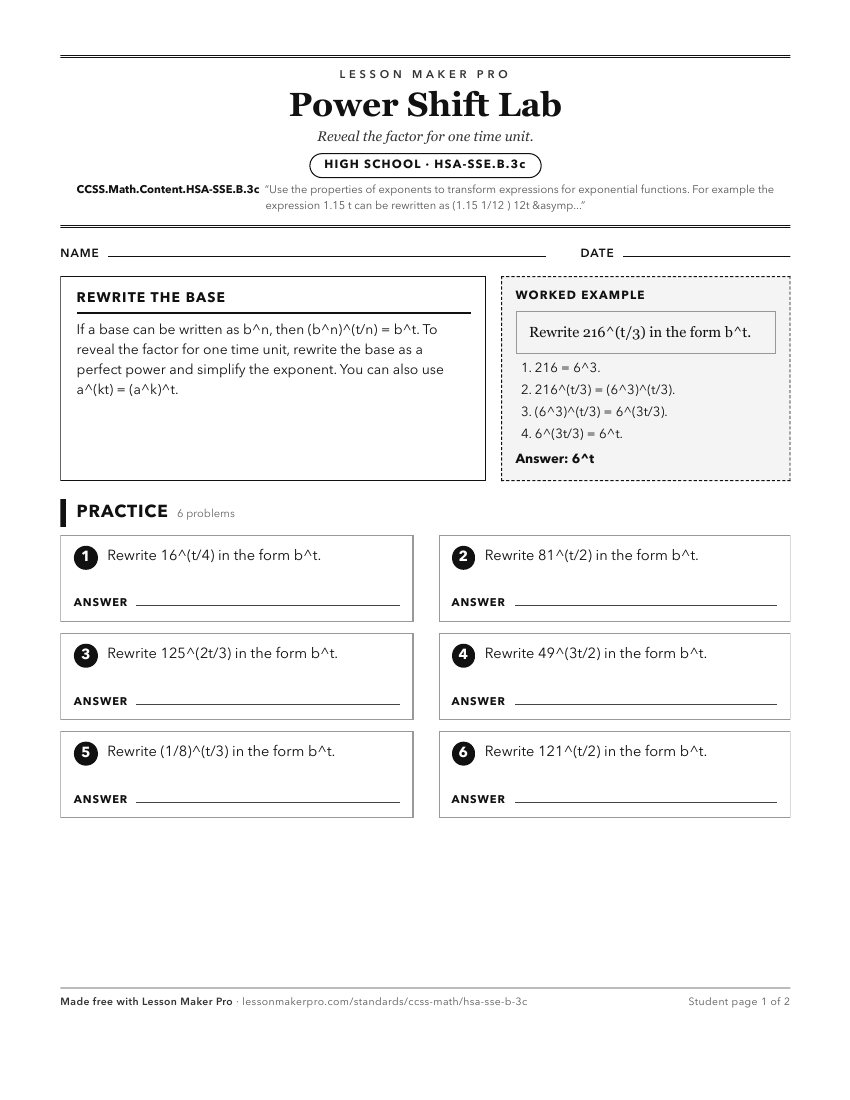
A ready-to-print activity worksheet aligned to CCSS.Math.Content.HSA-SSE.B.3c, with an answer key for the teacher on its own page. No account needed.
PDF, US Letter, prints cleanly in black and white.
Download the worksheetLearning progression
Where This Standard Sits
Before This Standard
If students are struggling here, check these first.
- CCSS.Math.Content.HSA-SSE.A.2
Recognizing expression structure supports choosing exponent rules and equivalent forms when transforming exponential expressions.
- CCSS.Math.Content.8.EE.A.1
Transforming exponential function forms requires fluently using exponent rules first practiced with numerical expressions and integer exponents.
- CCSS.Math.Content.HSF-IF.C.8b
Interpreting exponential forms with exponent rules supports rewriting them to reveal equivalent growth rates or time-unit changes.
What This Unlocks
Mastery here sets students up for these next.
- CCSS.Math.Content.HSA-SSE.B.4
Manipulating powers of the common ratio helps combine and simplify terms when deriving and applying the geometric series formula.
- CCSS.Math.Content.HSF-BF.B.5
Fluency with exponent rules supports rewriting exponential equations and interpreting logarithms as the inverse operation.
- CCSS.Math.Content.HSF-LE.A.4
Rewriting exponential expressions supports isolating and interpreting b^(ct) before using logarithms to solve for the exponent.
- CCSS.Math.Content.HSF-LE.A.1a
Rewriting b^(x+h) as b^x times b^h is what proves exponential functions have equal factors over equal intervals.
Keep exploring
Related Standards
Turn this exact standard into a lesson
Grade, subject, topic, and the complete standard are prefilled. Create one free, no account needed.
Also for this standard:Make a WorksheetMake a QuizMake a Sub Lesson