CCSS.
The Standard
(+) Understand the inverse relationship between exponents and logarithms and use this relationship to solve problems involving logarithms and exponents.
Common Core State Standards for Mathematics
Teacher's field guide
What This Standard Means
What Students Need to Do
- Students move between exponential and logarithmic forms. They use logarithms to find unknown exponents and interpret solutions in context.
What Mastery Looks Like
- Students can rewrite log base 2 of 32 equals 5 as 2^5 = 32, and reverse the process. They can solve equations such as 3^(x + 1) = 20 and check the result.
Common Misconceptions
- Students may treat the base, exponent, and logarithm as interchangeable positions. They may also assume log(a + b) equals log(a) + log(b), or take logarithms of zero or negative numbers.
How to Assess It
- Give this exit ticket: Solve 5^(2x - 1) = 40 using logarithms, then verify your answer by substitution.
Lesson moves
Ways to Teach It
Give pairs a card sort matching exponential equations, equivalent logarithmic equations, and their solutions.
Ask students to explain in writing why logarithms let them isolate an exponent in 2^x = 15.
Run a relay where teams rewrite equations between exponential and logarithmic forms, then solve for the missing value.
Use a compound interest table and ask students to find how many years an investment takes to reach a target amount.
Free download
Printable HSF-BF.B.5 Worksheet
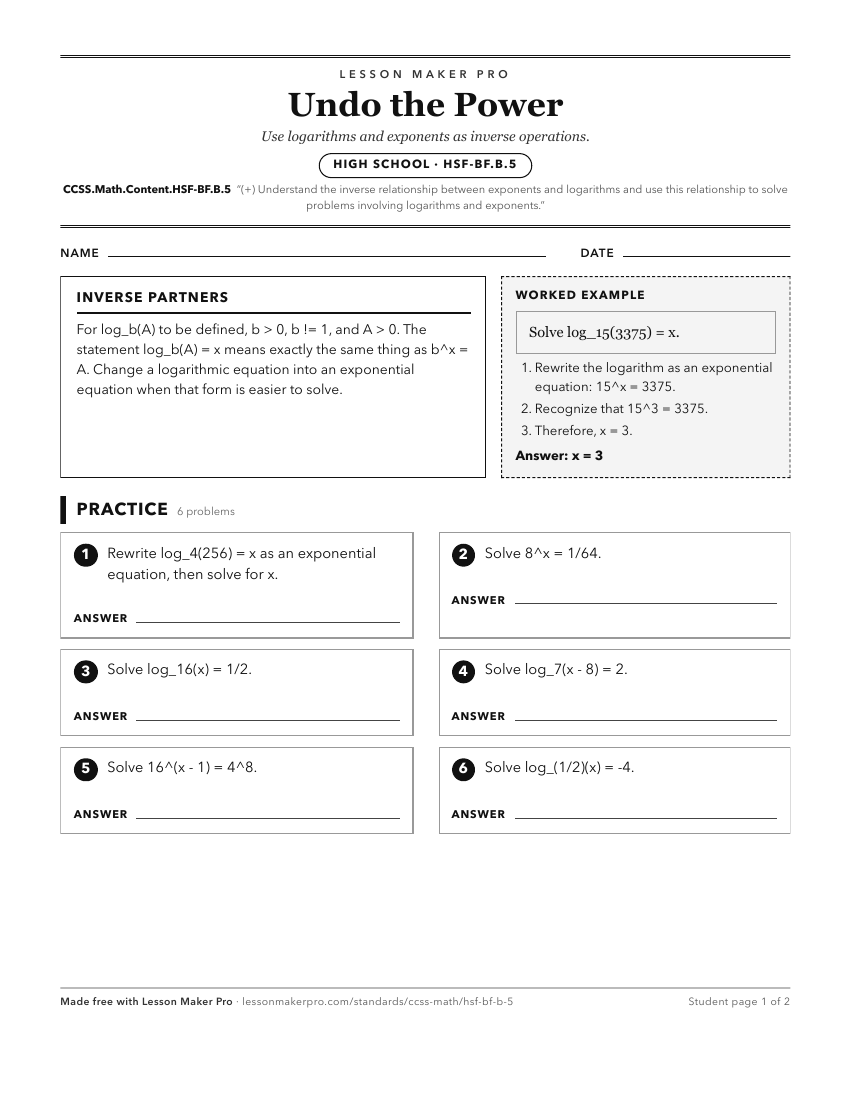
A ready-to-print activity worksheet aligned to CCSS.Math.Content.HSF-BF.B.5, with an answer key for the teacher on its own page. No account needed.
PDF, US Letter, prints cleanly in black and white.
Download the worksheetLearning progression
Where This Standard Sits
Before This Standard
If students are struggling here, check these first.
- CCSS.Math.Content.HSF-BF.B.4
Finding inverse functions carries over to seeing logarithms as the inverse of exponential functions and using that relationship to solve equations.
- CCSS.Math.Content.HSA-SSE.B.3c
Fluency with exponent rules supports rewriting exponential equations and interpreting logarithms as the inverse operation.
What This Unlocks
Mastery here sets students up for these next.
Keep exploring
Related Standards
- CCSS.Math.Content.HSF-TF.B.7
(+) Use inverse functions to solve trigonometric equations that arise in modeling contexts; evaluate the solutions using technology, and interpret them in terms...
- CCSS.Math.Content.HSF-BF.B.4c
(+) Read values of an inverse function from a graph or a table, given that the function has an inverse.
- CCSS.Math.Content.HSF-IF.C.8b
Use the properties of exponents to interpret expressions for exponential functions.
Turn this exact standard into a lesson
Grade, subject, topic, and the complete standard are prefilled. Create one free, no account needed.
Also for this standard:Make a WorksheetMake a QuizMake a Sub Lesson