CCSS.
The Standard
(+) Use inverse functions to solve trigonometric equations that arise in modeling contexts; evaluate the solutions using technology, and interpret them in terms of the context.
Common Core State Standards for Mathematics
Teacher's field guide
What This Standard Means
What Students Need to Do
- Students isolate a trigonometric expression and use inverse sine, cosine, or tangent on a calculator. They find all solutions within the model’s interval and explain what those values mean.
What Mastery Looks Like
- Students choose the correct inverse trigonometric function and use technology accurately. They find every solution in the given interval, check each one, and interpret the answers with units and context.
Common Misconceptions
- Students often report only the calculator’s principal value and miss other solutions in the time interval. They may use the wrong angle mode or keep answers that do not fit the situation.
How to Assess It
- Exit ticket: A Ferris wheel height is h(t) = 12 - 10 cos(πt/15). Find both times when h(t) = 17 for 0 ≤ t ≤ 30, then explain what each time means.
Lesson moves
Ways to Teach It
Mark heights on a paper plate Ferris wheel, rotate a rider marker, and connect two target-height positions to inverse cosine solutions.
Ask students to explain why a calculator gives one angle even when a periodic model has several valid times.
Give teams cards showing models, equations, calculator results, and interpretations, then have them race to assemble matching sets.
Use a tide-height model to calculate the next two times a harbor reaches a safe depth for a boat.
Free download
Printable HSF-TF.B.7 Worksheet
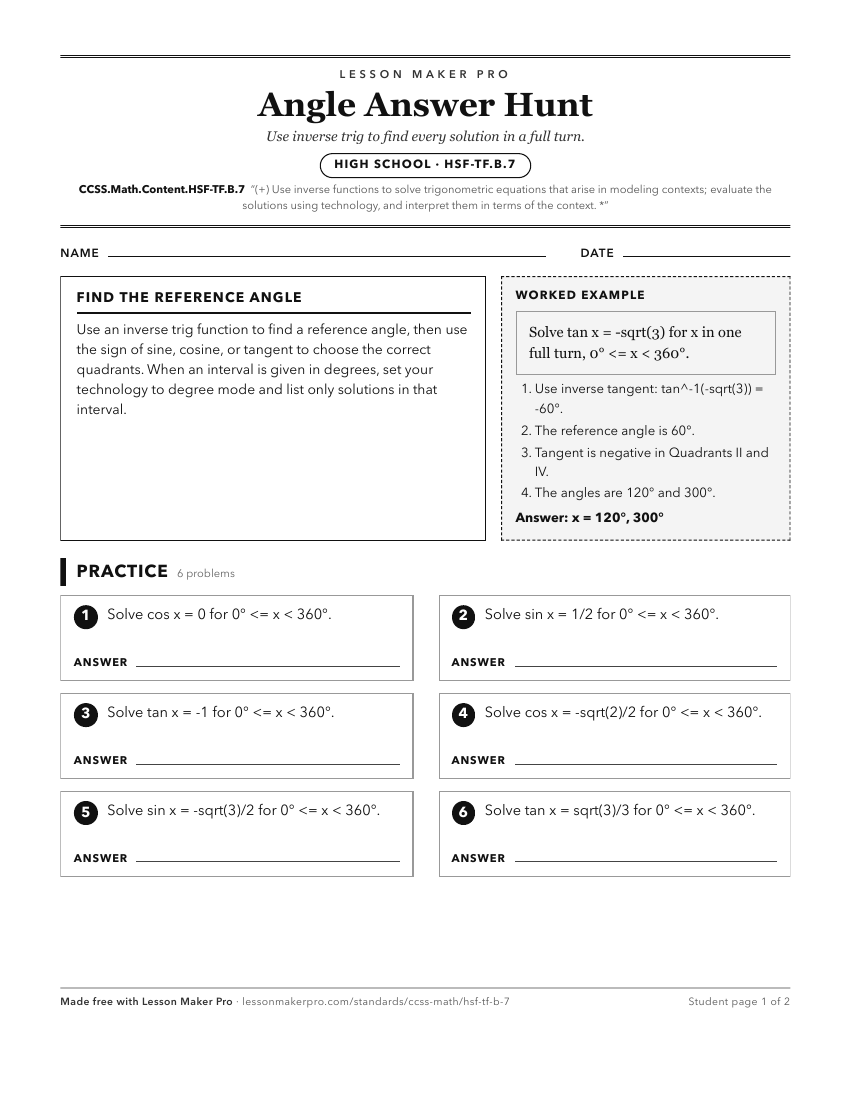
A ready-to-print activity worksheet aligned to CCSS.Math.Content.HSF-TF.B.7, with an answer key for the teacher on its own page. No account needed.
PDF, US Letter, prints cleanly in black and white.
Download the worksheetLearning progression
Where This Standard Sits
Before This Standard
If students are struggling here, check these first.
- CCSS.Math.Content.HSF-BF.B.4a
Solving f(x)=c with inverses carries into using inverse trig functions to isolate angles and interpret modeled solutions.
- CCSS.Math.Content.HSF-TF.B.6
Solving trig equations with inverse functions requires knowing inverse trig outputs come from restricted domains and may not list all solutions.
- CCSS.Math.Content.HSF-TF.B.5
Understanding amplitude, frequency, and midline helps students interpret trig equations from real models and judge solution meanings in context.
Keep exploring
Related Standards
- CCSS.Math.Content.HSG-SRT.D.10
(+) Prove the Laws of Sines and Cosines and use them to solve problems.
- CCSS.Math.Content.HSF-TF.A.4
(+) Use the unit circle to explain symmetry (odd and even) and periodicity of trigonometric functions.
- CCSS.Math.Content.HSF-TF.C.9
(+) Prove the addition and subtraction formulas for sine, cosine, and tangent and use them to solve problems.
- CCSS.Math.Content.HSG-SRT.D.11
(+) Understand and apply the Law of Sines and the Law of Cosines to find unknown measurements in right and non-right triangles (e.g., surveying problems, result...
Turn this exact standard into a lesson
Grade, subject, topic, and the complete standard are prefilled. Create one free, no account needed.
Also for this standard:Make a WorksheetMake a QuizMake a Sub Lesson