CCSS.
The Standard
(+) Use the unit circle to explain symmetry (odd and even) and periodicity of trigonometric functions.
Common Core State Standards for Mathematics
Teacher's field guide
What This Standard Means
What Students Need to Do
- Students compare points for θ and −θ on the unit circle to explain odd and even symmetry. They track repeated rotations to explain why trigonometric values repeat at fixed intervals.
What Mastery Looks Like
- Students use reflected or repeated points on the unit circle to justify identities. They identify sine as odd, cosine as even, and give correct periods for sine, cosine, and tangent.
Common Misconceptions
- Students may think every trigonometric function has period 2π, including tangent. They may also mix up angle reflection with coordinate signs or assume sine is even because its graph looks symmetric.
How to Assess It
- Give students one unit circle and ask them to justify sin(−θ) = −sin(θ), cos(−θ) = cos(θ), and the period of tangent.
Lesson moves
Ways to Teach It
Students mark θ, −θ, and repeated rotations on a paper unit circle, then record each point’s sine and cosine coordinates.
Ask students to write why reflecting a unit-circle point across the x-axis changes sine but not cosine.
Run a card sort matching unit-circle diagrams, symmetry identities, function names, and periods of π or 2π.
Model a Ferris wheel rotation and have students explain when a rider’s horizontal and vertical coordinates repeat or change sign.
Free download
Printable HSF-TF.A.4 Worksheet
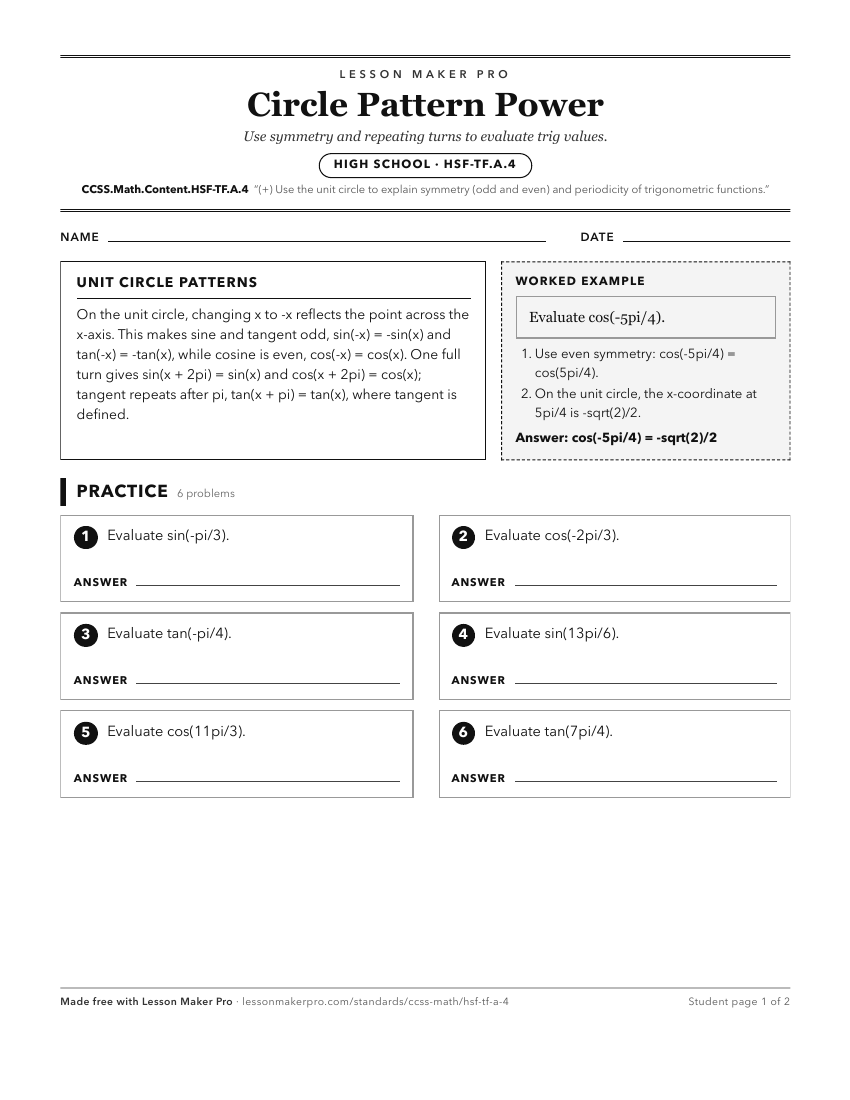
A ready-to-print activity worksheet aligned to CCSS.Math.Content.HSF-TF.A.4, with an answer key for the teacher on its own page. No account needed.
PDF, US Letter, prints cleanly in black and white.
Download the worksheetLearning progression
Where This Standard Sits
Before This Standard
If students are struggling here, check these first.
- CCSS.Math.Content.HSF-TF.A.1
Radian measure links real-number inputs to positions on the unit circle, supporting explanations of trig periodicity and symmetry.
- CCSS.Math.Content.HSF-TF.A.2
Students must understand trig values as coordinates on the unit circle before explaining their repeating and symmetric behavior.
- CCSS.Math.Content.HSF-IF.A.1
Understanding inputs, outputs, notation, and graphs supports explaining sine and cosine as functions with symmetry and repeating values.
Keep exploring
Related Standards
- CCSS.Math.Content.HSF-TF.B.7
(+) Use inverse functions to solve trigonometric equations that arise in modeling contexts; evaluate the solutions using technology, and interpret them in terms...
- CCSS.Math.Content.HSF-TF.B.5
Choose trigonometric functions to model periodic phenomena with specified amplitude, frequency, and midline.
- CCSS.Math.Content.HSG-SRT.D.10
(+) Prove the Laws of Sines and Cosines and use them to solve problems.
Turn this exact standard into a lesson
Grade, subject, topic, and the complete standard are prefilled. Create one free, no account needed.
Also for this standard:Make a WorksheetMake a QuizMake a Sub Lesson