CCSS.
The Standard
Explain how the unit circle in the coordinate plane enables the extension of trigonometric functions to all real numbers, interpreted as radian measures of angles traversed counterclockwise around the unit circle.
Common Core State Standards for Mathematics
Teacher's field guide
What This Standard Means
What Students Need to Do
- Students connect any real input to a point reached by rotating around a unit circle. They use the point’s coordinates to define cosine and sine for negative inputs and inputs beyond one turn.
What Mastery Looks Like
- A student can locate endpoints for values such as 5π/2, -3π/4, and 7π. They can state the sine and cosine from the coordinates and explain repeated values using coterminal positions.
Common Misconceptions
- Students often mix radians with degrees or treat negative inputs as negative distances. They may reverse sine and cosine coordinates. Some think values beyond one full turn are not allowed instead of finding a coterminal position.
How to Assess It
- Exit ticket: Plot the endpoints for t = -π/2 and t = 5π/2. Give sine and cosine for each, then explain why the endpoints match.
Lesson moves
Ways to Teach It
Use string cut to the circle’s radius to mark one-radian arcs, then trace positive and negative rotations and record endpoints.
Write why 9π/4 and π/4 land at the same point but represent different amounts of rotation.
Run a card sort matching radian inputs, coterminal values, unit-circle endpoints, and sine and cosine values.
Model a Ferris wheel rider’s coordinates after positive, negative, and multiple-turn rotations measured in radians.
Free download
Printable HSF-TF.A.2 Worksheet
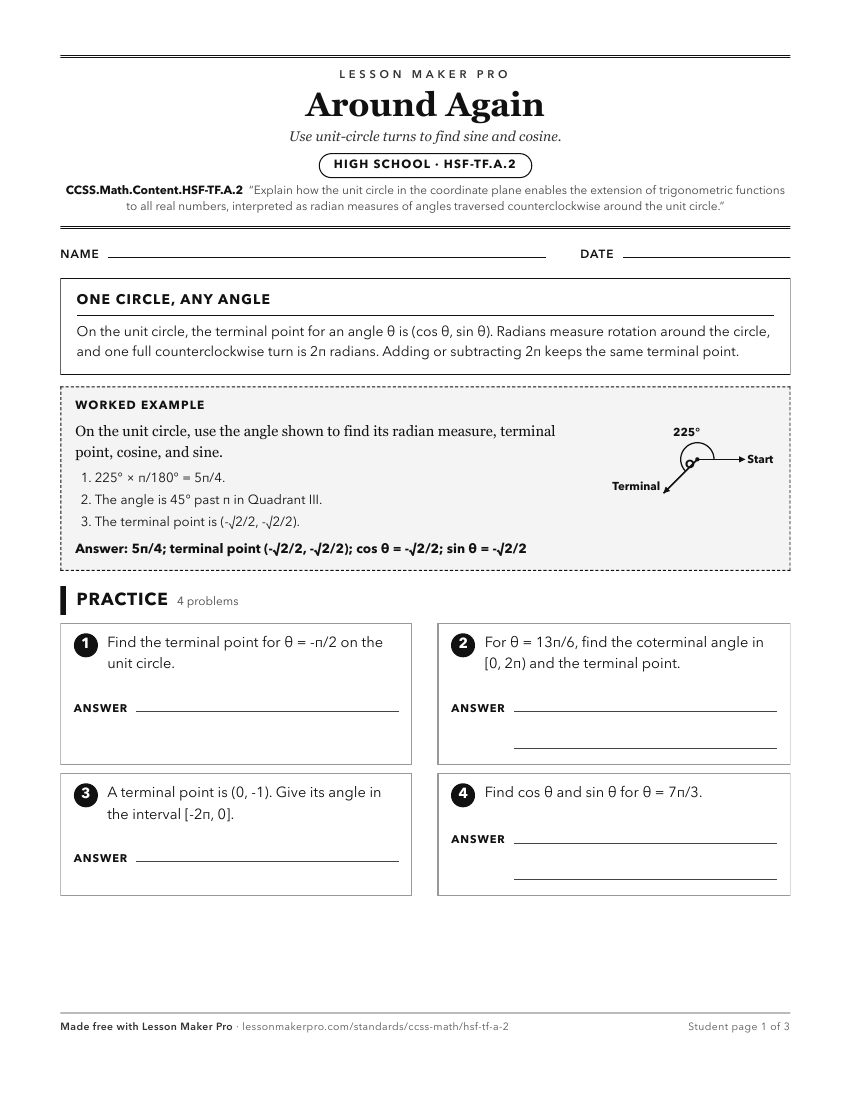
A ready-to-print activity worksheet aligned to CCSS.Math.Content.HSF-TF.A.2, with an answer key for the teacher on its own page. No account needed.
PDF, US Letter, prints cleanly in black and white.
Download the worksheetLearning progression
Where This Standard Sits
Before This Standard
If students are struggling here, check these first.
- CCSS.Math.Content.HSG-C.B.5
Defining radians through arc length supports interpreting real numbers as angles traveled around the unit circle.
- CCSS.Math.Content.HSF-TF.A.1
Students must understand radians as unit-circle arc length to map real numbers to rotations and define trig values.
- CCSS.Math.Content.HSG-SRT.C.6
Right-triangle sine and cosine for acute angles are the definitions that unit-circle coordinates extend to any radian angle.
What This Unlocks
Mastery here sets students up for these next.
- CCSS.Math.Content.HSF-TF.A.3
Students need unit-circle coordinates and radian angle motion to relate sine, cosine, and tangent at π−x, π+x, and 2π−x.
- CCSS.Math.Content.HSF-TF.A.4
Students must understand trig values as coordinates on the unit circle before explaining their repeating and symmetric behavior.
- CCSS.Math.Content.HSF-TF.B.5
Understanding sine and cosine as real-valued periodic functions supports choosing and transforming them for amplitude, frequency, and midline models.
- CCSS.Math.Content.HSF-TF.B.6
Unit circle definitions make trigonometric functions real-valued and periodic, which explains why inverse trig needs a restricted one-to-one domain.
- CCSS.Math.Content.HSF-TF.C.9
Addition formulas need sine and cosine as unit-circle coordinates for arbitrary angle measures, not just triangle ratios.
- CCSS.Math.Content.HSF-TF.C.8
Unit circle coordinates define sine and cosine for any angle, making the identity and quadrant sign choices meaningful.
Keep exploring
Related Standards
Turn this exact standard into a lesson
Grade, subject, topic, and the complete standard are prefilled. Create one free, no account needed.
Also for this standard:Make a WorksheetMake a QuizMake a Sub Lesson