CCSS.
Standard Cluster
Extend the domain of trigonometric functions using the unit circle
Common Core State Standards for Mathematics · High School — Functions
Cluster contents
Standards in This Cluster
CCSS.Math.Content.HSF-TF.A is a cluster heading. These are the individual standards under it.
- CCSS.Math.Content.HSF-TF.A.1
Understand radian measure of an angle as the length of the arc on the unit circle subtended by the angle.
- CCSS.Math.Content.HSF-TF.A.2
Explain how the unit circle in the coordinate plane enables the extension of trigonometric functions to all real numbers, interpreted as radian measures of angl...
- CCSS.Math.Content.HSF-TF.A.3
(+) Use special triangles to determine geometrically the values of sine, cosine, tangent for π/3, π/4 and π/6, and use the unit circle to express the values of ...
- CCSS.Math.Content.HSF-TF.A.4
(+) Use the unit circle to explain symmetry (odd and even) and periodicity of trigonometric functions.
Teacher's field guide
What This Cluster Means
What Students Need to Do
- Students connect real-number inputs to rotations measured in radians on the unit circle. They find exact trigonometric values and use coordinates to explain symmetry, signs, and periodic behavior.
What Mastery Looks Like
- Students locate positive and negative radian measures on the unit circle and give exact sine, cosine, and tangent values. They use reference angles, symmetry, and full rotations to explain repeated values and sign changes.
Common Misconceptions
- Students often mix degrees and radians, swap sine and cosine coordinates, or lose signs outside the first quadrant. They may also think adding 2π changes the function value or forget that tangent is undefined when cosine is zero.
How to Assess It
- Give this exit ticket: For θ = -5π/6, plot the unit-circle point, find sine and cosine, then explain what happens at θ + 2π.
Lesson moves
Ways to Teach It
Wrap string cut to one radius around a paper circle, marking each radius-length arc to build radian measures.
Ask students to write why sine stays unchanged when 2π is added, using unit-circle coordinates as evidence.
Play a card match with radian angles, unit-circle points, reference angles, and exact trigonometric values.
Model a Ferris wheel seat with a rotating point, then connect its height to the point’s sine value over time.
Free download
Printable HSF-TF.A Worksheet
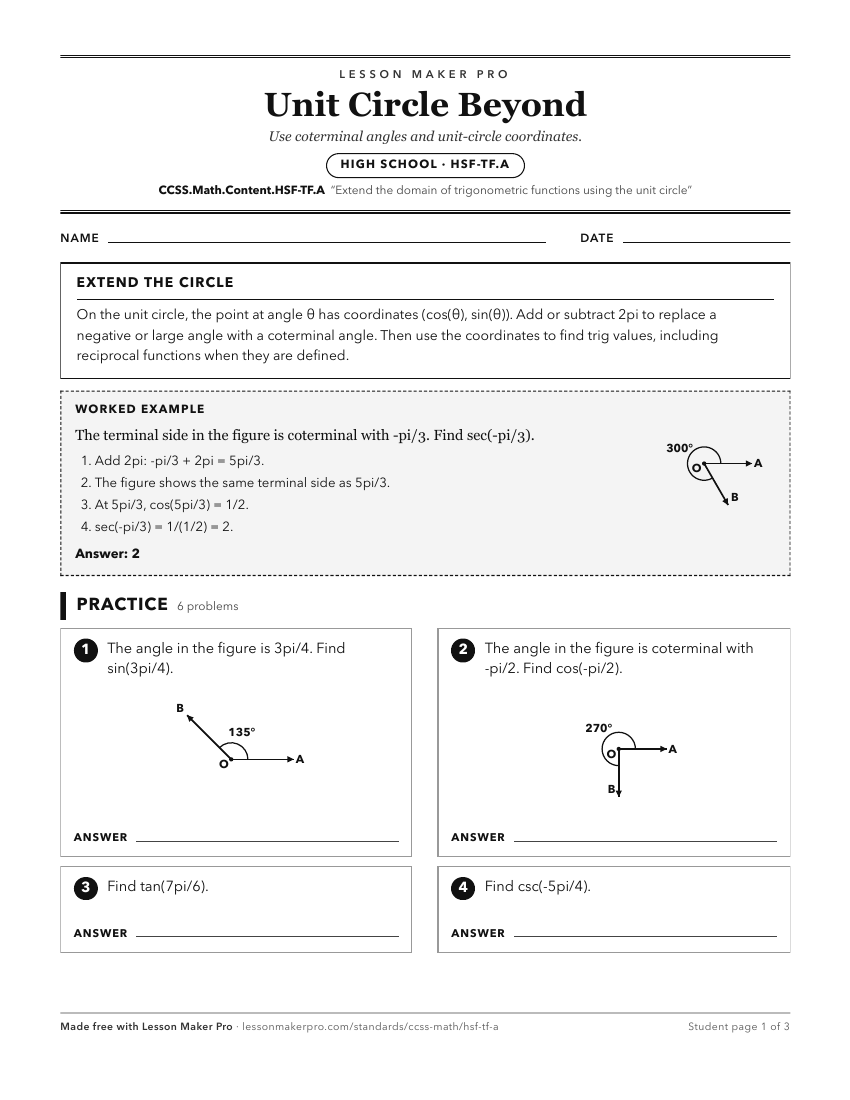
A ready-to-print activity worksheet aligned to CCSS.Math.Content.HSF-TF.A, with an answer key for the teacher on its own page. No account needed.
PDF, US Letter, prints cleanly in black and white.
Download the worksheetKeep exploring
Related Standards
Turn this cluster into a lesson
Grade, subject, topic, and the complete cluster are prefilled. Create one free, no account needed.
Also for this cluster:Make a WorksheetMake a QuizMake a Sub Lesson