CCSS.
The Standard
(+) Understand that restricting a trigonometric function to a domain on which it is always increasing or always decreasing allows its inverse to be constructed.
Common Core State Standards for Mathematics
Teacher's field guide
What This Standard Means
What Students Need to Do
- Students identify intervals where sine, cosine, or tangent is one-to-one because the function is always increasing or decreasing. They restrict the domain, then construct the inverse by swapping inputs and outputs or reflecting the graph across y = x. They interpret inverse values as principal angles.
What Mastery Looks Like
- A student can choose a valid restricted domain, state the resulting range, and show that each output corresponds to one input. The student can graph the inverse and explain why unrestricted sine or cosine has no inverse function.
Common Misconceptions
- Students often think inverse sine means 1/sin x, or that inverse notation cancels without a domain restriction. They may choose an interval containing a turning point, so repeated outputs remain. They may also expect an inverse trigonometric function to return every coterminal angle rather than one principal value.
How to Assess It
- Exit ticket: On a graph of y = cos x from -2π to 2π, mark one interval spanning the full range where cosine is always increasing or decreasing. State the inverse's domain and range, then explain why your restriction works.
Lesson moves
Ways to Teach It
Trace one period of y = sin x on transparency, cut out a monotonic branch, and flip it across y = x.
Write a response to: Why does y = sin x fail the horizontal line test, and how does [-π/2, π/2] fix it?
Match cards showing restricted trig graphs, inverse graphs, domains, and ranges, then justify each set to a partner.
Model a Ferris wheel height, then explain why one height gives two times unless the ride interval is restricted.
Free download
Printable HSF-TF.B.6 Worksheet
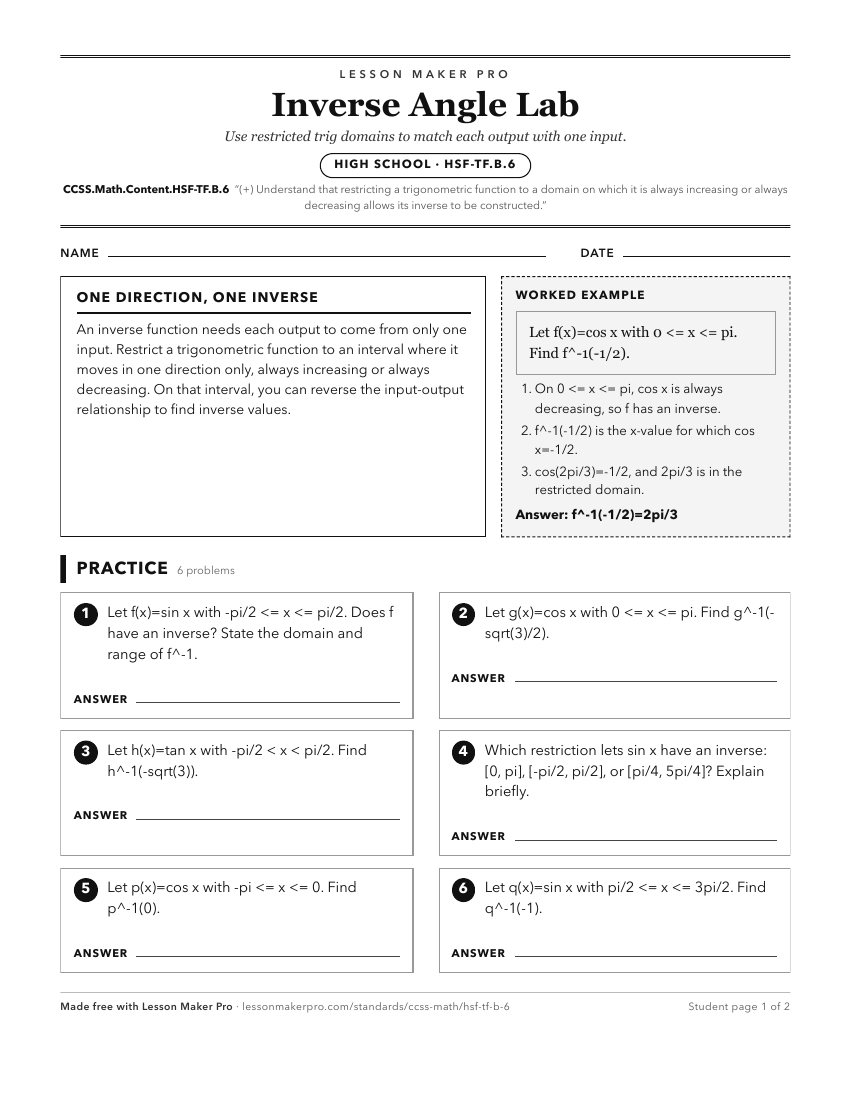
A ready-to-print activity worksheet aligned to CCSS.Math.Content.HSF-TF.B.6, with an answer key for the teacher on its own page. No account needed.
PDF, US Letter, prints cleanly in black and white.
Download the worksheetLearning progression
Where This Standard Sits
Before This Standard
If students are struggling here, check these first.
- CCSS.Math.Content.HSF-TF.A.2
Unit circle definitions make trigonometric functions real-valued and periodic, which explains why inverse trig needs a restricted one-to-one domain.
- CCSS.Math.Content.HSF-BF.B.4d
Students use domain restriction to make a function one-to-one, then apply that idea to define inverse trigonometric functions.
- CCSS.Math.Content.HSF-IF.B.5
Students use domain and graph understanding to see why a trig function must be restricted before it has an inverse.
What This Unlocks
Mastery here sets students up for these next.
Keep exploring
Related Standards
Turn this exact standard into a lesson
Grade, subject, topic, and the complete standard are prefilled. Create one free, no account needed.
Also for this standard:Make a WorksheetMake a QuizMake a Sub Lesson