CCSS.
The Standard
(+) Produce an invertible function from a non-invertible function by restricting the domain.
Common Core State Standards for Mathematics · Build new functions from existing functions
Teacher's field guide
What This Standard Means
What Students Need to Do
- Students use a graph, table, or equation to find where a function repeats output values. They choose a domain interval that makes outputs unique, then define and check the inverse.
What Mastery Looks Like
- For f(x) = x², a student can choose x ≥ 0 and write f⁻¹(x) = √x with correct domains and ranges. They can verify the choice using the horizontal line test and composition.
Common Misconceptions
- Students often use the vertical line test instead of the horizontal line test. They may restrict the range, keep duplicate outputs, or forget that the inverse domain is the restricted function’s range.
How to Assess It
- Exit ticket: For f(x) = (x − 2)² − 3, choose a domain restriction, find the inverse, and state the domain of each function.
Lesson moves
Ways to Teach It
Plot y = x² with sticky notes, then remove one branch and test the remaining points with a horizontal piece of string.
Write: Why do x ≥ 0 and x ≤ 0 both work for x², and how do their inverse rules differ?
Sort graph cards into invertible or needs restriction, then mark a valid restricted domain on every graph in the second group.
Graph a ball’s height over time, then use only ascent or descent so each height identifies one time.
Free download
Printable HSF-BF.B.4d Worksheet
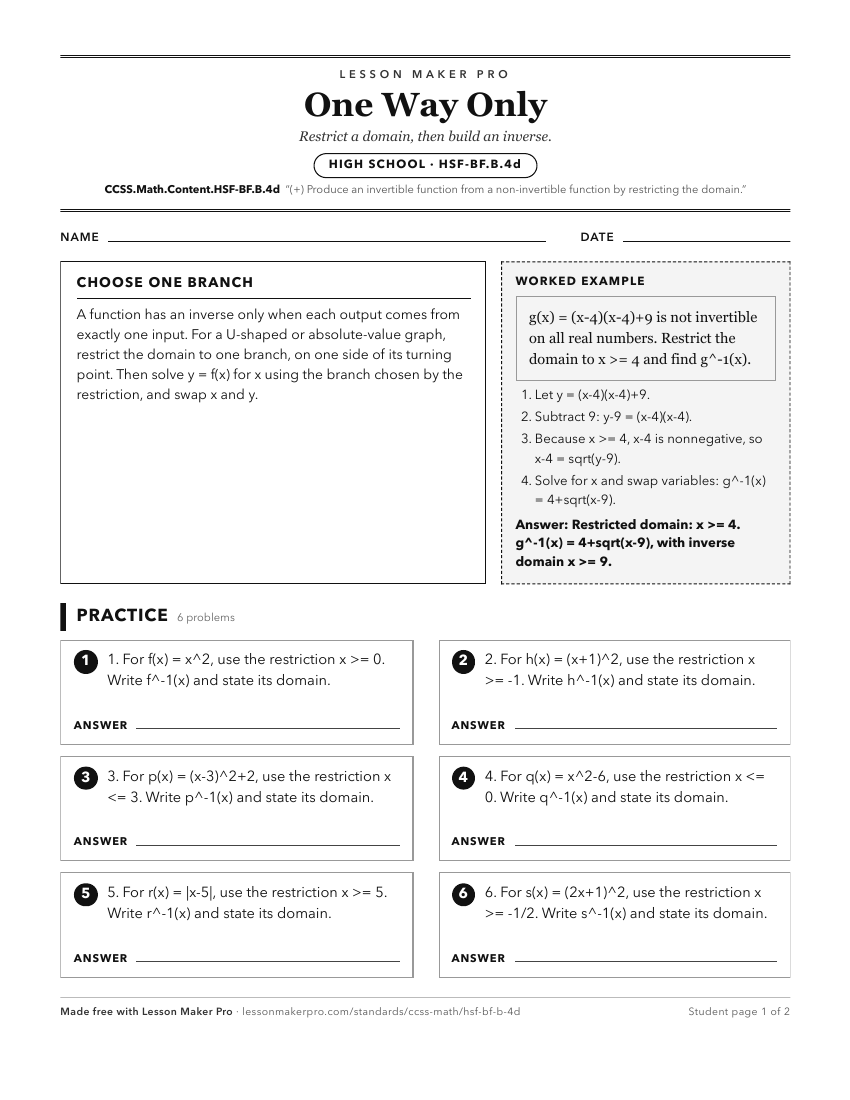
A ready-to-print activity worksheet aligned to CCSS.Math.Content.HSF-BF.B.4d, with an answer key for the teacher on its own page. No account needed.
PDF, US Letter, prints cleanly in black and white.
Download the worksheetLearning progression
Where This Standard Sits
Before This Standard
If students are struggling here, check these first.
- CCSS.Math.Content.HSF-BF.B.4
Restricting a domain to make a function invertible requires knowing what inverses are and when a function has one.
- CCSS.Math.Content.HSF-IF.A.1
Restricting a domain to make an inverse requires knowing functions, domains, outputs, and graphs from the function definition.
- CCSS.Math.Content.HSF-IF.B.5
Restricting a function’s domain to make it one-to-one requires seeing how allowed inputs appear on and limit the graph.
What This Unlocks
Mastery here sets students up for these next.
Keep exploring
Related Standards
Turn this exact standard into a lesson
Grade, subject, topic, and the complete standard are prefilled. Create one free, no account needed.
Also for this standard:Make a WorksheetMake a QuizMake a Sub Lesson