CCSS.
The Standard
(+) Read values of an inverse function from a graph or a table, given that the function has an inverse.
Common Core State Standards for Mathematics · Build new functions from existing functions
Teacher's field guide
What This Standard Means
What Students Need to Do
- Students work backward from an output to find the original input. They read that relationship from ordered pairs, tables, or points on a graph.
What Mastery Looks Like
- Students find the input that produced a given output. They use the fact that a point (a, b) on f becomes (b, a) on its inverse.
Common Misconceptions
- Students may treat f⁻¹(x) as 1/f(x) or as a negative exponent. They may also reverse the coordinate order incorrectly or search the wrong axis.
How to Assess It
- Show the table x: 1, 2, 4 and f(x): 7, 9, 12. Ask students to find f⁻¹(9) and explain their choice.
Lesson moves
Ways to Teach It
Give pairs of students coordinate cards from a function, then have them swap each ordered pair to build the inverse relation.
Ask students to explain why a point (3, 8) on f means f⁻¹(8) = 3.
Play an inverse matching game where students pair function table entries with inverse statements such as f⁻¹(14) = 5.
Use a Celsius and Fahrenheit table to identify which temperature input matches a given converted output.
Free download
Printable HSF-BF.B.4c Worksheet
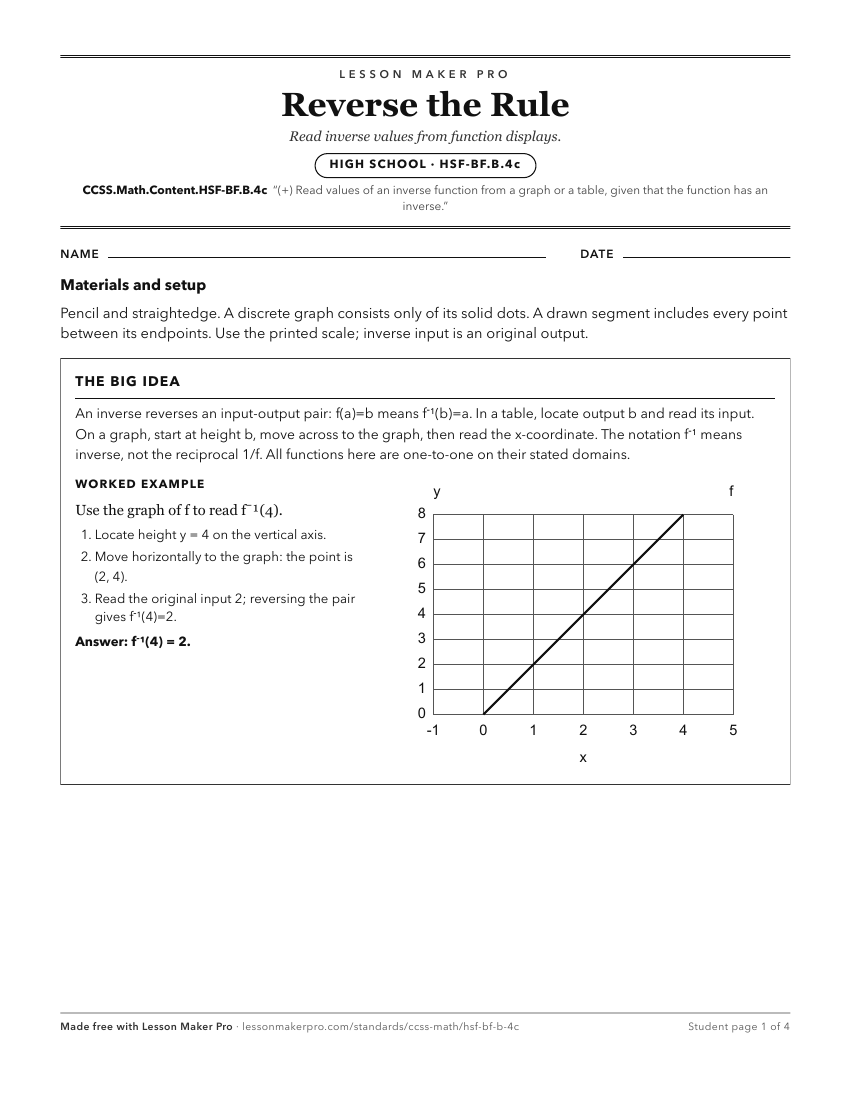
A ready-to-print activity worksheet aligned to CCSS.Math.Content.HSF-BF.B.4c, with an answer key for the teacher on its own page. No account needed.
PDF, US Letter, prints cleanly in black and white.
Download the worksheetLearning progression
Where This Standard Sits
Before This Standard
If students are struggling here, check these first.
- CCSS.Math.Content.HSF-IF.A.2
Understanding function inputs and outputs in notation supports reading inverse values by reversing which quantity is treated as input.
- CCSS.Math.Content.HSF-IF.A.1
Reading inverse values requires treating outputs as inputs and using function notation, tables, and graphs to connect x-values and y-values.
- CCSS.Math.Content.HSF-IF.B.4
Reading inverse values relies on interpreting graph and table inputs and outputs, then reversing the relationship for the inverse.
Keep exploring
Related Standards
- CCSS.Math.Content.HSF-BF.B.4
Find inverse functions.
- CCSS.Math.Content.HSF-TF.B.7
(+) Use inverse functions to solve trigonometric equations that arise in modeling contexts; evaluate the solutions using technology, and interpret them in terms...
- CCSS.Math.Content.HSF-BF.B.4b
(+) Verify by composition that one function is the inverse of another.
- CCSS.Math.Content.HSF-BF.B.4d
(+) Produce an invertible function from a non-invertible function by restricting the domain.
Turn this exact standard into a lesson
Grade, subject, topic, and the complete standard are prefilled. Create one free, no account needed.
Also for this standard:Make a WorksheetMake a QuizMake a Sub Lesson