CCSS.
The Standard
(+) Use special triangles to determine geometrically the values of sine, cosine, tangent for π/3, π/4 and π/6, and use the unit circle to express the values of sine, cosine, and tangent for π-x, π+x, and 2π-x in terms of their values for x, where x is any real number.
Common Core State Standards for Mathematics
Teacher's field guide
What This Standard Means
What Students Need to Do
- Students use 30-60-90 and 45-45-90 triangles to derive exact sine, cosine, and tangent values. They use unit-circle symmetry to rewrite values for related angles, including correct signs.
What Mastery Looks Like
- Students derive exact trigonometric values from labeled special triangles without a calculator. They use unit-circle coordinates and quadrant signs to rewrite related angles correctly.
Common Misconceptions
- Students often swap opposite and adjacent sides or use decimal approximations instead of exact values. They may miss quadrant signs, treat tangent as always defined, or confuse reflection across the axes.
How to Assess It
- Exit ticket: Derive cos(π/6) from a special triangle, then express sin(π + x), cos(2π − x), and tan(2π − x) using x.
Lesson moves
Ways to Teach It
Cut an equilateral triangle and a square diagonally, label side lengths, and build exact sine, cosine, and tangent tables.
Explain why cosine keeps its sign at 2π − x while sine changes, using reflected unit-circle coordinates.
Run a card match with angle cards, exact-value cards, and unit-circle symmetry cards; pairs must justify every match.
Use a 30° or 45° line-of-sight diagram to calculate a building height exactly from a measured ground distance.
Free download
Printable HSF-TF.A.3 Worksheet
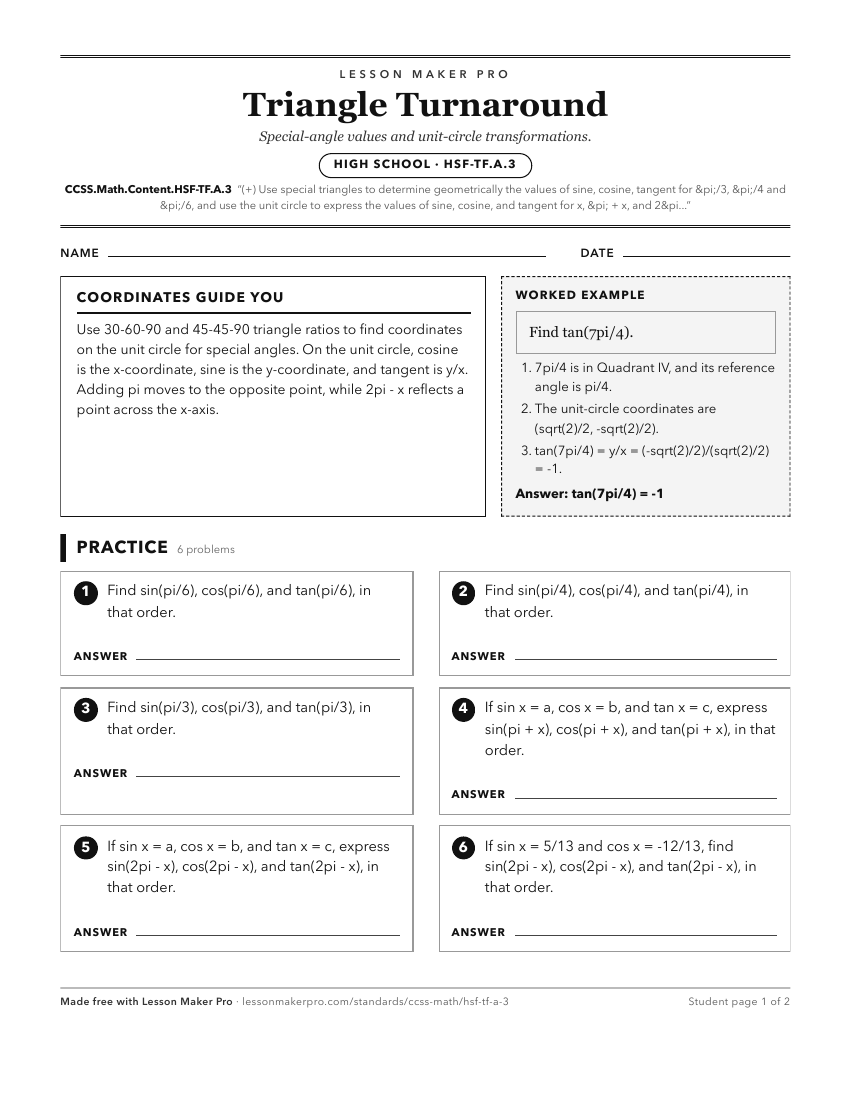
A ready-to-print activity worksheet aligned to CCSS.Math.Content.HSF-TF.A.3, with an answer key for the teacher on its own page. No account needed.
PDF, US Letter, prints cleanly in black and white.
Download the worksheetLearning progression
Where This Standard Sits
Before This Standard
If students are struggling here, check these first.
- CCSS.Math.Content.HSG-SRT.C.6
Right-triangle ratio definitions are needed to derive special-angle sine, cosine, and tangent before extending them on the unit circle.
- CCSS.Math.Content.HSF-TF.A.2
Students need unit-circle coordinates and radian angle motion to relate sine, cosine, and tangent at π−x, π+x, and 2π−x.
- CCSS.Math.Content.HSF-TF.A.1
Radian measure lets students interpret π-based angles and reference-angle positions on the unit circle used for exact trig values.
Keep exploring
Related Standards
- CCSS.Math.Content.HSF-TF.A
Extend the domain of trigonometric functions using the unit circle
- CCSS.Math.Content.HSF-TF.B.7
(+) Use inverse functions to solve trigonometric equations that arise in modeling contexts; evaluate the solutions using technology, and interpret them in terms...
- CCSS.Math.Content.HSF-TF.A.4
(+) Use the unit circle to explain symmetry (odd and even) and periodicity of trigonometric functions.
- CCSS.Math.Content.HSF-TF.C.9
(+) Prove the addition and subtraction formulas for sine, cosine, and tangent and use them to solve problems.
Turn this exact standard into a lesson
Grade, subject, topic, and the complete standard are prefilled. Create one free, no account needed.
Also for this standard:Make a WorksheetMake a QuizMake a Sub Lesson