CCSS.
The Standard
Understand that by similarity, side ratios in right triangles are properties of the angles in the triangle, leading to definitions of trigonometric ratios for acute angles.
Common Core State Standards for Mathematics
Teacher's field guide
What This Standard Means
What Students Need to Do
- Students choose an acute angle and identify the opposite side, adjacent side, and hypotenuse. They compare those side lengths using sine, cosine, and tangent. They connect equal ratios across similar right triangles to a fixed angle.
What Mastery Looks Like
- Students correctly label the hypotenuse, opposite side, and adjacent side from a chosen acute angle. They calculate sine, cosine, and tangent in similar right triangles and get matching values. They explain that scaling changes side lengths but not their ratios.
Common Misconceptions
- Students may name opposite and adjacent sides by the triangle’s position instead of by the chosen angle. They may swap sine and cosine or use the hypotenuse in the tangent ratio. Some expect side ratios to change when a triangle is enlarged.
How to Assess It
- Exit ticket: Draw 3-4-5 and 6-8-10 right triangles, mark matching acute angles, and calculate sine, cosine, and tangent for each. Explain why the matching ratios are equal.
Lesson moves
Ways to Teach It
Build similar right triangles with straws at two scales, mark matching angles, then compare opposite, adjacent, and hypotenuse ratios.
Write a response to: Why does doubling every side length leave sine, cosine, and tangent unchanged?
Play a card sort matching triangle diagrams, marked angles, side ratios, and sine, cosine, or tangent labels.
Measure a ramp’s rise and run, calculate the tangent ratio, and compare ramps to decide which has the steeper angle.
Free download
Printable HSG-SRT.C.6 Worksheet
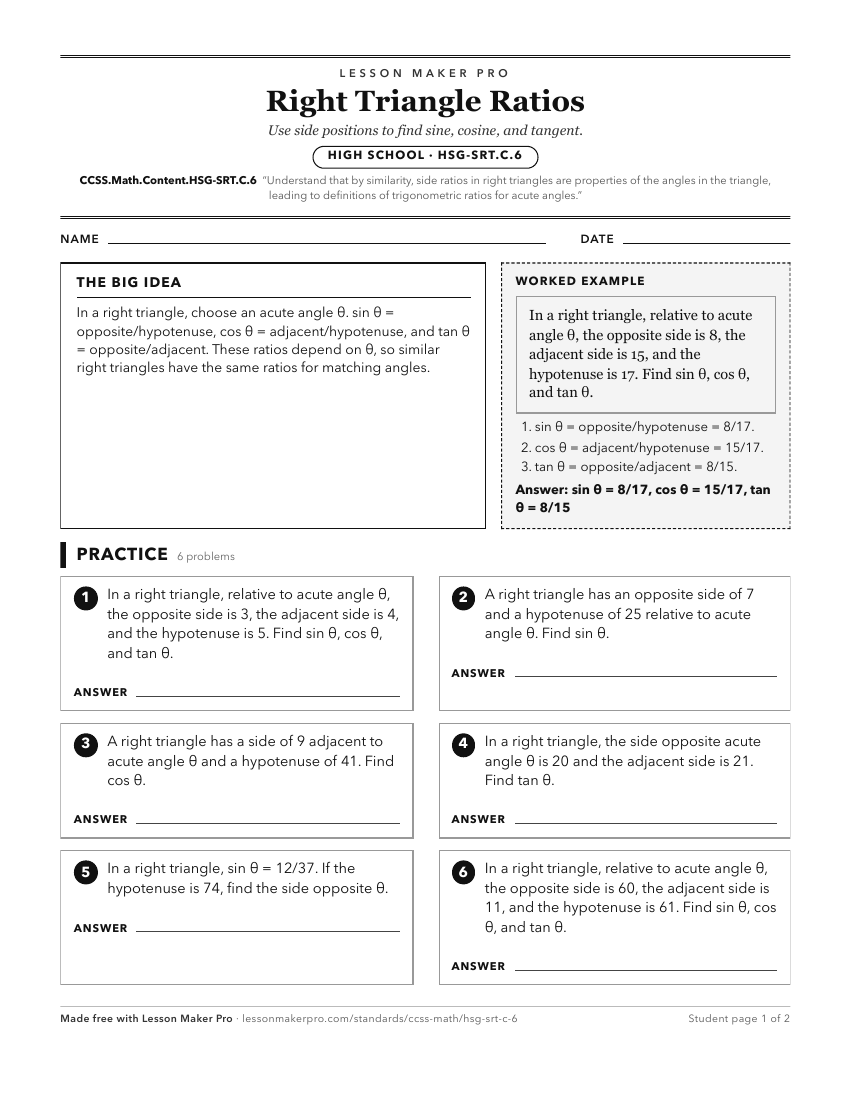
A ready-to-print activity worksheet aligned to CCSS.Math.Content.HSG-SRT.C.6, with an answer key for the teacher on its own page. No account needed.
PDF, US Letter, prints cleanly in black and white.
Download the worksheetLearning progression
Where This Standard Sits
Before This Standard
If students are struggling here, check these first.
- CCSS.Math.Content.HSG-SRT.A.3
AA similarity justifies that right triangles with the same acute angle have equal side ratios, which defines trig ratios.
- CCSS.Math.Content.HSG-SRT.A.2
Trigonometric ratios require knowing similar right triangles have equal angles and proportional corresponding sides, so a fixed angle gives fixed ratios.
- CCSS.Math.Content.7.RP.A.2
Trigonometric ratios rely on seeing corresponding side lengths in similar right triangles as proportional and representing those constant ratios.
What This Unlocks
Mastery here sets students up for these next.
- CCSS.Math.Content.HSG-SRT.C.8
Students must know sine, cosine, and tangent as angle-based side ratios before using them to find missing sides or angles.
- CCSS.Math.Content.HSG-SRT.D.10
Right-triangle sine and cosine definitions are needed to prove and apply sine and cosine relationships in non-right triangles.
- CCSS.Math.Content.HSF-TF.A.3
Right-triangle ratio definitions are needed to derive special-angle sine, cosine, and tangent before extending them on the unit circle.
- CCSS.Math.Content.HSN-CN.B.4
Right-triangle trigonometric ratios support seeing polar form’s radius and angle as rectangular real and imaginary components.
- CCSS.Math.Content.HSG-SRT.D.9
Deriving the area formula requires using sine in the right triangle formed by the altitude to express height from a side and angle.
- CCSS.Math.Content.HSG-SRT.C.7
Students need right-triangle sine and cosine ratios tied to angles to see complementary angles swap opposite and adjacent sides.
Keep exploring
Related Standards
Turn this exact standard into a lesson
Grade, subject, topic, and the complete standard are prefilled. Create one free, no account needed.
Also for this standard:Make a WorksheetMake a QuizMake a Sub Lesson