CCSS.
The Standard
Choose trigonometric functions to model periodic phenomena with specified amplitude, frequency, and midline.
Common Core State Standards for Mathematics
Teacher's field guide
What This Standard Means
What Students Need to Do
- Students choose sine or cosine to represent a repeating pattern. They set the vertical stretch, center line, cycle rate, and any horizontal shift. They check the equation against the pattern’s high point, low point, and cycle length.
What Mastery Looks Like
- A student can write an equation such as y = A cos(B(x − C)) + D and explain each parameter. The model reaches the correct high and low values, completes cycles at the stated rate, and matches the starting position. The student recognizes equivalent sine and cosine models.
Common Misconceptions
- Students often use the maximum value as the amplitude or assume the midline is always the x-axis. They may confuse cycles per unit with the angle coefficient, forgetting the 2π conversion when using radians. Some force every model to start at the midline instead of using cosine or a phase shift.
How to Assess It
- Exit ticket: A Ferris wheel moves from 2 to 18 meters, completes one turn every 40 seconds, and starts at the top. Write a height model and label its amplitude, frequency, and midline.
Lesson moves
Ways to Teach It
Place a dot on a paper plate, rotate it in equal steps, record its height, graph the data, and fit a cosine model.
Compare y = 3sin(2πx) + 5 and y = 3cos(2πx) + 5, then explain which starting conditions each model fits.
Run a card sort matching situation cards with graphs and equations that share amplitude, frequency, midline, and starting position.
Use monthly daylight data for your city to build a sinusoidal model and predict the dates with the longest and shortest daylight.
Free download
Printable HSF-TF.B.5 Worksheet
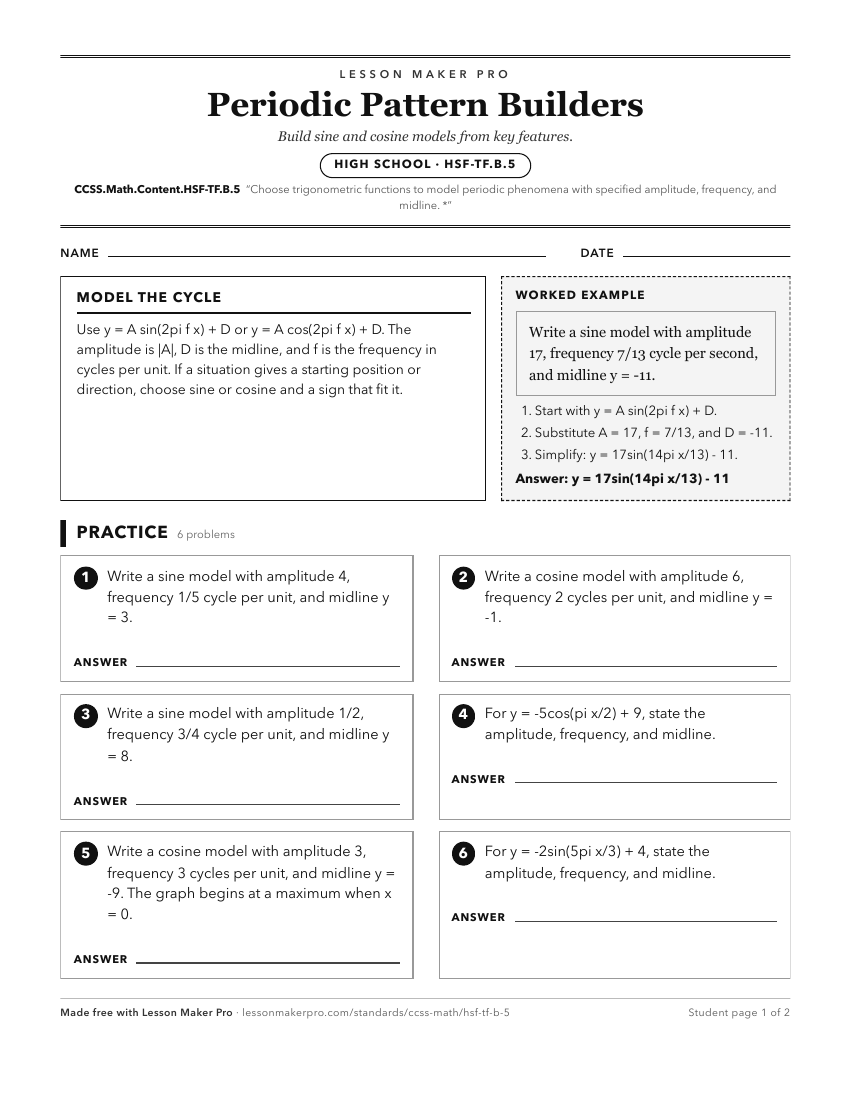
A ready-to-print activity worksheet aligned to CCSS.Math.Content.HSF-TF.B.5, with an answer key for the teacher on its own page. No account needed.
PDF, US Letter, prints cleanly in black and white.
Download the worksheetLearning progression
Where This Standard Sits
Before This Standard
If students are struggling here, check these first.
- CCSS.Math.Content.HSF-BF.B.3
Amplitude, frequency, and midline are vertical scale, horizontal scale, and vertical shift of sine or cosine graphs.
- CCSS.Math.Content.HSF-TF.A.2
Understanding sine and cosine as real-valued periodic functions supports choosing and transforming them for amplitude, frequency, and midline models.
- CCSS.Math.Content.HSF-IF.C.7e
Reading trig graphs for period, midline, and amplitude supports choosing a sine or cosine model with those features.
What This Unlocks
Mastery here sets students up for these next.
Keep exploring
Related Standards
Turn this exact standard into a lesson
Grade, subject, topic, and the complete standard are prefilled. Create one free, no account needed.
Also for this standard:Make a WorksheetMake a QuizMake a Sub Lesson