CCSS.
Standard Cluster
Model periodic phenomena with trigonometric functions
Common Core State Standards for Mathematics · High School — Functions
Cluster contents
Standards in This Cluster
CCSS.Math.Content.HSF-TF.B is a cluster heading. These are the individual standards under it.
- CCSS.Math.Content.HSF-TF.B.5
Choose trigonometric functions to model periodic phenomena with specified amplitude, frequency, and midline.
- CCSS.Math.Content.HSF-TF.B.6
(+) Understand that restricting a trigonometric function to a domain on which it is always increasing or always decreasing allows its inverse to be constructed.
- CCSS.Math.Content.HSF-TF.B.7
(+) Use inverse functions to solve trigonometric equations that arise in modeling contexts; evaluate the solutions using technology, and interpret them in terms...
Teacher's field guide
What This Cluster Means
What Students Need to Do
- Students represent repeating patterns with sine or cosine functions. They identify amplitude, period, frequency, midline, and phase shift, then use the model to make predictions.
What Mastery Looks Like
- Given a graph, table, or context, students can write a sine or cosine equation with correct parameters. They can use the equation to predict values and explain what each parameter means.
Common Misconceptions
- Students often call the maximum value the amplitude instead of finding half the range. They may confuse period with frequency, reverse a phase shift’s sign, or mix degrees and radians.
How to Assess It
- Exit ticket: A rider’s height ranges from 2 to 18 meters and repeats every 40 seconds, starting at minimum. Write a model and find the height at 10 seconds.
Lesson moves
Ways to Teach It
Rotate a marked paper plate beside a ruler, record the point’s height every 15 degrees, and graph the ordered pairs.
Ask students to explain whether sine or cosine better models a Ferris wheel rider starting at the bottom.
Play parameter match: teams pair sine and cosine equations with graph cards showing different amplitudes, periods, midlines, and shifts.
Use monthly daylight data for your city to build a sinusoidal model and predict daylight hours for an unlisted date.
Free download
Printable HSF-TF.B Worksheet
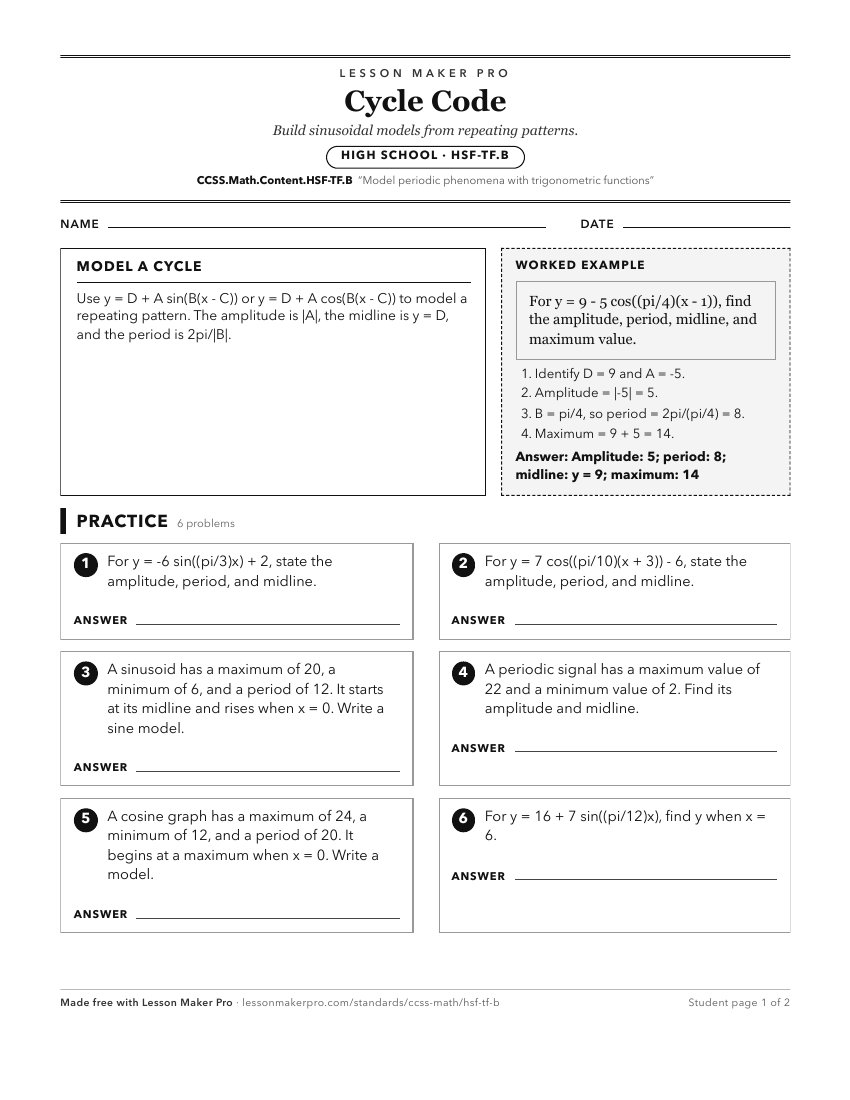
A ready-to-print activity worksheet aligned to CCSS.Math.Content.HSF-TF.B, with an answer key for the teacher on its own page. No account needed.
PDF, US Letter, prints cleanly in black and white.
Download the worksheetKeep exploring
Related Standards
- CCSS.Math.Content.HSF-IF.C.7e
Graph exponential and logarithmic functions, showing intercepts and end behavior, and trigonometric functions, showing period, midline, and amplitude.
- CCSS.Math.Content.HSF-TF.A
Extend the domain of trigonometric functions using the unit circle
- CCSS.Math.Content.HSF-TF.A.4
(+) Use the unit circle to explain symmetry (odd and even) and periodicity of trigonometric functions.
Turn this cluster into a lesson
Grade, subject, topic, and the complete cluster are prefilled. Create one free, no account needed.
Also for this cluster:Make a WorksheetMake a QuizMake a Sub Lesson