CCSS.
The Standard
Use the properties of exponents to interpret expressions for exponential functions.
Common Core State Standards for Mathematics · Analyze functions using different representations
Teacher's field guide
What This Standard Means
What Students Need to Do
- Students read the base and exponent to identify growth or decay and the time interval for the change. They use exponent rules to rewrite expressions and find the multiplier and percent change for one chosen time unit.
What Mastery Looks Like
- Students can rewrite f(t)=300(1.02)^(12t) as 300[(1.02)^12]^t and report about 26.8 percent yearly growth. They can explain that (0.8)^(t/5) represents 20 percent decay every five units, not every unit.
Common Misconceptions
- Students often treat the base as the one-unit rate without checking the exponent. They may call 0.97 a 97 percent decrease instead of a 3 percent decrease. They also confuse a 20 percent change over ten units with a 20 percent change each unit.
How to Assess It
- Exit ticket: For f(t)=500(1.04)^(3t), classify the change and find the percent change when t increases by 1. Show an equivalent expression that supports your answer.
Lesson moves
Ways to Teach It
Have pairs sort expression cards by growth or decay, then match each card to its one-unit multiplier and percent change.
Ask students to explain why (1.005)^(12t) is not 0.5 percent yearly growth, then calculate and defend the yearly rate.
Run a whiteboard relay: show an expression, and teams write growth or decay, the interval, and the matching percent rate.
Model a medication amount with A(t)=80(0.85)^(t/6), and have students interpret the decay over six hours and one hour.
Free download
Printable HSF-IF.C.8b Worksheet
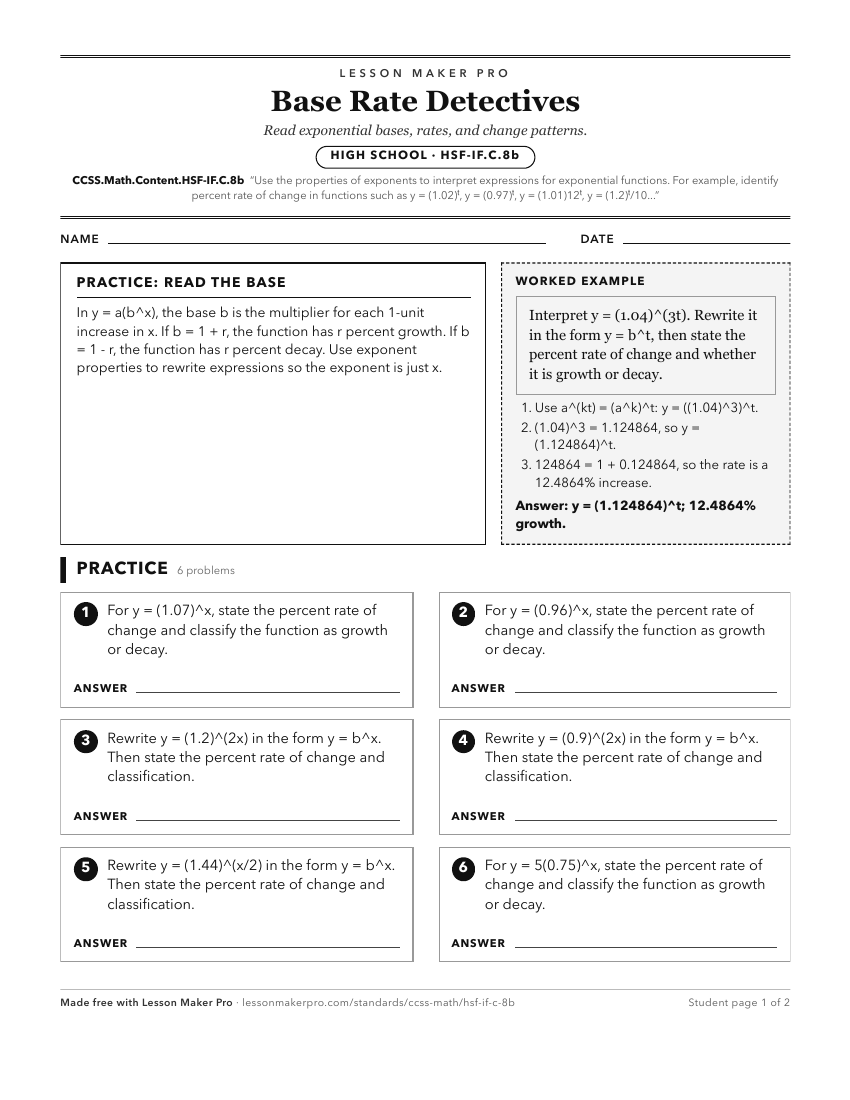
A ready-to-print activity worksheet aligned to CCSS.Math.Content.HSF-IF.C.8b, with an answer key for the teacher on its own page. No account needed.
PDF, US Letter, prints cleanly in black and white.
Download the worksheetLearning progression
Where This Standard Sits
Before This Standard
If students are struggling here, check these first.
- CCSS.Math.Content.8.EE.A.1
Interpreting exponential function forms relies on exponent laws like powers of powers and products of powers to see growth rates.
- CCSS.Math.Content.HSA-SSE.A.1
Interpreting parts of contextual expressions supports explaining exponential forms, factors, and rates after exponent properties rewrite them.
What This Unlocks
Mastery here sets students up for these next.
Keep exploring
Related Standards
Turn this exact standard into a lesson
Grade, subject, topic, and the complete standard are prefilled. Create one free, no account needed.
Also for this standard:Make a WorksheetMake a QuizMake a Sub Lesson