CCSS.
The Standard
Derive the formula for the sum of a finite geometric series (when the common ratio is not 1), and use the formula to solve problems.
Common Core State Standards for Mathematics
Teacher's field guide
What This Standard Means
What Students Need to Do
- Students build the finite geometric series formula by multiplying a written series by its common ratio and subtracting. They use the formula to find sums and solve financial or growth problems.
What Mastery Looks Like
- Students identify the first term, common ratio, and number of terms from an expression or context. They derive the formula by multiplying the series by r and subtracting, then use it accurately.
Common Misconceptions
- Students may use the nth-term formula when the problem asks for a sum. They may miscount the terms, reverse subtraction signs, or use the series formula when r = 1.
How to Assess It
- Give this exit ticket: For 6 + 18 + 54 + 162, identify a, r, and n, derive the sum formula by subtraction, then calculate the sum.
Lesson moves
Ways to Teach It
Arrange paper strips with lengths 1, 1/2, 1/4, and 1/8, then compare their total with the formula.
Ask students to explain why subtracting rS from S cancels most terms and leaves only the first and final powers.
Use task cards with geometric sums, and have pairs race to identify a, r, and n before calculating each total.
Use a spreadsheet to compare monthly mortgage payments for two interest rates by applying the finite geometric series formula.
Free download
Printable HSA-SSE.B.4 Worksheet
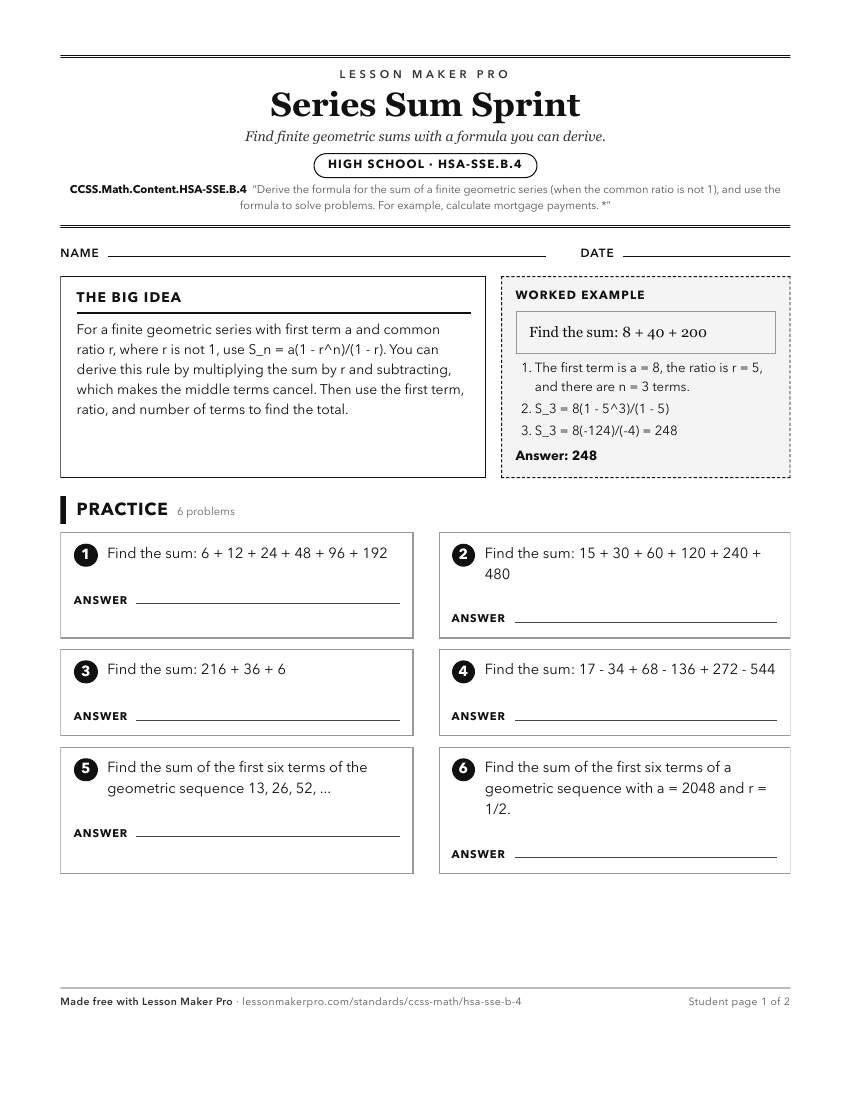
A ready-to-print activity worksheet aligned to CCSS.Math.Content.HSA-SSE.B.4, with an answer key for the teacher on its own page. No account needed.
PDF, US Letter, prints cleanly in black and white.
Download the worksheetLearning progression
Where This Standard Sits
Before This Standard
If students are struggling here, check these first.
- CCSS.Math.Content.HSA-SSE.A.2
Seeing structure in expressions supports rewriting a geometric sum, multiplying by the ratio, and subtracting to derive the formula.
- CCSS.Math.Content.HSA-SSE.B.3c
Manipulating powers of the common ratio helps combine and simplify terms when deriving and applying the geometric series formula.
- CCSS.Math.Content.HSF-BF.A.2
Finite geometric series require recognizing geometric terms, common ratios, and explicit nth-term structure from geometric sequences.
Keep exploring
Related Standards
- CCSS.Math.Content.HSG-CO.C
Prove geometric theorems
- CCSS.Math.Content.HSA-CED.A.4
Rearrange formulas to highlight a quantity of interest, using the same reasoning as in solving equations.
- CCSS.Math.Content.7.G.B.4
Know the formulas for the area and circumference of a circle and use them to solve problems; give an informal derivation of the relationship between the circumf...
Turn this exact standard into a lesson
Grade, subject, topic, and the complete standard are prefilled. Create one free, no account needed.
Also for this standard:Make a WorksheetMake a QuizMake a Sub Lesson