CCSS.
The Standard
For exponential models, express as a logarithm the solution to abct = d where a, c, and d are numbers and the base b is 2, 10, or e; evaluate the logarithm using technology.
Common Core State Standards for Mathematics
Teacher's field guide
What This Standard Means
What Students Need to Do
- Students isolate the exponential factor, rewrite the unknown exponent using a logarithm, and solve for the variable. They use base-2 log, common log, or natural log as appropriate, then evaluate with a calculator.
What Mastery Looks Like
- A student isolates the exponential expression before taking a logarithm. They write t = log_b(d/a)/c, or an equivalent change-of-base form, and calculate an accurate decimal. They check the result by substitution and include reasonable units when needed.
Common Misconceptions
- Students may take the logarithm before dividing by the coefficient, or treat log(d/a) as log d divided by log a. Some solve for ct but forget to divide by c. Others confuse common log with natural log or omit calculator parentheses.
How to Assess It
- Exit ticket: Solve 5·2^(0.3t) = 47, write a logarithmic expression, and round t to the nearest tenth. The result should be about 10.8.
Lesson moves
Ways to Teach It
Give pairs doubling-time and target-value cards; students build a table, estimate t, then use logarithms to refine the estimate.
Post two solutions to 3·2^(0.4t) = 25, one dividing by 3 first, and ask students to defend the valid method.
Run a card sort matching exponential equations, isolated exponential forms, logarithmic expressions, and calculator answers.
Use A = 120e^(-0.18t) for medicine in the body, and have students find when 30 milligrams remain.
Free download
Printable HSF-LE.A.4 Worksheet
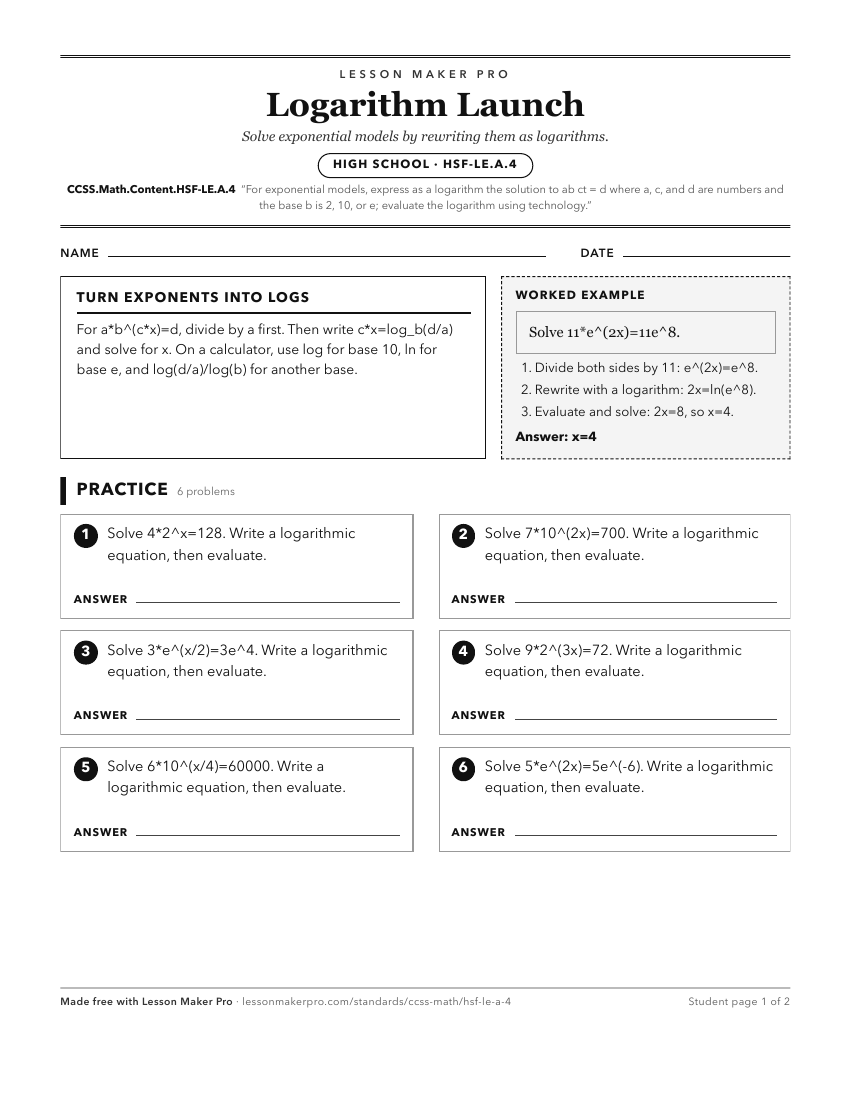
A ready-to-print activity worksheet aligned to CCSS.Math.Content.HSF-LE.A.4, with an answer key for the teacher on its own page. No account needed.
PDF, US Letter, prints cleanly in black and white.
Download the worksheetLearning progression
Where This Standard Sits
Before This Standard
If students are struggling here, check these first.
- CCSS.Math.Content.HSF-BF.B.5
Solving exponential model equations by writing logarithms directly requires knowing logarithms undo exponents.
- CCSS.Math.Content.HSA-SSE.B.3c
Rewriting exponential expressions supports isolating and interpreting b^(ct) before using logarithms to solve for the exponent.
- CCSS.Math.Content.HSA-CED.A.4
Solving the exponential equation requires isolating the exponential term and the variable before applying a logarithm.
Keep exploring
Related Standards
- CCSS.Math.Content.HSF-LE.A.1
Distinguish between situations that can be modeled with linear functions and with exponential functions.
- CCSS.Math.Content.HSF-LE.B.5
Interpret the parameters in a linear or exponential function in terms of a context.
- CCSS.Math.Content.HSF-LE.A
Construct and compare linear, quadratic, and exponential models and solve problems
Turn this exact standard into a lesson
Grade, subject, topic, and the complete standard are prefilled. Create one free, no account needed.
Also for this standard:Make a WorksheetMake a QuizMake a Sub Lesson