CCSS.
The Standard
Distinguish between situations that can be modeled with linear functions and with exponential functions.
Common Core State Standards for Mathematics
Teacher's field guide
What This Standard Means
What Students Need to Do
- Students decide whether a situation shows additive change or multiplicative change. They use tables, graphs, equations, and verbal descriptions to identify linear and exponential models and explain their reasoning.
What Mastery Looks Like
- Students correctly classify tables, graphs, equations, and descriptions as linear or exponential. They justify each choice using a constant difference, constant rate, constant ratio, or repeated percent change.
Common Misconceptions
- Students may call any increasing graph exponential or assume a curved graph must show exponential growth. They often confuse adding the same amount with multiplying by the same factor. They may also compare raw changes instead of consecutive differences or ratios.
How to Assess It
- Give students the sequences 5, 9, 13, 17 and 5, 10, 20, 40. Ask them to label each linear or exponential and justify using differences or ratios.
Lesson moves
Ways to Teach It
Use counters to build one pattern by adding three each round and another by doubling, then record both patterns in tables.
Ask students to explain why earning $20 weekly is linear while a savings balance growing 5 percent monthly is exponential.
Run a card sort with equations, tables, graphs, and scenarios, requiring students to match representations and state the evidence.
Compare simple and compound interest on $500 over five years, then identify which balance is linear and which is exponential.
Free download
Printable HSF-LE.A.1 Worksheet
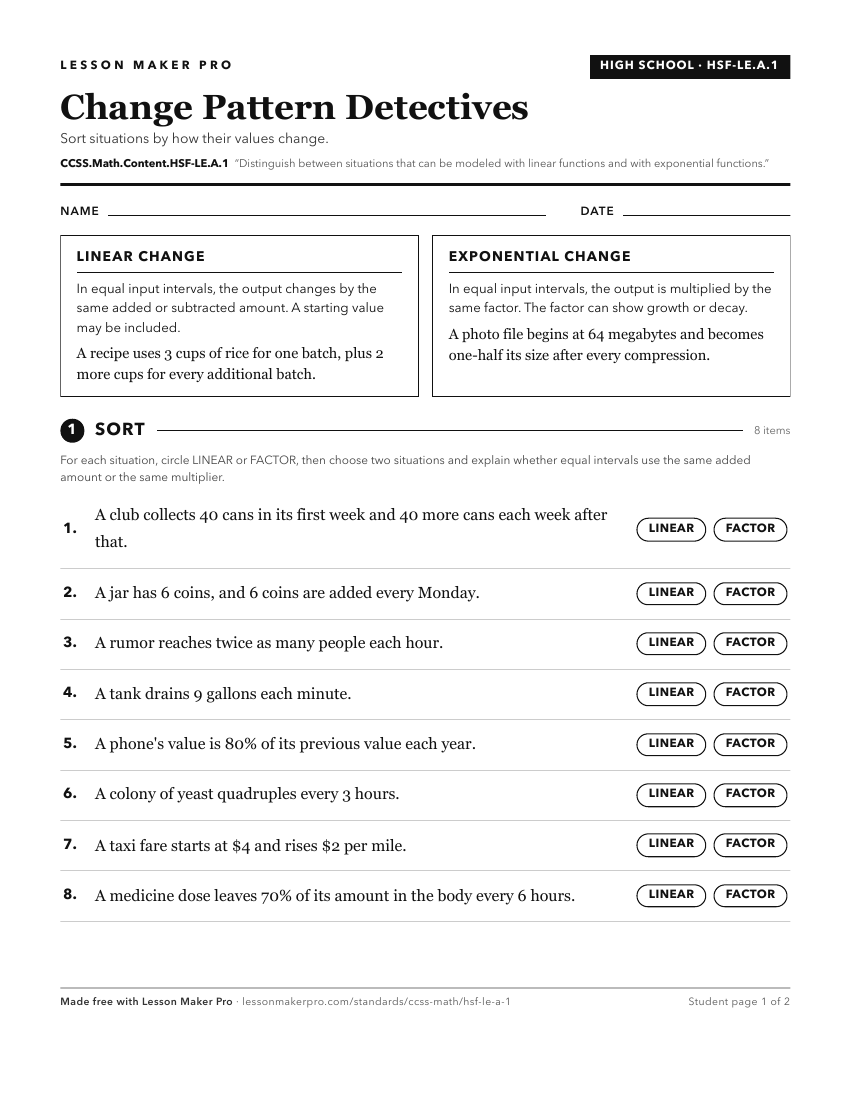
A ready-to-print activity worksheet aligned to CCSS.Math.Content.HSF-LE.A.1, with an answer key for the teacher on its own page. No account needed.
PDF, US Letter, prints cleanly in black and white.
Download the worksheetLearning progression
Where This Standard Sits
Before This Standard
If students are struggling here, check these first.
- CCSS.Math.Content.8.F.A.1
Recognizing functions as input output rules supports comparing constant differences and constant ratios in linear and exponential models.
- CCSS.Math.Content.8.F.A.3
Recognizing y=mx+b and straight-line graphs supports comparing constant-change linear models with exponential growth or decay situations.
- CCSS.Math.Content.8.EE.A.1
Exponent notation and equivalent powers support writing exponential patterns, though distinguishing additive from multiplicative change can begin conceptually.
What This Unlocks
Mastery here sets students up for these next.
Keep exploring
Related Standards
- CCSS.Math.Content.HSF-LE.A.1a
Prove that linear functions grow by equal differences over equal intervals, and that exponential functions grow by equal factors over equal intervals.
- CCSS.Math.Content.HSF-LE.B.5
Interpret the parameters in a linear or exponential function in terms of a context.
- CCSS.Math.Content.HSF-LE.A
Construct and compare linear, quadratic, and exponential models and solve problems
Turn this exact standard into a lesson
Grade, subject, topic, and the complete standard are prefilled. Create one free, no account needed.
Also for this standard:Make a WorksheetMake a QuizMake a Sub Lesson