CCSS.
The Standard
Construct linear and exponential functions, including arithmetic and geometric sequences, given a graph, a description of a relationship, or two input-output pairs (include reading these from a table).
Common Core State Standards for Mathematics
Teacher's field guide
What This Standard Means
What Students Need to Do
- Students decide whether outputs change by equal amounts or equal factors. They find the starting value and write a rule for any input, including a term number in a sequence. They read the needed values from a graph, table, or situation.
What Mastery Looks Like
- A student can calculate slope and intercept from two points, even when the input step is not one. They can find a per-step growth factor and initial value, then use either rule to predict and verify outputs. They can also write nth-term rules for arithmetic and geometric sequences.
Common Misconceptions
- Students may confuse a constant added amount with a constant multiplying factor. They may calculate slope without dividing by the input change. For exponential data, they may use the total ratio as the base when inputs differ by more than one.
How to Assess It
- Exit ticket: A linear rule passes through (2, 11) and (5, 23), and an exponential rule passes through (1, 6) and (3, 54). Write both rules and show how you found each rate.
Lesson moves
Ways to Teach It
Build two sequences with linking cubes, adding three cubes each round for one and doubling groups for the other, then write both rules.
Ask, “How can you tell from a table whether change is additive or multiplicative, and where is the starting value?”
Play a model matching relay where teams pair graph, table, context, and equation cards, then justify every match.
Compare a taxi fare with a savings account: write each rule from posted rates, then predict costs and balances after given times.
Free download
Printable HSF-LE.A.2 Worksheet
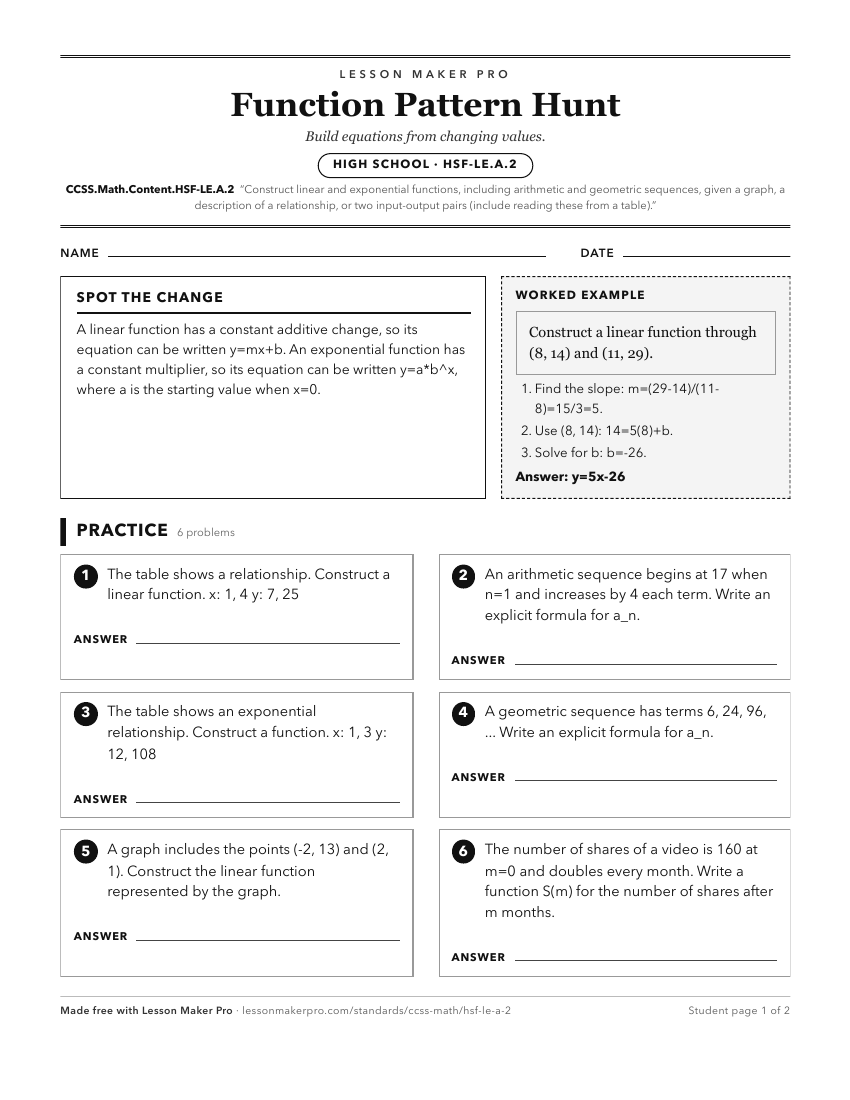
A ready-to-print activity worksheet aligned to CCSS.Math.Content.HSF-LE.A.2, with an answer key for the teacher on its own page. No account needed.
PDF, US Letter, prints cleanly in black and white.
Download the worksheetLearning progression
Where This Standard Sits
Before This Standard
If students are struggling here, check these first.
- CCSS.Math.Content.8.F.B.4
Constructing linear rules from tables, graphs, and contexts carries over directly before adding exponential models and sequences.
- CCSS.Math.Content.HSF-LE.A.1
Choosing whether change is constant or by a constant factor helps students select the correct linear or exponential function form.
- CCSS.Math.Content.HSF-BF.A.1a
Writing explicit or recursive rules from contexts supports forming linear, exponential, arithmetic, and geometric function models from descriptions or tables.
What This Unlocks
Mastery here sets students up for these next.
- CCSS.Math.Content.HSF-LE.B.5
Writing linear and exponential rules from contexts supports seeing slope, intercept, initial value, and growth factor as meaningful quantities.
- CCSS.Math.Content.HSF-BF.A.2
Constructing arithmetic and geometric rules from tables or descriptions supports finding common differences or ratios for explicit and recursive sequence formulas.
Keep exploring
Related Standards
Turn this exact standard into a lesson
Grade, subject, topic, and the complete standard are prefilled. Create one free, no account needed.
Also for this standard:Make a WorksheetMake a QuizMake a Sub Lesson