CCSS.
The Standard
Prove that linear functions grow by equal differences over equal intervals, and that exponential functions grow by equal factors over equal intervals.
Common Core State Standards for Mathematics · Construct and compare linear, quadratic, and exponential models and solve problems
Teacher's field guide
What This Standard Means
What Students Need to Do
- Students examine tables, equations, and graphs to compare output changes over matching input intervals. They calculate differences for linear functions and ratios for exponential functions. They use algebra to show why each pattern continues.
What Mastery Looks Like
- Given an equation or table, a student identifies equal input intervals and computes output differences or ratios. For an interval of length h, the student derives mh for a linear function and b^h as the exponential factor.
Common Misconceptions
- Students may check differences in output values without noticing that the input values are not equally spaced. They may confuse repeated addition with repeated multiplication, or label rapid linear growth as exponential.
How to Assess It
- Exit ticket: For f(x)=3x+2 and g(x)=2(3^x), find outputs at x=0, 1, and 2, then identify the constant difference or ratio. Require one algebraic sentence explaining why each pattern continues.
Lesson moves
Ways to Teach It
Give groups table cards for linear and exponential functions; students calculate changes, sort the cards, and defend one placement.
Ask students to write: Why does adding 2 to x add 2m for f(x)=mx+b but multiply g(x)=ab^x by b²?
Play Constant Difference or Constant Ratio bingo using projected tables, with students marking the matching model and showing calculations on mini whiteboards.
Compare a job paying $20 more each week with an account growing 5 percent weekly, then chart eight weeks and describe each pattern.
Free download
Printable HSF-LE.A.1a Worksheet
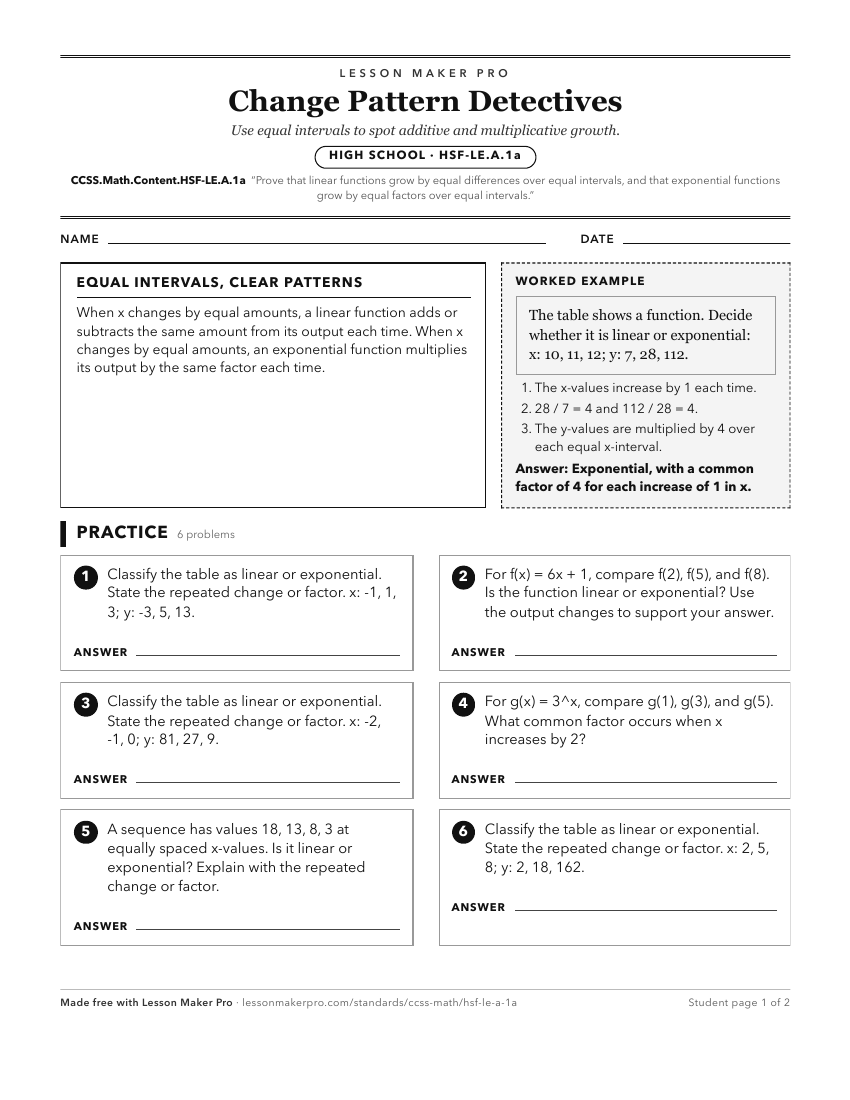
A ready-to-print activity worksheet aligned to CCSS.Math.Content.HSF-LE.A.1a, with an answer key for the teacher on its own page. No account needed.
PDF, US Letter, prints cleanly in black and white.
Download the worksheetLearning progression
Where This Standard Sits
Before This Standard
If students are struggling here, check these first.
- CCSS.Math.Content.HSF-IF.A.1
Understanding inputs, outputs, and f(x) supports comparing function values across intervals to prove linear and exponential growth patterns.
- CCSS.Math.Content.8.F.A.3
Knowing linear functions as y = mx + b supports showing slope gives the same output change for equal input intervals.
- CCSS.Math.Content.HSA-SSE.B.3c
Rewriting b^(x+h) as b^x times b^h is what proves exponential functions have equal factors over equal intervals.
What This Unlocks
Mastery here sets students up for these next.
- CCSS.Math.Content.HSF-LE.A.1c
Recognizing constant percent change uses the idea that exponential growth multiplies by the same factor each interval.
- CCSS.Math.Content.HSF-LE.A.3
Recognizing constant differences versus constant factors helps students compare table patterns and see why exponential growth eventually outpaces polynomial growth.
Keep exploring
Related Standards
- CCSS.Math.Content.HSF-LE.A.1
Distinguish between situations that can be modeled with linear functions and with exponential functions.
- CCSS.Math.Content.HSF-LE.A.2
Construct linear and exponential functions, including arithmetic and geometric sequences, given a graph, a description of a relationship, or two input-output pa...
Turn this exact standard into a lesson
Grade, subject, topic, and the complete standard are prefilled. Create one free, no account needed.
Also for this standard:Make a WorksheetMake a QuizMake a Sub Lesson