CCSS.
The Standard
Understand that a function from one set (called the domain) to another set (called the range) assigns to each element of the domain exactly one element of the range. If f is a function and x is an element of its domain, then f(x) denotes the output of f corresponding to the input x. The graph of f is the graph of the equation y = f(x).
Common Core State Standards for Mathematics
Teacher's field guide
What This Standard Means
What Students Need to Do
- Students decide whether a relation gives each input only one output. They use function notation to name outputs. They connect ordered pairs on a graph to input and output values.
What Mastery Looks Like
- Students can identify functions in tables, mappings, ordered pairs, and graphs. They can name the domain and range, evaluate f(x), and explain what a plotted point represents.
Common Misconceptions
- Students may think repeated outputs mean a relation is not a function. They may read f(x) as multiplication. They may also confuse input values with output values on a graph.
How to Assess It
- Exit ticket: Given {(-1, 3), (0, 2), (2, 3)}, decide whether it is a function, justify your answer, state f(0), and plot the points.
Lesson moves
Ways to Teach It
Use input and output cards with string links, then have students fix any mapping where one input connects to two outputs.
Ask students to explain why two inputs may share an output, but one input cannot have two outputs.
Play a Function or Not card sort using tables, ordered pairs, mapping diagrams, and graphs.
Match times to recorded temperatures, then discuss why each time must have only one temperature reading in the data set.
Free download
Printable HSF-IF.A.1 Worksheet
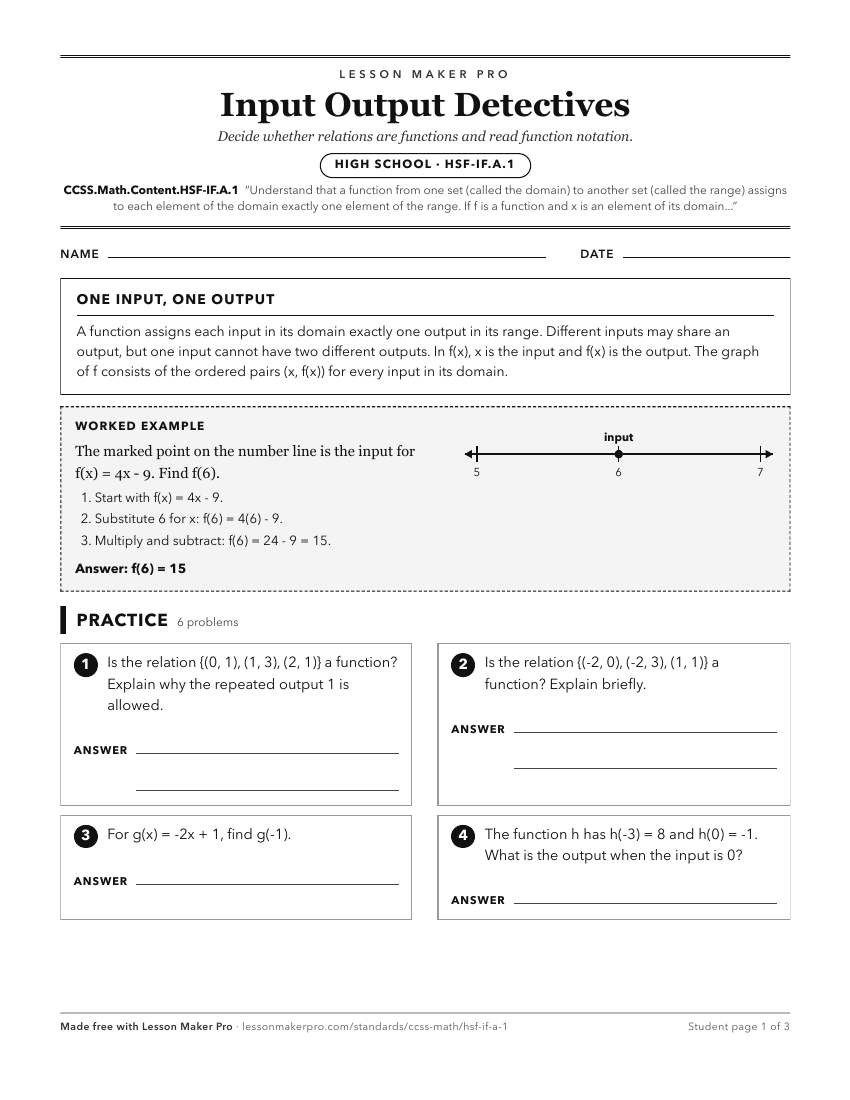
A ready-to-print activity worksheet aligned to CCSS.Math.Content.HSF-IF.A.1, with an answer key for the teacher on its own page. No account needed.
PDF, US Letter, prints cleanly in black and white.
Download the worksheetLearning progression
Where This Standard Sits
Before This Standard
If students are struggling here, check these first.
- CCSS.Math.Content.8.F.A.1
The high school definition formalizes the same input-output rule using domain, range, function notation, and graphs as y = f(x).
- CCSS.Math.Content.HSA-REI.D.10
Seeing a graph as solution pairs supports interpreting a function graph as all input-output pairs satisfying y = f(x).
What This Unlocks
Mastery here sets students up for these next.
- CCSS.Math.Content.HSF-IF.A.3
Recognizing sequences as functions requires knowing functions pair each allowed input with exactly one output and have a domain.
- CCSS.Math.Content.HSF-BF.A.1a
Writing rules from contexts uses the idea that each input has one output and can be named with function notation.
- CCSS.Math.Content.HSF-BF.B.4d
Restricting a domain to make an inverse requires knowing functions, domains, outputs, and graphs from the function definition.
- CCSS.Math.Content.HSF-LE.A.1a
Understanding inputs, outputs, and f(x) supports comparing function values across intervals to prove linear and exponential growth patterns.
- CCSS.Math.Content.HSF-BF.B.4c
Reading inverse values requires treating outputs as inputs and using function notation, tables, and graphs to connect x-values and y-values.
- CCSS.Math.Content.HSF-BF.A.1
Writing a function requires knowing inputs, outputs, f(x) notation, and that each input has exactly one output.
Keep exploring
Related Standards
- CCSS.Math.Content.HSA-REI.D.11
Explain why the x-coordinates of the points where the graphs of the equations y = f(x) and y = g(x) intersect are the solutions of the equation f(x) = g(x); fin...
- CCSS.Math.Content.HSF-IF.A.2
Use function notation, evaluate functions for inputs in their domains, and interpret statements that use function notation in terms of a context.
- CCSS.Math.Content.HSF-IF.B.5
Relate the domain of a function to its graph and, where applicable, to the quantitative relationship it describes.
Turn this exact standard into a lesson
Grade, subject, topic, and the complete standard are prefilled. Create one free, no account needed.
Also for this standard:Make a WorksheetMake a QuizMake a Sub Lesson