CCSS.
The Standard
Relate the domain of a function to its graph and, where applicable, to the quantitative relationship it describes.
Common Core State Standards for Mathematics
Teacher's field guide
What This Standard Means
What Students Need to Do
- Students identify which input values are allowed for a function. They read those limits from a graph and adjust them when a real situation restricts the inputs.
What Mastery Looks Like
- Students can state a domain from a graph using words, inequalities, or interval notation. They can decide whether inputs should be continuous or discrete and explain any limits from the situation.
Common Misconceptions
- Students may give the range instead of the domain. They may choose all real numbers from an equation even when the context allows only whole numbers. They may also overlook open endpoints, closed endpoints, holes, or arrows on a graph.
How to Assess It
- Show a graph of water depth during a 10-minute tank-filling period, with closed endpoints at 0 and 10. Ask students to state the domain and explain why both endpoints are included.
Lesson moves
Ways to Teach It
Sort cards showing graphs, tables, and situations into continuous, discrete, and restricted domains, then match each set with interval notation.
Write whether the input for concert tickets should be whole numbers or real numbers, and defend the choice with one sentence.
Play Domain Detective: teams inspect graph endpoints, holes, and arrows, then earn points for stating each domain correctly.
Use a phone battery graph from one school day to identify the meaningful time interval and explain why later times are excluded.
Free download
Printable HSF-IF.B.5 Worksheet
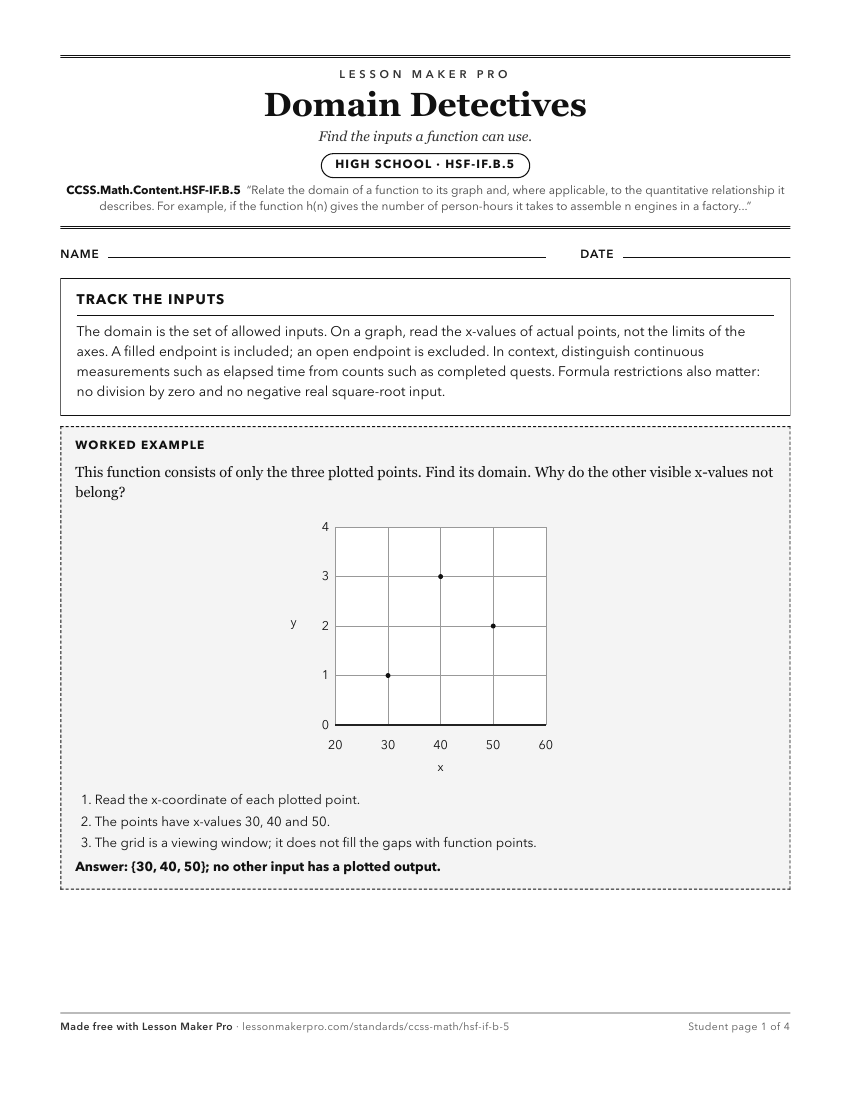
A ready-to-print activity worksheet aligned to CCSS.Math.Content.HSF-IF.B.5, with an answer key for the teacher on its own page. No account needed.
PDF, US Letter, prints cleanly in black and white.
Download the worksheetLearning progression
Where This Standard Sits
Before This Standard
If students are struggling here, check these first.
- CCSS.Math.Content.8.F.A.1
Understanding inputs, outputs, and graph points is necessary to identify the domain and interpret its meaning in context.
- CCSS.Math.Content.HSF-IF.A.1
Students must know domain as allowable inputs and graph points y=f(x) before connecting domain restrictions to graphs and contexts.
- CCSS.Math.Content.HSF-IF.B.4
Interpreting graph features in context supports seeing which input values appear on the graph and make sense in the situation.
What This Unlocks
Mastery here sets students up for these next.
- CCSS.Math.Content.HSF-BF.B.4d
Restricting a function’s domain to make it one-to-one requires seeing how allowed inputs appear on and limit the graph.
- CCSS.Math.Content.HSF-IF.C.7b
Understanding domain helps students know where square root and piecewise graphs exist and how intervals limit the graph.
- CCSS.Math.Content.HSF-IF.C.7d
Understanding domain restrictions helps students connect excluded x-values to rational-function graphs, especially vertical asymptotes and holes.
- CCSS.Math.Content.HSF-TF.B.6
Students use domain and graph understanding to see why a trig function must be restricted before it has an inverse.
Keep exploring
Related Standards
- CCSS.Math.Content.8.F.A.2
Compare properties of two functions each represented in a different way (algebraically, graphically, numerically in tables, or by verbal descriptions).
- CCSS.Math.Content.8.F.B.5
Describe qualitatively the functional relationship between two quantities by analyzing a graph (e.g., where the function is increasing or decreasing, linear or ...
- CCSS.Math.Content.HSF-LE.A.2
Construct linear and exponential functions, including arithmetic and geometric sequences, given a graph, a description of a relationship, or two input-output pa...
Turn this exact standard into a lesson
Grade, subject, topic, and the complete standard are prefilled. Create one free, no account needed.
Also for this standard:Make a WorksheetMake a QuizMake a Sub Lesson