CCSS.
The Standard
(+) Graph rational functions, identifying zeros and asymptotes when suitable factorizations are available, and showing end behavior.
Common Core State Standards for Mathematics · Analyze functions using different representations
Teacher's field guide
What This Standard Means
What Students Need to Do
- Students factor the numerator and denominator to find zeros, excluded inputs, holes, and vertical asymptotes. They compare degrees or divide polynomials to find horizontal or slant asymptotes. They use these features to sketch the graph and show end behavior.
What Mastery Looks Like
- Given a factored rational function, a student labels intercepts, holes, asymptotes, and enough points to sketch every branch. The graph has the correct sign on each interval and approaches the correct line at both ends.
Common Misconceptions
- Students often mark every denominator zero as a vertical asymptote, even when a canceled factor creates a hole. They may treat a horizontal asymptote as a boundary the graph cannot cross. They also confuse zeros with excluded inputs or ignore multiplicity at an x-intercept.
How to Assess It
- Exit ticket: Graph f(x)=((x-2)(x+1))/((x-2)(x-3)). Label the zero, hole, vertical and horizontal asymptotes, and describe the end behavior.
Lesson moves
Ways to Teach It
Place colored tape for asymptotes on a coordinate grid, then plot interval test points and sketch each branch around the tape.
Compare f(x)=(x-2)/(x-3) and g(x)=(x-2)^2/((x-2)(x-3)); explain why x=2 behaves differently.
Run a card sort matching factored equations, graphs, zeros, holes, asymptotes, and end behavior descriptions.
Graph A(n)=500/n+8 as average cost per item, then interpret the horizontal asymptote and explain why n must be positive.
Free download
Printable HSF-IF.C.7d Worksheet
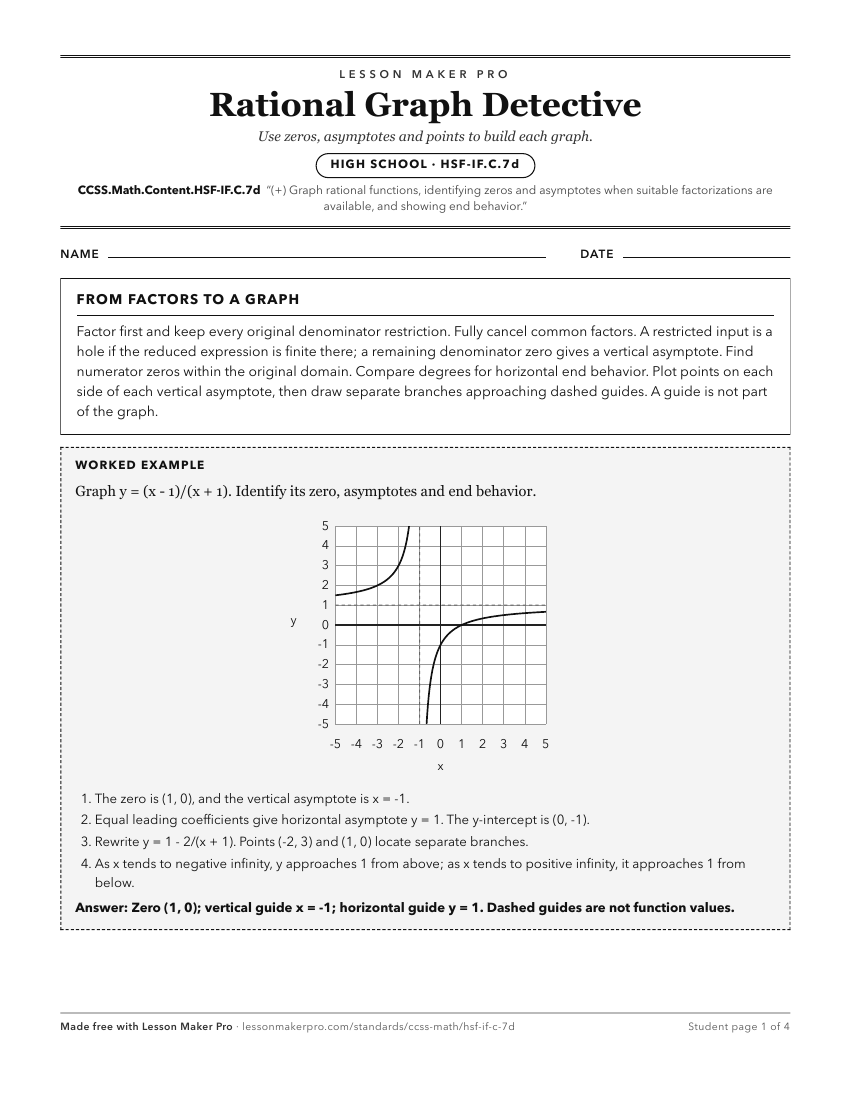
A ready-to-print activity worksheet aligned to CCSS.Math.Content.HSF-IF.C.7d, with an answer key for the teacher on its own page. No account needed.
PDF, US Letter, prints cleanly in black and white.
Download the worksheetLearning progression
Where This Standard Sits
Before This Standard
If students are struggling here, check these first.
- CCSS.Math.Content.HSA-APR.D.6
Rewriting rational expressions by division helps identify quotient end behavior and slant asymptotes when graphing rational functions.
- CCSS.Math.Content.HSF-IF.C.7
Rational-function graphing requires the general skill of turning symbolic rules into graphs and identifying important features.
- CCSS.Math.Content.HSF-IF.B.5
Understanding domain restrictions helps students connect excluded x-values to rational-function graphs, especially vertical asymptotes and holes.
Keep exploring
Related Standards
- CCSS.Math.Content.HSA-APR.B.3
Identify zeros of polynomials when suitable factorizations are available, and use the zeros to construct a rough graph of the function defined by the polynomial...
- CCSS.Math.Content.HSF-IF.C.8a
Use the process of factoring and completing the square in a quadratic function to show zeros, extreme values, and symmetry of the graph, and interpret these in ...
- CCSS.Math.Content.HSF-IF.C.7c
Graph polynomial functions, identifying zeros when suitable factorizations are available, and showing end behavior.
- CCSS.Math.Content.HSA-SSE.B.3a
Factor a quadratic expression to reveal the zeros of the function it defines.
Turn this exact standard into a lesson
Grade, subject, topic, and the complete standard are prefilled. Create one free, no account needed.
Also for this standard:Make a WorksheetMake a QuizMake a Sub Lesson