CCSS.
The Standard
Graph polynomial functions, identifying zeros when suitable factorizations are available, and showing end behavior.
Common Core State Standards for Mathematics · Analyze functions using different representations
Teacher's field guide
What This Standard Means
What Students Need to Do
- Students use a polynomial’s factors to find where its graph meets the x-axis. They sketch the graph and show how each tail behaves based on the degree and leading coefficient.
What Mastery Looks Like
- A student can use a factored equation to locate each x-intercept and decide whether the graph crosses or turns there. The sketch shows correct intercepts, a reasonable shape, and correct left and right tail directions.
Common Misconceptions
- Students may report 2 as the zero of x + 2 instead of -2. They often draw every zero as a crossing, even when an even multiplicity makes the graph touch and turn. They may reverse the tails by ignoring the leading coefficient’s sign.
How to Assess It
- Ask students to sketch f(x) = (x + 2)(x - 1)^2, label each zero, and add arrows showing both tails. Have them explain why the graph crosses or turns at each zero.
Lesson moves
Ways to Teach It
Use a floor coordinate grid, place sticky notes at roots, then shape yarn through them and add arrow cards for both ends.
Compare f(x) = (x - 2)^2(x + 1) and g(x) = (x - 2)(x + 1)^2; write how repeated factors change each graph.
Play a card match with factored equations, zero lists, tail descriptions, and graph cards; students justify every completed set.
Graph V(x) = x(20 - 2x)(30 - 2x) for an open box cut from a 20-by-30 sheet, then explain which zeros make physical sense.
Free download
Printable HSF-IF.C.7c Worksheet
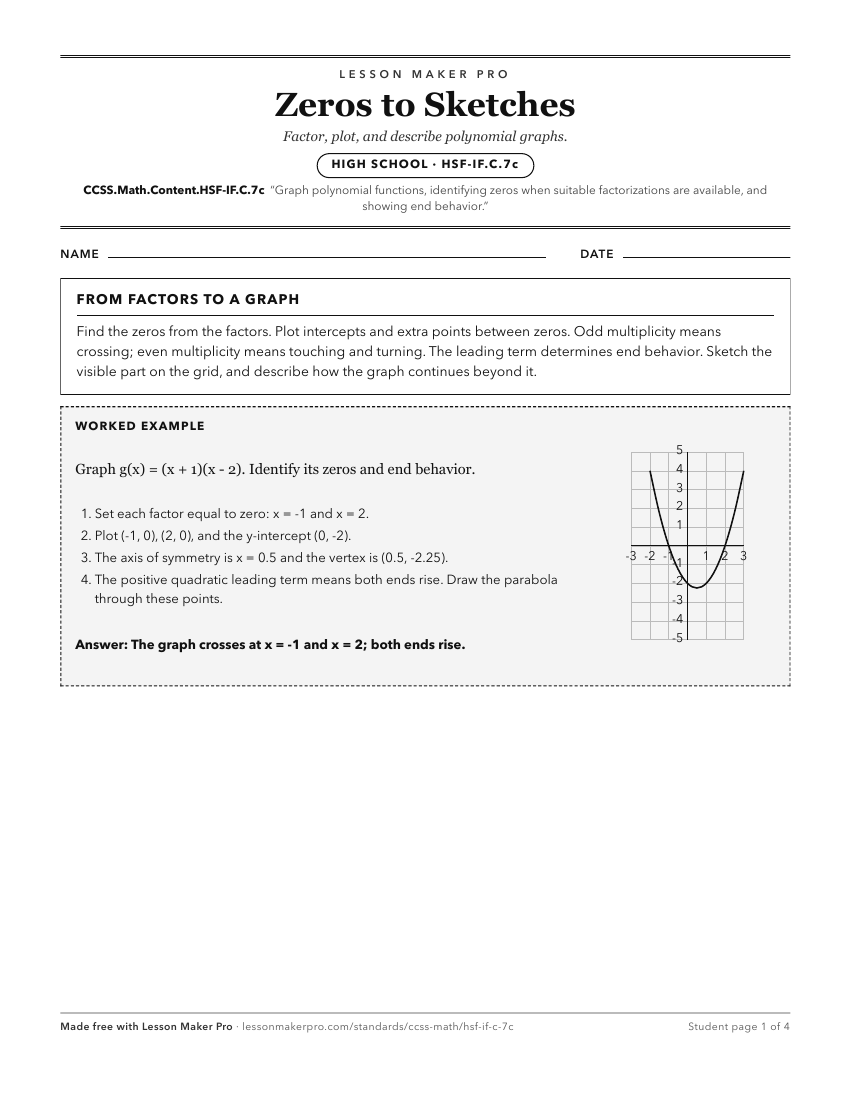
A ready-to-print activity worksheet aligned to CCSS.Math.Content.HSF-IF.C.7c, with an answer key for the teacher on its own page. No account needed.
PDF, US Letter, prints cleanly in black and white.
Download the worksheetLearning progression
Where This Standard Sits
Before This Standard
If students are struggling here, check these first.
- CCSS.Math.Content.HSA-APR.B.3
Finding zeros from factored forms and sketching their graph locations are essential parts of graphing polynomials with end behavior.
- CCSS.Math.Content.HSA-SSE.A.2
Recognizing expression structure supports factoring polynomials, which helps identify zeros needed when graphing polynomial functions.
- CCSS.Math.Content.HSA-REI.D.10
Students use the idea that points on y=f(x) satisfy the equation when plotting polynomials and interpreting zeros.
Keep exploring
Related Standards
- CCSS.Math.Content.HSA-APR.B
Understand the relationship between zeros and factors of polynomials
- CCSS.Math.Content.HSF-IF.C.8a
Use the process of factoring and completing the square in a quadratic function to show zeros, extreme values, and symmetry of the graph, and interpret these in ...
- CCSS.Math.Content.HSF-IF.C.7d
(+) Graph rational functions, identifying zeros and asymptotes when suitable factorizations are available, and showing end behavior.
Turn this exact standard into a lesson
Grade, subject, topic, and the complete standard are prefilled. Create one free, no account needed.
Also for this standard:Make a WorksheetMake a QuizMake a Sub Lesson