CCSS.
The Standard
Understand that the graph of an equation in two variables is the set of all its solutions plotted in the coordinate plane, often forming a curve (which could be a line).
Common Core State Standards for Mathematics
Teacher's field guide
What This Standard Means
What Students Need to Do
- Students connect ordered pairs to equations by substituting x- and y-values. They recognize that the complete graph contains every ordered pair that makes the equation true.
What Mastery Looks Like
- Students can test an ordered pair by substitution and locate it correctly on the coordinate plane. They can explain why points on the line or curve satisfy the equation and points off it do not.
Common Misconceptions
- Students may call a point a solution because it looks close to the graph, without checking by substitution. They may reverse the x- and y-coordinates or think only plotted table points are solutions.
How to Assess It
- Exit ticket: For y = 2x - 3, decide whether (4, 5) and (2, 2) are solutions. Show each substitution and explain your decision.
Lesson moves
Ways to Teach It
Give students coordinate cards to test in an equation, then place accepted points on a large floor coordinate grid.
Ask students to write why a point that lies near a line is not necessarily a solution.
Play a solution sort game where teams classify ordered pairs as on or off a graph, then verify by substitution.
Graph C = 3 + 2m for a taxi fare, then interpret which distance and cost pairs are possible.
Free download
Printable HSA-REI.D.10 Worksheet
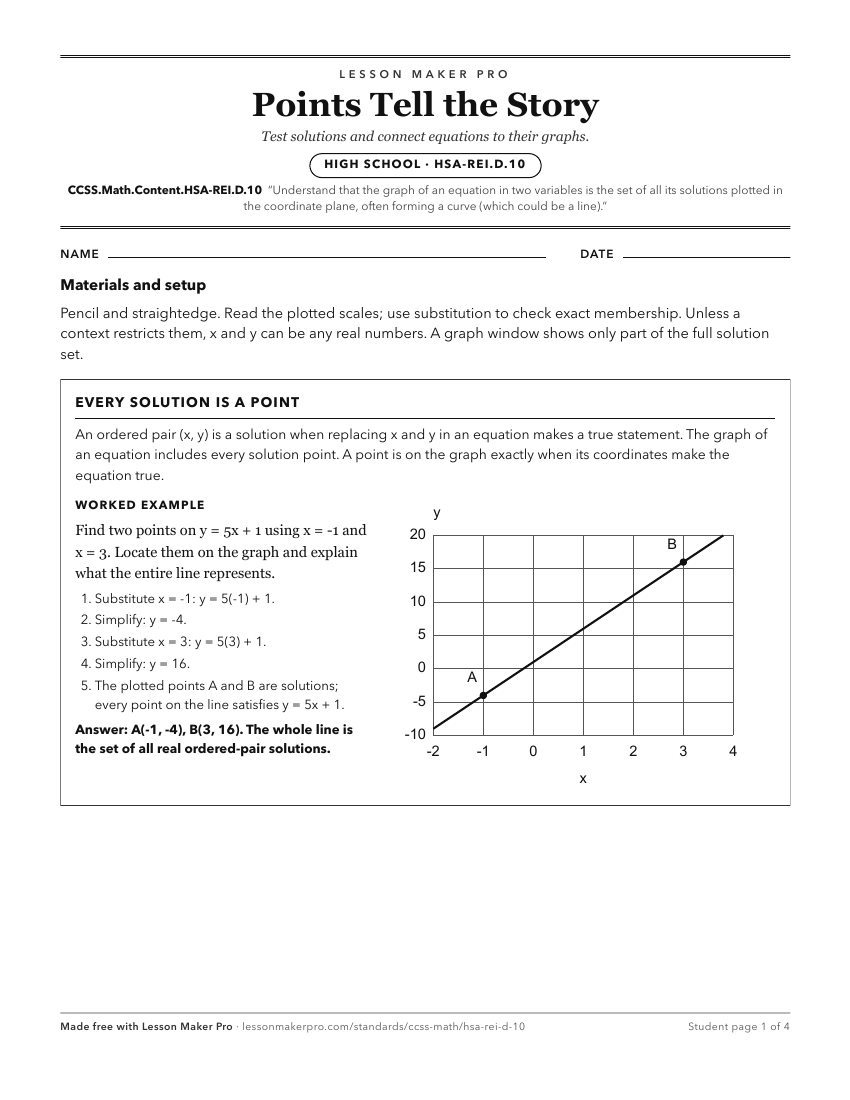
A ready-to-print activity worksheet aligned to CCSS.Math.Content.HSA-REI.D.10, with an answer key for the teacher on its own page. No account needed.
PDF, US Letter, prints cleanly in black and white.
Download the worksheetLearning progression
Where This Standard Sits
Before This Standard
If students are struggling here, check these first.
- CCSS.Math.Content.8.F.A.1
Function graphs introduce graphs as ordered pairs, supporting the shift to equations whose graphs include all solution pairs.
- CCSS.Math.Content.7.RP.A.2d
Interpreting points on proportional graphs supports seeing any graph as coordinate pairs that satisfy a two-variable relationship.
- CCSS.Math.Content.8.F.A.3
Seeing y = mx + b as a line helps students generalize graphs as all coordinate pairs satisfying an equation.
What This Unlocks
Mastery here sets students up for these next.
- CCSS.Math.Content.HSA-CED.A.2
Students use the idea that graph points are equation solutions when graphing their own equations with meaningful axes and scales.
- CCSS.Math.Content.HSA-REI.D.11
Students must know each graph shows all solutions to its equation to see intersections as inputs making both outputs equal.
- CCSS.Math.Content.HSA-REI.D.12
Graphing inequality half-planes requires seeing a two-variable relation as all coordinate pairs that make the statement true.
- CCSS.Math.Content.HSF-IF.C.7a
Students use the idea that plotted points satisfy the equation when finding intercepts and sketching linear or quadratic graphs.
- CCSS.Math.Content.HSA-REI.C.7
Solving graphically requires seeing each line or parabola as all solutions, so intersections represent shared solutions to the system.
- CCSS.Math.Content.HSF-IF.C.7c
Students use the idea that points on y=f(x) satisfy the equation when plotting polynomials and interpreting zeros.
Keep exploring
Related Standards
Turn this exact standard into a lesson
Grade, subject, topic, and the complete standard are prefilled. Create one free, no account needed.
Also for this standard:Make a WorksheetMake a QuizMake a Sub Lesson