CCSS.
The Standard
Solve a simple system consisting of a linear equation and a quadratic equation in two variables algebraically and graphically.
Common Core State Standards for Mathematics
Teacher's field guide
What This Standard Means
What Students Need to Do
- Students substitute the linear expression into the quadratic equation and solve for x. They use each x-value to find the matching y-value. They graph both relations and connect intersection points to the ordered-pair solutions.
What Mastery Looks Like
- A student correctly uses substitution to create and solve one quadratic equation. They find zero, one, or two ordered-pair solutions. They verify each solution in both original equations and locate it on the graph.
Common Misconceptions
- Students may stop after finding x-values and never calculate the matching y-values. They may assume every system has two solutions. They may also trust a rough graph instead of checking intersections algebraically.
How to Assess It
- Give the exit ticket: Solve y = x + 2 and y = x² both algebraically and graphically. List each solution as an ordered pair and explain how the graph confirms it.
Lesson moves
Ways to Teach It
Plot a line and parabola on separate transparencies, overlay them, then mark and verify every intersection.
Ask students to explain why a line and parabola can meet zero, one, or two times.
Run a card sort matching systems, substituted quadratic equations, graphs, and solution sets.
Model a ball’s parabolic path crossing a sloped ramp, then calculate where the path and ramp meet.
Free download
Printable HSA-REI.C.7 Worksheet
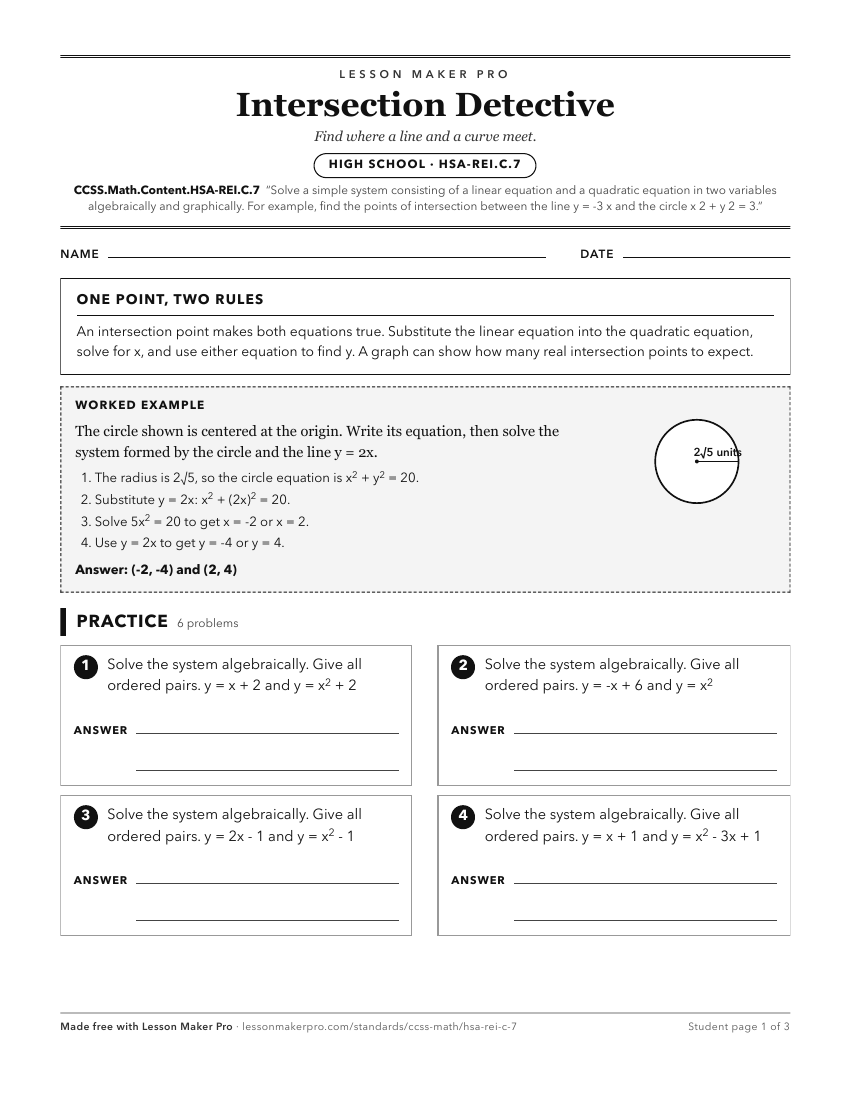
A ready-to-print activity worksheet aligned to CCSS.Math.Content.HSA-REI.C.7, with an answer key for the teacher on its own page. No account needed.
PDF, US Letter, prints cleanly in black and white.
Download the worksheetLearning progression
Where This Standard Sits
Before This Standard
If students are struggling here, check these first.
- CCSS.Math.Content.HSA-REI.B.4
Solving a linear-quadratic system often reduces by substitution to a one-variable quadratic equation whose roots give intersection points.
- CCSS.Math.Content.HSA-REI.C.6
Linear systems introduce simultaneous solutions and graph intersections, which carry over when one equation becomes quadratic.
- CCSS.Math.Content.HSA-REI.D.10
Solving graphically requires seeing each line or parabola as all solutions, so intersections represent shared solutions to the system.
Keep exploring
Related Standards
Turn this exact standard into a lesson
Grade, subject, topic, and the complete standard are prefilled. Create one free, no account needed.
Also for this standard:Make a WorksheetMake a QuizMake a Sub Lesson