CCSS.
The Standard
Use the process of factoring and completing the square in a quadratic function to show zeros, extreme values, and symmetry of the graph, and interpret these in terms of a context.
Common Core State Standards for Mathematics · Analyze functions using different representations
Teacher's field guide
What This Standard Means
What Students Need to Do
- Students rewrite quadratic functions by factoring and completing the square. They use each form to find intercepts, a maximum or minimum, and the line of symmetry, then explain what those values mean in a situation.
What Mastery Looks Like
- Students move correctly among standard, factored, and vertex forms without changing the function. They identify zeros, the vertex, and the axis of symmetry, then explain each value with units and reject answers that do not fit the situation.
Common Misconceptions
- Students often reverse signs when finding zeros from factors or reading the vertex from vertex form. They may change the function while completing the square or confuse zeros with the y-intercept. They may also report a negative time or another answer that does not fit the context.
How to Assess It
- Exit ticket: For h(t) = -16t² + 64t + 80, write factored and vertex forms. Find the landing time, maximum height, time of maximum height, and axis of symmetry.
Lesson moves
Ways to Teach It
Build x² + 6x + 5 with algebra tiles, identify four missing unit tiles, and write the matching vertex form.
Ask: Which form best shows the roots, maximum, and symmetry, and what evidence supports each choice?
Run a card match with standard forms, factored forms, vertex forms, graphs, and feature cards, requiring a written justification for each set.
Use P(x) = -2(x - 10)(x - 50) for a fundraiser; students find break-even sales, maximum profit, and the sales count producing it.
Free download
Printable HSF-IF.C.8a Worksheet
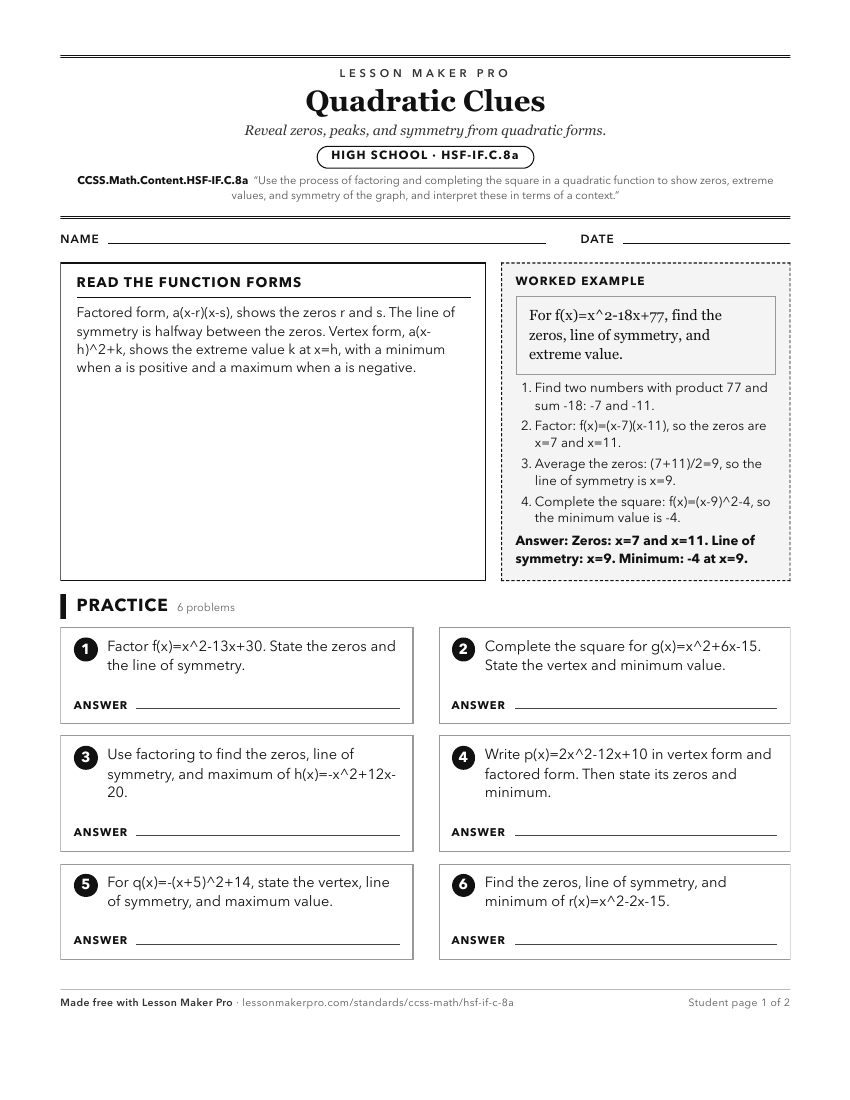
A ready-to-print activity worksheet aligned to CCSS.Math.Content.HSF-IF.C.8a, with an answer key for the teacher on its own page. No account needed.
PDF, US Letter, prints cleanly in black and white.
Download the worksheetLearning progression
Where This Standard Sits
Before This Standard
If students are struggling here, check these first.
- CCSS.Math.Content.HSA-SSE.B.3b
Completing the square to find a quadratic’s maximum or minimum is needed to show vertex, symmetry, and contextual extremes.
- CCSS.Math.Content.HSA-SSE.B.3a
Factoring quadratics to find zeros is directly needed when the target uses factored form to analyze roots and graph features.
- CCSS.Math.Content.HSF-IF.B.4
Interpreting zeros, extremes, symmetry, and context in quadratic forms relies on recognizing those same key features in graphs and tables.
Keep exploring
Related Standards
- CCSS.Math.Content.HSA-REI.B.4b
Solve quadratic equations by inspection (e.g., for x² = 49), taking square roots, completing the square, the quadratic formula and factoring, as appropriate to ...
- CCSS.Math.Content.HSA-APR.B.3
Identify zeros of polynomials when suitable factorizations are available, and use the zeros to construct a rough graph of the function defined by the polynomial...
- CCSS.Math.Content.HSF-IF.C.7c
Graph polynomial functions, identifying zeros when suitable factorizations are available, and showing end behavior.
Turn this exact standard into a lesson
Grade, subject, topic, and the complete standard are prefilled. Create one free, no account needed.
Also for this standard:Make a WorksheetMake a QuizMake a Sub Lesson